0
Login Wishlist Cart 0

Brustsiegel des Wächters

Your Price: $18.99
Free Shipping on orders $100+ | APO/FPO Always Free — No minimum
Request a custom quote for bulk orders, agency procurement, or government purchases
SKU: 20-001
Type: Brustsiegel
Vendor: Safeguard Medical
$18.99
PRODUCT INFORMATION

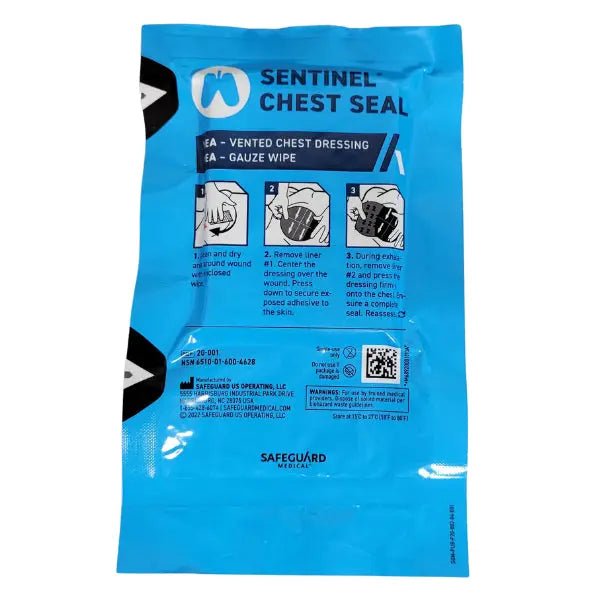
Sentinel® Brustversiegelung
Erweiterte Behandlung offener Brustwunden für medizinisches Fachpersonal


Die effektive Behandlung offener Brustwunden ist entscheidend, um Spannungspneumothorax zu verhindern, eine der häufigsten Ursachen für vermeidbare Todesfälle bei traumatischen Verletzungen. Der Sentinel® Chest Seal wurde sorgfältig entwickelt, um eine zuverlässige und effiziente Lösung zum Verschließen offener Brustwunden zu bieten und so das Risiko eines Spannungspneumothorax sowohl in der militärischen als auch in der zivilen Notfallmedizin zu verringern.


Hauptmerkmale und Vorteile

Besonderheit Beschreibung Nutzen
Patentiertes Dual-Vent-Design Erleichtert die gleichzeitige Freisetzung von Blut und Luft und minimiert gleichzeitig das Risiko einer Verstopfung der Öffnung. Sorgt für eine kontinuierliche Dekompression des Pleuraraums und verringert so die Wahrscheinlichkeit eines Spannungspneumothorax.
360° Sentinel 10x™ Klebstoff Verwendet einen robusten, nicht auf Wasser basierenden Klebstoff, der unter unterschiedlichen Umgebungsbedingungen seine Haftung behält. Sorgt für eine sichere Platzierung am Verletzten, sodass keine mehrfache Anwendung erforderlich ist.
Transparente Konstruktion Ermöglicht eine ungehinderte Sicht auf die Wunde während der Anwendung und Überwachung. Verbessert die Beurteilung und gewährleistet eine korrekte Platzierung ohne Störungen.
Reservoir-Kanalisierungssystem Leitet das Blut von der Wunde weg, um ein Verstopfen des Entlüftungsmechanismus zu verhindern. Erhält die Funktionalität der Dichtung und gewährleistet eine effektive Entlüftung.
Zweiteilige Peeling-Anwendung Verfügt über ein doppeltes Abziehdesign für eine kontrollierte und präzise Platzierung über der Wunde. Ermöglicht eine schnelle und präzise Anwendung in Hochdrucksituationen.
Einhaltung der CoTCCC-Richtlinien Erfüllt die Empfehlungen des Committee on Tactical Combat Casualty Care für belüftete Brustversiegelungen. Richtet sich nach bewährten Verfahren in der Traumaversorgung und gewährleistet die Einhaltung etablierter medizinischer Protokolle.

Technische Daten:

  • NSN : 6510-01-600-4628
  • Teilenummer/SKU : 20-001
  • Ausgabeeinheit : Karton
  • FDA-Status : Gelistet
  • Verwendung : Einmalgebrauch
  • Latexgehalt : Nicht aus Naturkautschuklatex hergestellt
  • Verfügbarkeit : Direkt, Prime Vendor, ECAT, CEC und GSA
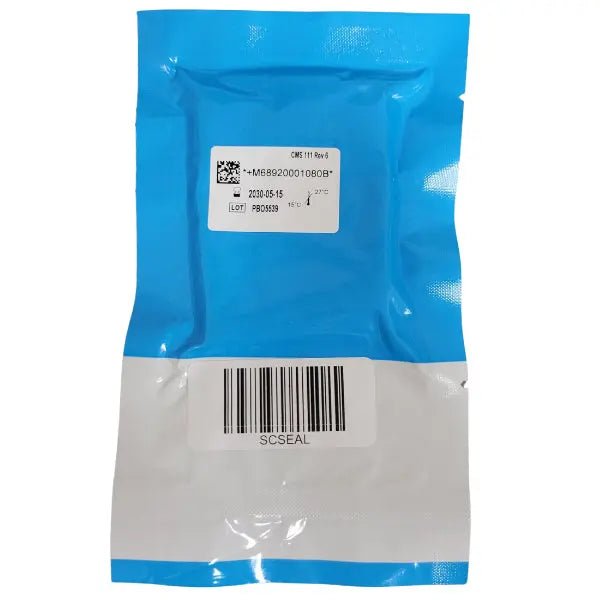
  • Haltbarkeit : 6 Jahre
  • Herkunftsland : Vereinigte Staaten
  • Geräteabmessungen :
    • Verpackt : 7,5 Zoll (L) x 8 Zoll (B)
    • Ausgefahren : 6,5 Zoll Durchmesser
    • Gewicht : 1 oz

Klinische Vorteile:

Das innovative Design des Sentinel® Chest Seal erfüllt die dringende Notwendigkeit einer effektiven Behandlung offener Brustwunden in der Traumaversorgung. Sein Dual-Vent-System gewährleistet eine kontinuierliche Evakuierung von Luft und Flüssigkeiten und verhindert so die Ansammlung, die zu einem Spannungspneumothorax führt. Der robuste Klebstoff hält die Dichtungsintegrität unter verschiedenen Umgebungsbedingungen aufrecht und gewährleistet Zuverlässigkeit sowohl im Rettungsdienst als auch im Kampfeinsatz. Das transparente Material ermöglicht eine fortlaufende Wundbeurteilung, ohne dass die Dichtung entfernt werden muss, wodurch Sterilität und Wirksamkeit gewährleistet bleiben.


Aufruf zum Handeln

Verbessern Sie Ihre Fähigkeiten zur Traumaversorgung mit dem Sentinel® Chest Seal . Seine fortschrittlichen Funktionen und die Einhaltung taktischer medizinischer Richtlinien machen es zu einem unverzichtbaren Werkzeug für medizinisches Personal in Notfall- und Kampfumgebungen. Sorgen Sie für optimale Patientenergebnisse, indem Sie das Sentinel® Chest Seal in Ihre Traumareaktionsprotokolle integrieren.

    SPECS & MEASUREMENTS

    Specifications coming soon. Contact us for detailed product information.

    CLINICAL RATIONALE

    Chest Seals in Thoracic Trauma

    Chest seals are critical life-saving tools for treating open chest wounds (sucking chest wounds) that disrupt the negative pressure needed for normal breathing.
    When air enters the pleural space through a penetrating injury, it prevents the lung from fully expanding and may lead to a tension pneumothorax — a life-threatening condition if not addressed promptly.
    Properly applied chest seals restore intrathoracic pressure balance and allow the injured lung to re-expand, buying vital time until definitive care or decompression is available.

    1. Vented Chest Seals

    Clinical Rationale (Vented):

    Vented chest seals feature one-way valves or channels that allow trapped air and fluids to escape from the chest cavity while preventing further air entry.
    This controlled venting mechanism reduces the risk of developing a tension pneumothorax and is recommended by the Committee on Tactical Combat Casualty Care (CoTCCC) for most open thoracic injuries when the vent remains unobstructed.
    In tactical and emergency medical settings, vented seals maintain proper intrathoracic pressure dynamics and help stabilize respiration during evacuation.

    • Allows air and blood to escape while blocking additional air entry
    • Recommended by CoTCCC for most penetrating chest wounds
    • Prevents progression to tension pneumothorax
    • Effective during movement and transport phases

    2. Non-Vented Chest Seals

    Clinical Rationale (Non-Vented):

    Non-vented chest seals provide a fully occlusive barrier that prevents any external air from entering the pleural cavity.
    These are preferred when environmental factors — such as dust, debris, heavy clothing, or complex wound locations — could obstruct a vent or prevent it from functioning properly.
    Non-vented models are especially effective when there are multiple wounds or when both sides of the chest are compromised.

    • Creates an airtight seal to stop further air intrusion
    • Ideal for contaminated or complex wound environments
    • Preferred for posterior or multiple thoracic injuries
    • Simple and reliable under stress conditions

    3. Twin Pack / Dual Application

    Clinical Rationale (Twin Pack):

    Twin chest seal packs are designed for simultaneous coverage of entry and exit wounds or multiple penetrating thoracic injuries.
    Applying seals to both anterior and posterior wounds prevents air intrusion from either side and ensures consistent intrathoracic pressure stabilization.
    This configuration allows medics and responders to treat through-and-through injuries quickly and efficiently without improvisation.

    • Enables rapid treatment of entry and exit wounds
    • Maintains consistent chest pressure across both sides
    • Optimized for tactical and prehospital trauma management
    • Reduces need for multiple packages or improvised seals

    4. Training Chest Seals

    Clinical Rationale (Training):

    Training chest seals replicate the adhesive strength and venting design of operational models using non-sterile materials.
    They are intended for classroom, simulation, and scenario-based instruction, allowing responders to practice correct placement, adhesion, and vent inspection without wasting live medical gear.
    Consistent repetition with realistic trainers develops muscle memory and speed during actual trauma incidents.

    • Simulates vented or occlusive seal behavior for realistic training
    • Promotes correct placement and adhesion technique
    • Preserves sterile operational supplies
    • Ideal for EMT, tactical, and civilian responder courses

    Clinical Summary

    Chest seals play a pivotal role in preventing death from tension pneumothorax, one of the leading causes of preventable trauma mortality.
    Both vented and non-vented designs serve distinct operational needs, while twin and training packs ensure preparedness across all care phases — from education to battlefield or civilian emergencies.

    • Vented: Allows controlled egress of trapped air; standard CoTCCC-recommended choice.
    • Non-Vented: Fully occlusive; best for debris-rich or posterior wound sites.
    • Twin Pack: Provides coverage for through-and-through injuries.
    • Training: Non-sterile practice tool for skill retention and readiness.

    By re-establishing chest wall integrity and controlling air movement, chest seals restore lung expansion and stabilize respiratory mechanics until advanced medical care is available.

    FREQUENTLY ASKED QUESTIONS

    Shopping cart

    Your cart is empty.

    Return to shop
    Link copied to clipboard