





1
/
13
SKU:
MM1MM
Type:
EMS Bag
Vendor:
Eberlestock

PRODUCT INFORMATION
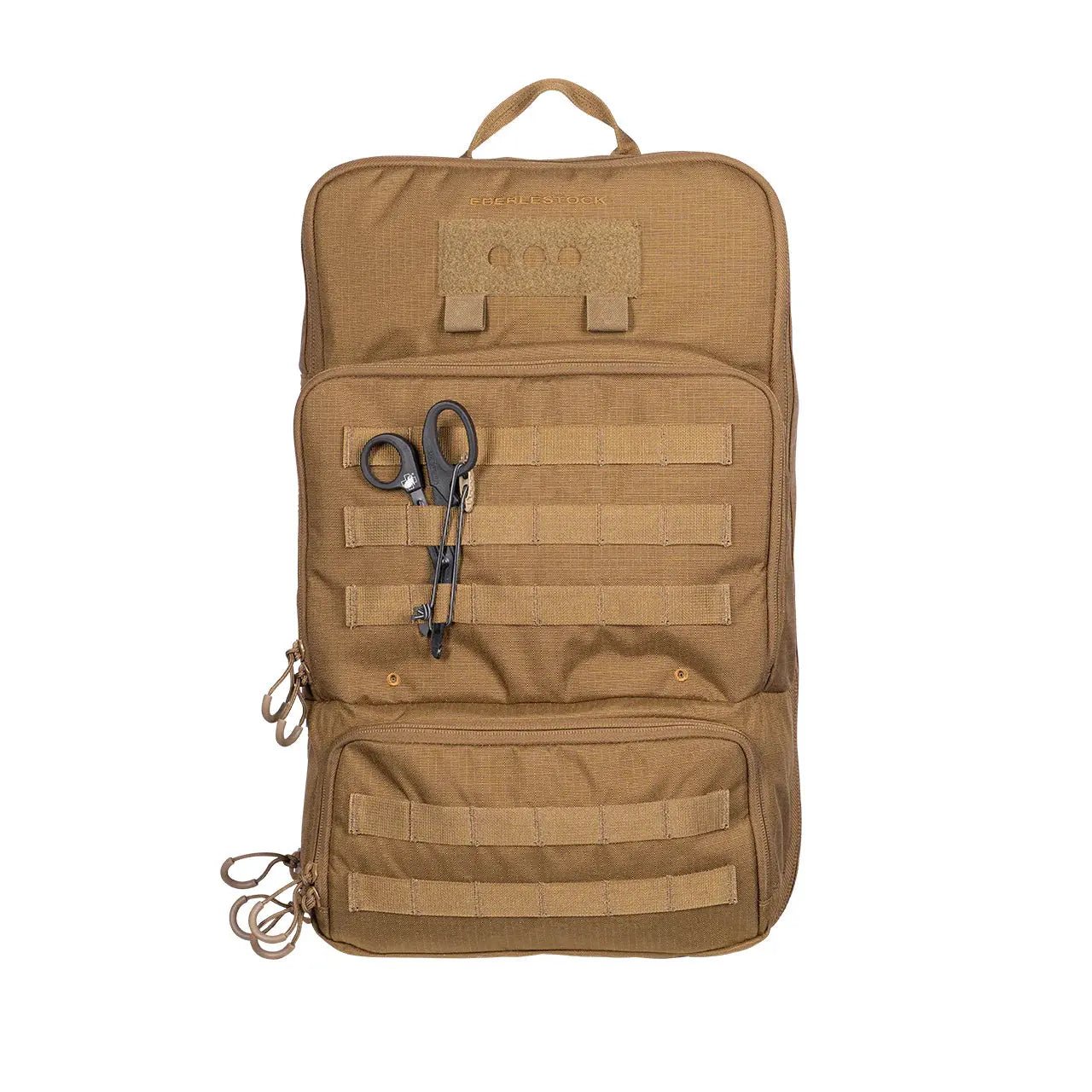
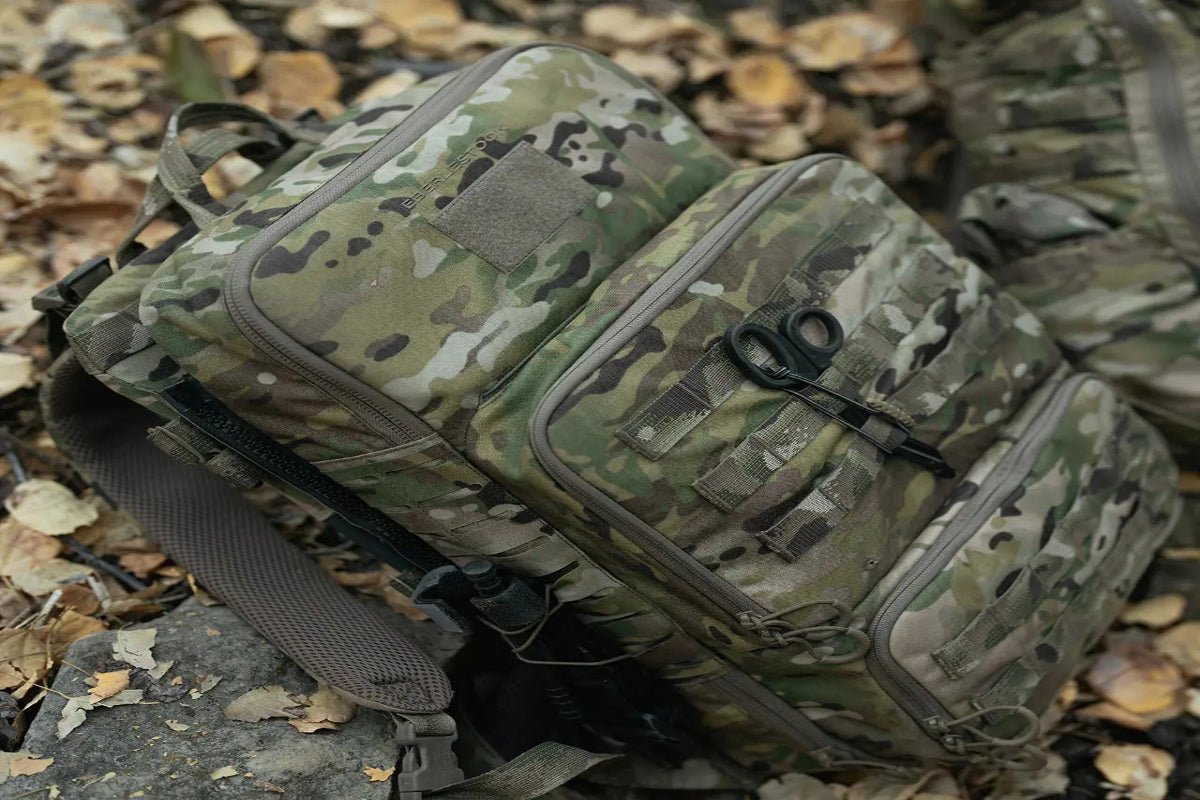
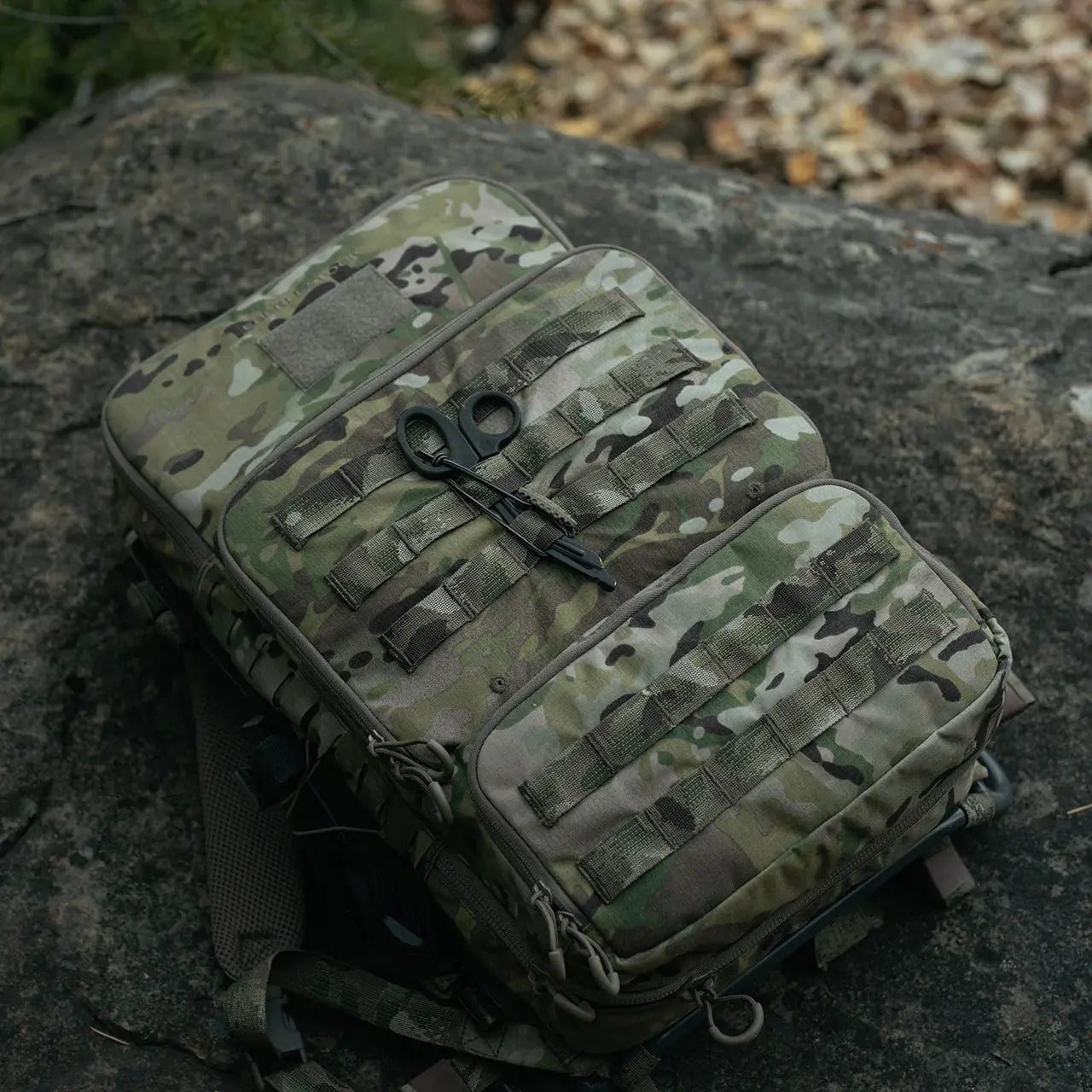
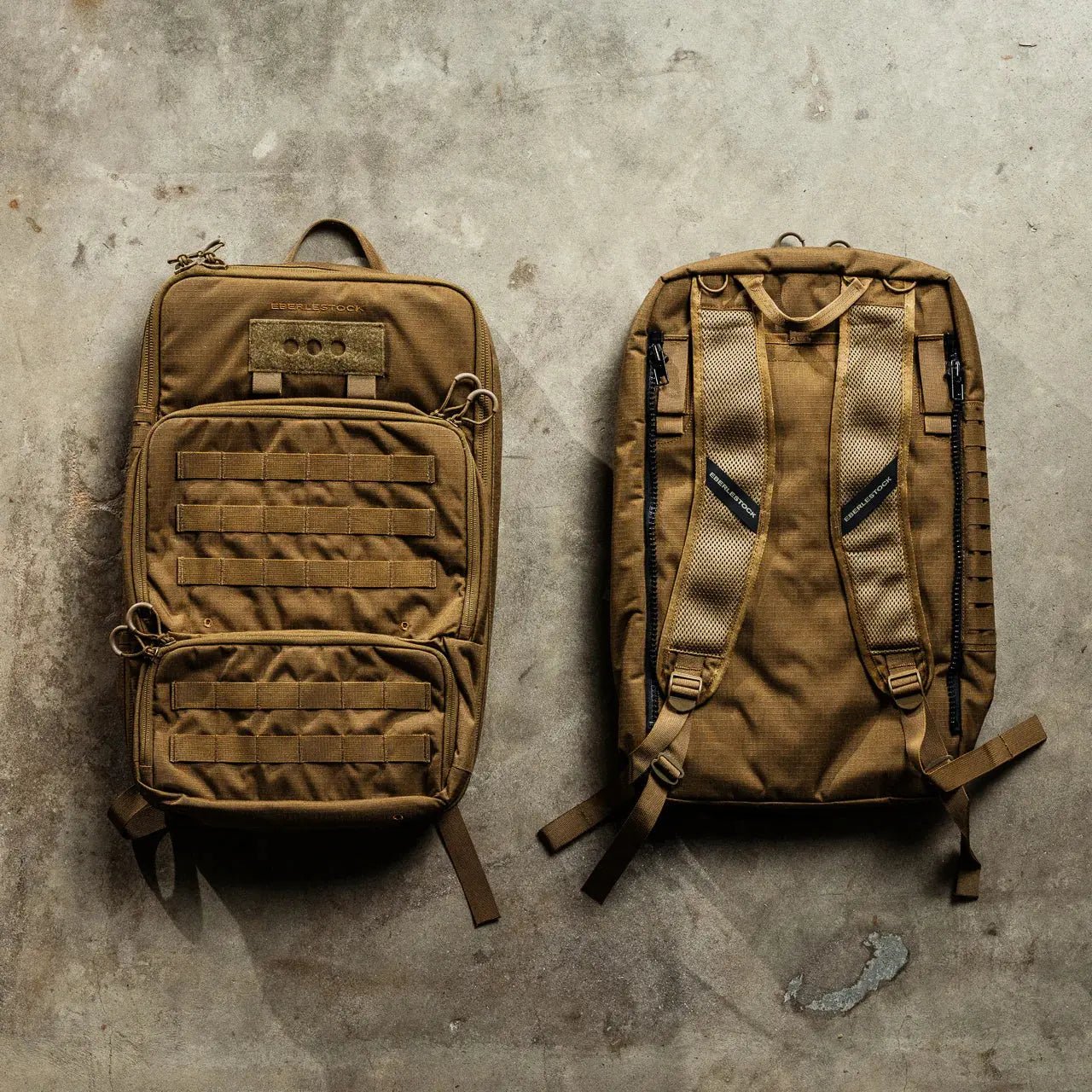
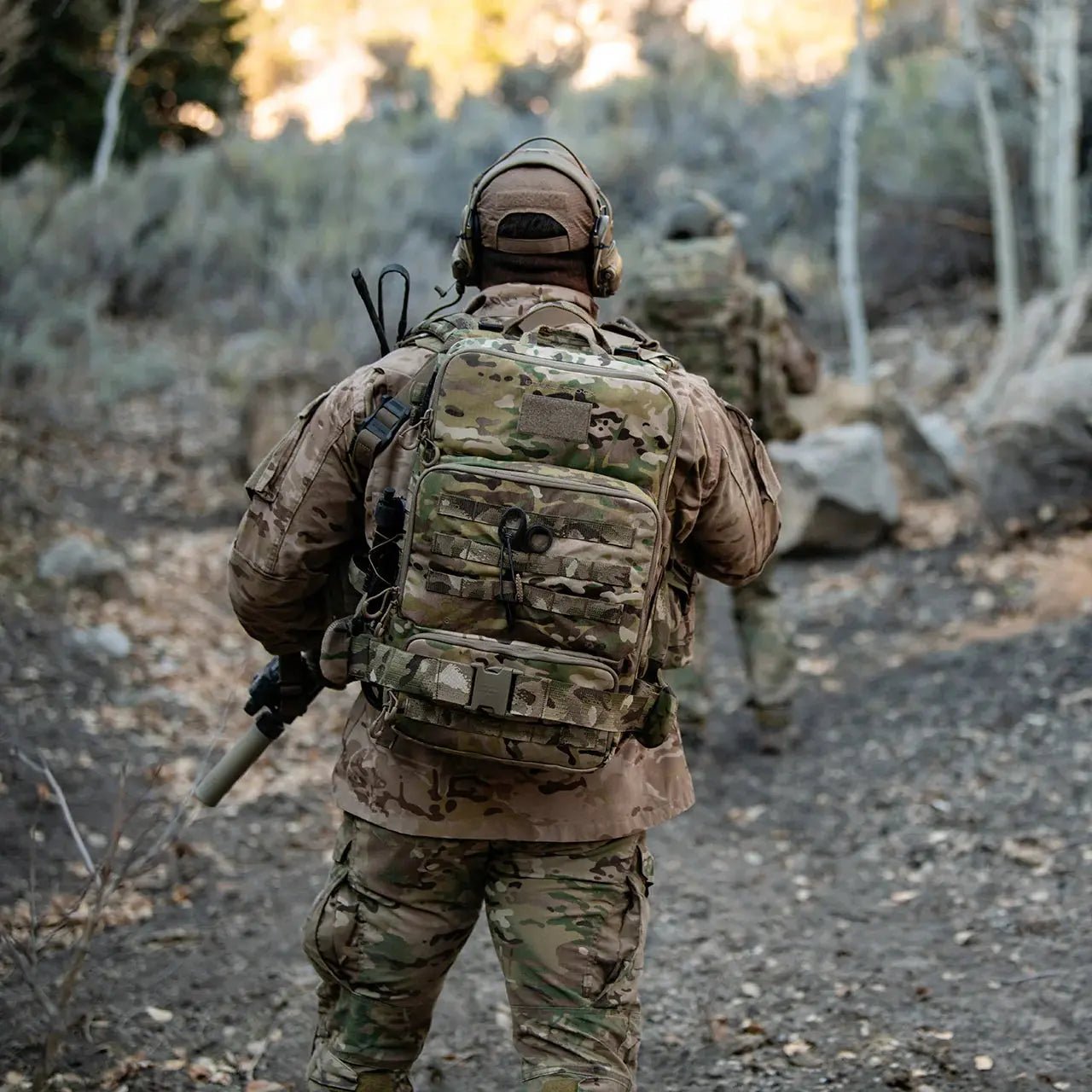
The Eberlestock Mission Medic Pack is a purpose-built 500D Nylon tactical medical backpack engineered for organized, rapid-access trauma care in austere and high-demand environments. Weighing 3 lb 10 oz and holding 1,717 cubic inches across a main compartment with seven tear-away pouches, five MARCH pockets, three flat zipper pockets, an organizer section, and stowable low-profile shoulder straps, it is designed around the needs of combat medics, tactical EMS providers, and first responders who require systematic, category-organized medical supply access during mass casualty and MASCAL scenarios. Available in Multicam (MM1MM), Coyote Tan (MM1MC), and Military Green (MM1MJ).
Key Specifications
| Specification | Detail |
|---|---|
| Manufacturer | Eberlestock |
| SKU — Multicam | MM1MM |
| SKU — Coyote Tan | MM1MC |
| SKU — Military Green | MM1MJ |
| Volume | 1,717 cubic inches (28.1 liters) |
| Weight | 3 lb 10 oz (1.6 kg) |
| Dimensions | 20″H × 12″W × 5.5″D |
| Primary Material | 500D Ripstop Nylon |
| Lining Material | 210D Nylon |
| Main Compartment Pouches | 7 tear-away pouches + 2 tear-away accessory panels |
| MARCH Pockets | 5 dedicated MARCH category pockets |
| Flat Zipper Pockets | 3 |
| Organizer | 1 integrated organizer section |
| Shoulder Straps | Stowable, low-profile |
| Frame Compatibility | Compatible with Eberlestock Mission Frame (EMOD system) |
| Colors Available | Multicam, Coyote Tan, Military Green |
Built Around M.A.R.C.H. — Tactical Medical Organization That Matters
The M.A.R.C.H. framework — Massive hemorrhage, Airway, Respiration, Circulation, Hypothermia — is the standard care sequence for Tactical Combat Casualty Care (TCCC) and most modern advanced prehospital protocols. The Mission Medic Pack's 5 dedicated MARCH pockets organize supplies by care priority rather than arbitrary categorization, matching the way medical providers actually think and work under stress.
When a medic reaches for a chest seal or a tourniquet under fire, they should not need to search through a general medical bag. MARCH-organized pockets ensure that the first item accessed in the care sequence — hemorrhage control — is immediately available, and that subsequent care steps are organizationally predictable regardless of stress level or lighting conditions.
| MARCH Category | Clinical Priority | Typical Supplies Organized Here |
|---|---|---|
| M — Massive Hemorrhage | 1st priority | Tourniquets, hemostatic gauze, pressure bandages |
| A — Airway | 2nd priority | NPAs, supraglottic airways, surgical airway kits |
| R — Respiration | 3rd priority | Chest seals, needle decompression kits, chest tubes |
| C — Circulation | 4th priority | IV access, IO needles, IV fluids, blood volume expanders |
| H — Hypothermia | 5th priority | Emergency blankets, heat packs, warming supplies |
Note: Specific supplies for each pocket are not included with the Mission Medic Pack. The pack ships empty — supplies are configured and loaded by the individual medic according to their unit's TCCC loadout standards.
The Tear-Away Pouch System
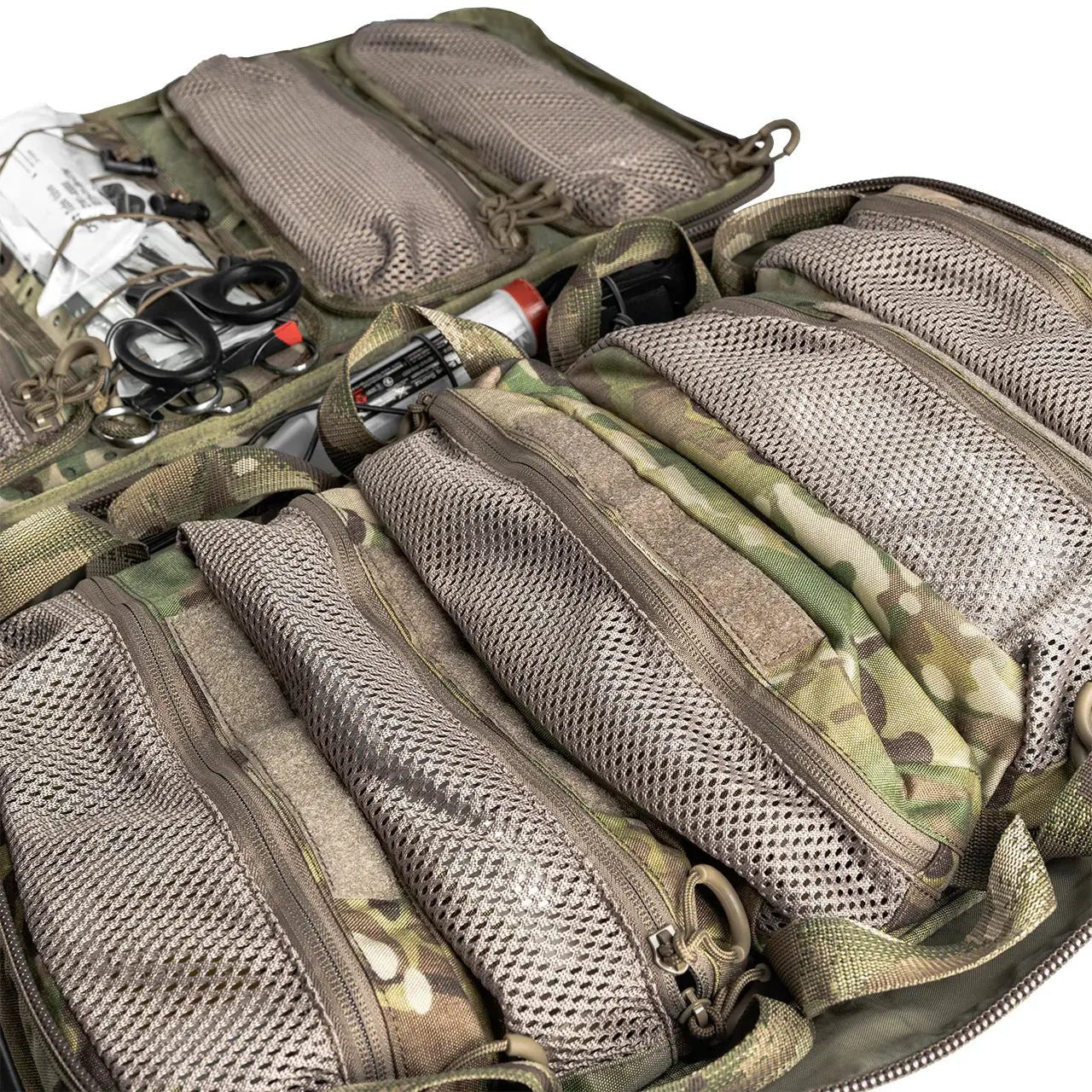
The Mission Medic Pack's defining organizational feature is its main compartment system of seven tear-away pouches and two tear-away accessory panels. These pre-built sub-kits transform how a medic responds to mass casualty events:
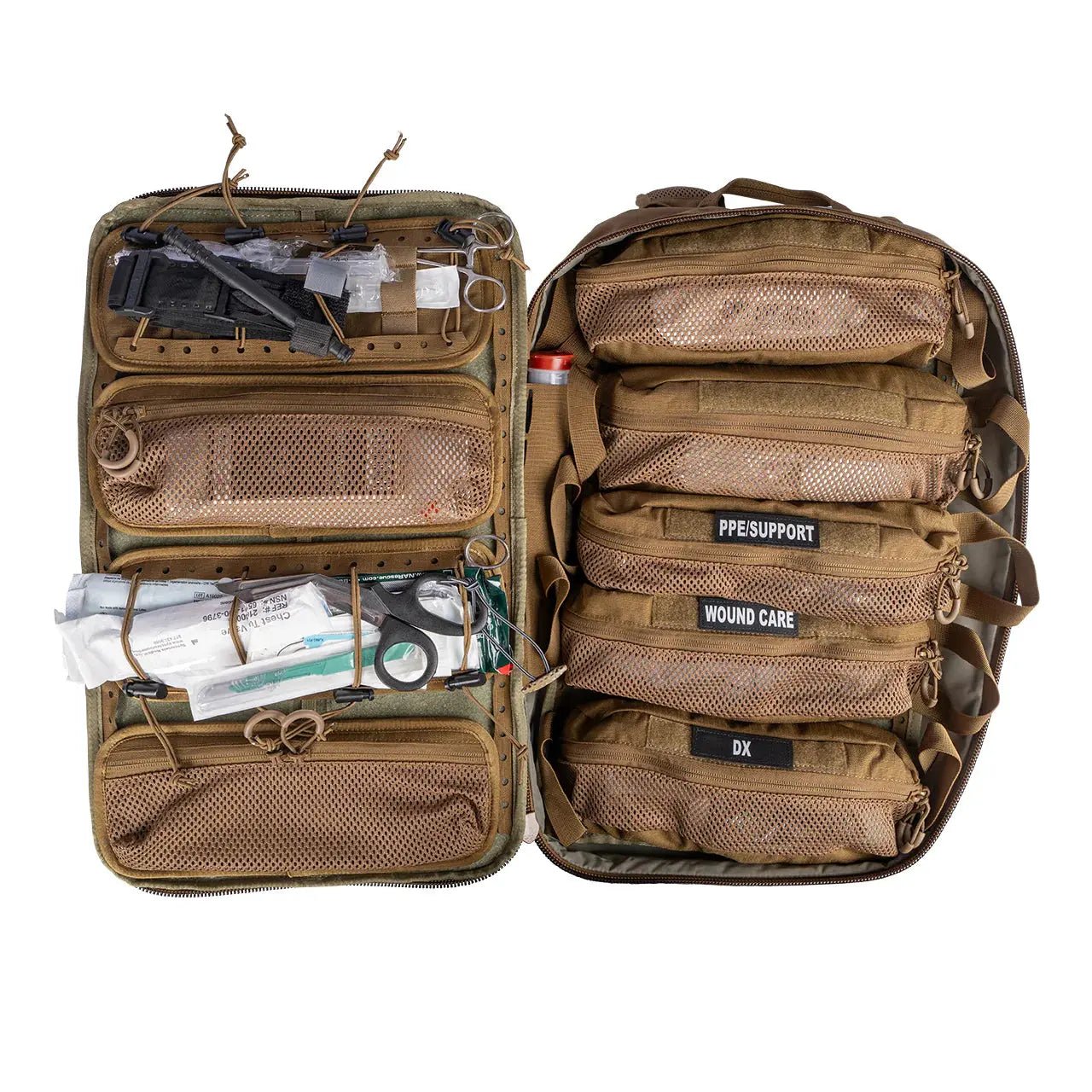
Pre-built trauma sub-kits: Each tear-away pouch can be pre-loaded as a complete trauma kit for a specific injury category — one pouch for hemorrhage control, one for airway, one for chest seals, etc. Pouches are labeled with velcro ID tags so categories are identifiable in low-light conditions.
MASCAL deployment capability: In a mass casualty event, a single medic can pull multiple tear-away pouches and distribute them to responders or position them at different patient stations — creating distributed care capability from a single pack without carrying multiple IFAKs as separate items.
Rip-away deployment: Tear-away pouches release from the main compartment quickly under pull force — allowing a medic to grab a specific kit and move to a patient without opening the full pack. This is the organizational advantage that distinguishes the Mission Medic Pack from general-purpose medical bags.
Key Features
Seven Tear-Away Pouches
The main compartment houses seven individual tear-away pouches that can be pre-built as trauma sub-kits, distributed in MASCAL events, or deployed rapidly to a patient without opening the full pack.
Two Tear-Away Accessory Panels
Supplemental rip-away panels for additional supply organization — ideal for airway management equipment, IV kits, or other secondary care category supplies that require dedicated separate access.
Five MARCH Pockets
Five pockets organized around the M.A.R.C.H. care framework — aligning pack organization with tactical medical care sequence for intuitive, stress-resistant supply access under operational conditions.
Fully Opening Main Compartment
The main compartment opens completely — full clamshell access to all interior pouches and panels simultaneously. No blind-reaching into a constrained opening; full visual inventory of all supplies in one motion.
500D Ripstop Nylon Construction
500-denier ripstop nylon provides abrasion and tear resistance for demanding field use — the same material weight class used across professional tactical gear. The 210D nylon lining reduces interior weight while maintaining durability.
Stowable Low-Profile Shoulder Straps
Shoulder straps stow completely for low-profile carry or vehicle use — the pack can be carried as a medic bag, dropped on a vehicle seat, or staged without dangling straps that snag on equipment or doorways.
Mission Frame Compatible
Designed to interface with Eberlestock's Mission Frame (EMOD system) for integrated load carriage — the pack mounts directly to the frame, providing a stable, load-close-to-body configuration for extended carry in field environments.
Velcro Label System
Velcro label attachment points on pouches and panels allow category identification in dim light or under stress — medics can use standard velcro label tape to mark each pouch with its contents or MARCH category designation.
Lightweight at 3 lb 10 oz
At 3 lb 10 oz empty, the Mission Medic Pack adds minimal unloaded weight — leaving the full weight budget for medical supplies rather than the bag itself. The 1,717 ci / 28.1 L volume provides generous capacity for a complete TCCC loadout.
Who Is This For?
Combat Medics (68W) & 18D Special Forces Medics
The Mission Medic Pack was built around the needs of military medics who require structured, MARCH-organized access to a full tactical trauma loadout in a pack that can keep pace with an operational element. The tear-away pouch system is specifically designed for the MASCAL scenario — a medic treating multiple casualties simultaneously needs to distribute care capability without distributing the entire pack.
Tactical EMS & TEMS Providers
TEMS providers embedded with law enforcement tactical teams need a medical pack that functions in the same environment as the tactical operators they support — lightweight, durable, and organized around the care protocols they actually use under stress. The MARCH pocket organization aligns with TCCC-based EMS protocols adopted across most US tactical EMS programs.
Firefighter-Paramedics & Advanced Life Support Providers
ALS providers who respond to trauma in uncontrolled environments — structure fires with trauma, vehicle extrication, active threat responses — benefit from a medical pack that maintains supply organization under the physical and temporal demands of those response scenarios.
Search & Rescue (SAR) Medical Officers
Wilderness SAR medics, mountain rescue teams, and technical rescue medical officers operating in terrain-constrained environments need a lightweight, organized medical pack that can be carried on extended backcountry approaches. At 3 lb 10 oz empty, the Mission Medic Pack imposes minimal carry penalty on multi-day SAR operations.
Disaster Medical Assistance Teams (DMATs) & MCI Responders
Mass casualty incident (MCI) responders benefit specifically from the tear-away pouch architecture — the ability to pre-build and rapidly distribute individual trauma kits from a single pack directly addresses the MASCAL challenge of providing care to multiple patients simultaneously with limited personnel.
How to Configure the Mission Medic Pack
The Mission Medic Pack ships empty — it is a supply-agnostic platform designed to accept any TCCC-standard loadout. The following approach is recommended for initial configuration:
- Establish your MARCH loadout: Determine the specific supplies required for each MARCH category based on your scope of practice and operational medical plan.
- Assign tear-away pouches by MARCH category: Pre-load each of the seven tear-away pouches as a dedicated trauma sub-kit — e.g., one pouch for hemorrhage control (TQs + hemostatic gauze), one for airway, one for chest seals, etc. Label each with velcro category tags.
- Load MARCH pockets: Place supplies that don't require a full pouch in the five MARCH pockets — individual items, single-use supplies, and smaller equipment that are accessed individually rather than kit-deployed.
- Use flat zipper pockets for secondary supplies: Three flat zipper pockets accommodate documentation, secondary supplies, gloves, markers, and other items accessed less frequently than primary trauma supplies.
- Use the organizer section: The integrated organizer section is ideal for small tools, writing instruments, reference cards, and items that require dedicated compartmentalization.
MASCAL pre-build tip: Pre-build at least two tear-away hemorrhage control pouches. In a mass casualty event, hemorrhage is the most common immediately life-threatening condition — having redundant hemorrhage control kits ready to distribute reduces the time to first intervention for multiple casualties.
Why the Eberlestock Mission Medic Pack?
Eberlestock has built its reputation on patented, purpose-engineered load carriage systems for military, hunting, and tactical applications — their products are used by special operations units, military procurement programs, and serious practitioners who require equipment that performs beyond the conditions it was tested in.
The Mission Medic Pack represents Eberlestock's approach to medical pack design: build the organization system first, then build the pack around it. The tear-away pouch system and MARCH pocket architecture are not afterthoughts — they are the primary design requirement, with all other features serving that organizational objective.
For medics and EMS providers building out a complete medical carry system, the Mission Medic Pack integrates with the rest of Eberlestock's Mission EMOD frame system — allowing the same pack to function as a standalone backpack, a frame-mounted medical load, or a vehicle-accessible staged trauma kit depending on the operational context.
Browse MED-TAC's complete collection of tactical medical backpacks and EMS bags to compare pack options for your specific mission profile.
Frequently Asked Questions
Does the Mission Medic Pack come with medical supplies?
No. The Mission Medic Pack ships as an empty organizational platform. Medical supplies are purchased separately and loaded by the user according to their TCCC or EMS loadout standards. This allows medics and agencies to configure the pack precisely to their protocols, scope of practice, and authorized formulary. Browse MED-TAC's hemorrhage control, airway management, and chest/thoracic supplies collections to build your loadout.
What is the Eberlestock Mission Frame, and is it required?
The Eberlestock Mission Frame is the modular frame component of Eberlestock's EMOD (Eberlestock Modular) system. The Mission Medic Pack interfaces with this frame for integrated load carriage — allowing stable, body-close load distribution for extended carry. The frame is not required to use the pack; the stowable shoulder straps allow standard backpack carry without the frame. Contact MED-TAC International for Mission Frame availability.
How does 1,717 cubic inches compare to other tactical medical packs?
At 1,717 ci (28.1 liters), the Mission Medic Pack is a medium-large tactical medical pack — large enough for a comprehensive TCCC loadout with substantial MARCH supply coverage, but not so large as to be impractical for individual carry during fast-moving operations. It is sized for a combat medic or TEMS provider's primary medical bag role, not a supplemental IFAK or a full aid station cache.
Can the tear-away pouches be reattached after deployment?
Yes. The tear-away (rip-away) attachment system uses hook-and-loop (velcro) attachment — pouches can be re-attached to the main compartment after deployment and resupply. This allows the medic to reload a pouch with fresh supplies and re-stage it in the pack between calls or after a MASCAL event.
What color should I choose for my operational environment?
Multicam (MM1MM) is the standard choice for mixed-terrain military operations and civilian tactical contexts where Multicam has become the de facto standard pattern. Coyote Tan (MM1MC) is appropriate for arid/desert environments and complements tan-based kit configurations. Military Green (MM1MJ) suits woodland, jungle, and verdant environments. All three versions are functionally identical — color selection is purely operational context and unit coordination-driven.
Is the 500D Nylon construction appropriate for long-term field use?
500-denier ripstop nylon is a proven tactical fabric weight — durable enough for sustained field use while light enough to justify in a pack designed for carry efficiency. The ripstop weave prevents small tears from propagating. Eberlestock's construction quality and material sourcing are consistent with the professional military and law enforcement market the Mission Medic Pack is designed for.
What supplies do MED-TAC recommend for loading the MARCH pockets?
For hemorrhage pockets: CoTCCC-recommended tourniquets and hemostatic gauze. For airway: NPA kits and airway management supplies. For respiration: chest seals and needle decompression kits. For circulation and hypothermia: IV access kits, warming supplies, and emergency blankets. Your specific loadout should be defined by your unit's medical standing operating procedures (MSOP) and your authorized scope of practice.
Load Your Mission Medic Pack
The pack is only as capable as the supplies inside it. Build your MARCH loadout from MED-TAC's verified supply collections:
- Massive Hemorrhage Control — Tourniquets, hemostatic gauze, pressure bandages for M-pocket
- Airway Management — NPAs, supraglottic airways, surgical airway kits for A-pocket
- Chest & Thoracic Supplies — Chest seals, needle decompression kits for R-pocket
- Bandages & Dressings — Israeli bandages, compression dressings, wound care supplies
- Hemostatic Agents — QuikClot®, Celox, and other CoTCCC-recommended hemostatic options
- Tactical Medical Backpacks — Compare other tactical medical pack options
All products sourced from the actual brand manufacturer or authorized master distributors. CoTCCC recommendation status verified where applicable. Ships from MED-TAC International, Pembroke Pines, FL — clinician-founded, veteran-led, SDVOSB-certified.
ADDITIONAL INFORMATION
Available Options:
- Multicam
- Coyote Tan
- Military Green
SPECS & MEASUREMENTS
| Specification | Value |
|---|---|
| Width | 12 Inches |
| Length | 20 Inches |
| Height | 5.5 Inches |
| Weight | 3.10 Lbs. |
| Dimensions | 28 Liters - 1,717 c.i. |
CLINICAL RATIONALE
FREQUENTLY ASKED QUESTIONS

Shopping cart
