


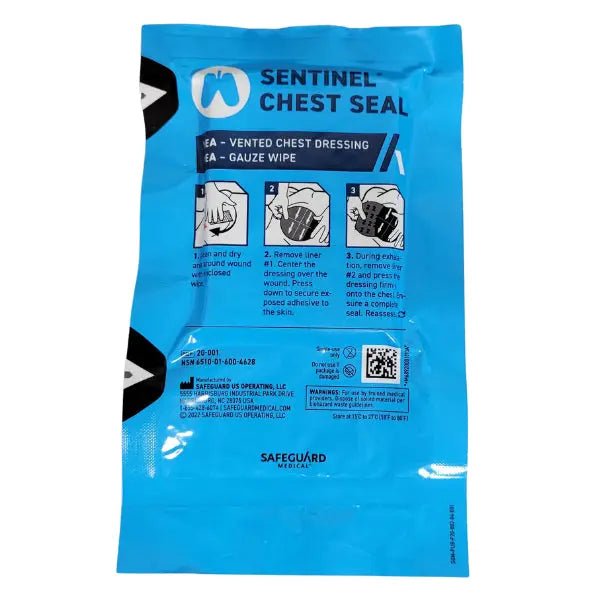



Sentinel™ Chest Seal
A vented occlusive dressing with dual-vent technology and a 360° acrylate adhesive base — separate air and blood pathways to minimize vent occlusion.
What is the Sentinel™ Chest Seal? A vented occlusive dressing (SKU 20-001) with dual-vent technology and a 360° Sentinel 10x™ acrylate adhesive base. At 0.7 oz deployed and packaged at 19.7 × 14 × 1.3 cm, it provides simultaneous, separate blood-and-air release pathways that minimize vent occlusion while staying adhered across environments. FDA Listed, CE Marked, Made in USA — a vented chest seal consistent with CoTCCC-recommended practice for open chest wounds.
Key Specifications
| Manufacturer | Safeguard Medical |
| SKU | 20-001 |
| Type | Vented — dual-vent technology with simultaneous blood and air release |
| Adhesive | 360° Sentinel 10x™ acrylate adhesive disc |
| Packaged Dimensions | 19.7 × 14 × 1.3 cm |
| Deployed Dimensions | 20.3 × 15.2 cm |
| Weight | 0.7 oz |
| Regulatory Status | FDA Listed, CE Marked |
| Origin | Made in USA |
| Guideline Status | Vented chest seal — consistent with CoTCCC-recommended practice for open chest wounds |
What It Is
The Sentinel™ Chest Seal addresses two failure modes common to vented seals: vent occlusion from blood or soft tissue, and adhesion loss in contaminated environments. The dual-vent technology provides simultaneous release pathways for air and blood and — critically — channels them separately, reducing the chance that pooling blood occludes the air-venting pathway. Published research (Kotora Jr. et al.) found that vented chest seals prevent tension pneumothorax in communicating-pneumothorax models, and the Sentinel was engineered specifically to minimize the vent-occlusion risk that research identified.
The 360° Sentinel 10x™ adhesive base uses an acrylate formulation that encircles the wound in a complete ring to maintain placement across a wide range of conditions. Unlike water-based hydrogel-only designs, the acrylate base does not soften or swell in the presence of water or blood, maintaining a consistent adhesive surface over long evacuation periods. The transparent layered construction allows wound monitoring after application without removing the device.
The Sentinel is also the standalone seal component of Safeguard’s SENTINEL Chest Trauma Kit, which adds a needle-decompression device and the Dart Target placement guide. Buying the individual seal allows integration into existing IFAKs or trauma kits.
Operating notes. Expose and clear the wound, peel the backing, center the seal over the wound, and press the 360° adhesive ring firmly from center outward; the transparent backing confirms placement. Apply a second seal to any exit wound and monitor for signs of tension pneumothorax, escalating to advanced care per local protocol if tension develops. This summary is not a substitute for accredited training or local protocol.
See also: SENTINEL Chest Trauma Kit, Chest & Thoracic Supplies, and IFAK Kits.
When to Choose This Chest Seal
- Penetrating chest wounds in wet or high-humidity environments: the acrylate-based adhesive does not absorb moisture or swell like hydrogel, maintaining consistent adhesion after submersion exposure or heavy rain.
- Long CASEVAC with ongoing wound monitoring: the transparent layered construction enables visual wound assessment through the applied seal without removal.
- Situations with potential vent occlusion from blood: the dual-vent technology channels air and blood through separate pathways, reducing the single-channel failure mode where pooling blood blocks the air vent.
- Integration into the SENTINEL Chest Trauma Kit configuration: pairs directly with the Dart™ 14 Ga × 3.25" decompression needle and Dart Target™ placement guide as the seal component of Safeguard's complete chest trauma set.
vs. The Alternatives
- vs. Russell Chest Seal (Safeguard Medical): Both are Safeguard vented seals, but the Sentinel uses an acrylate adhesive and dual-vent technology; the Russell uses a hydrogel matrix and a four-aperture peripheral valve. The Sentinel's acrylate performs better in very wet conditions; the Russell is slightly more compact and published in the Kheirabadi 100%-effectiveness dataset. Operators in extremely wet environments may prefer the Sentinel's non-water-based adhesive chemistry.
- vs. HyFin Vent Twin Pack (NAR): The HyFin Twin Pack provides two seals for entry and exit wounds in one package; the Sentinel is a single-seal product. The HyFin's three-tine channel vent is simpler; the Sentinel's dual-vent separates blood and air pathways. For operators who standardize on twin-pack chest seal carry, HyFin is a natural choice; for individual seal integration into an existing kit with separate exit-wound coverage, the Sentinel is competitive.
- vs. Bolin Chest Seal (Safeguard Medical): The Bolin is non-vented (fully occlusive); the Sentinel is vented. Per CoTCCC-recommended guidelines, use a vented seal when vent patency can be maintained; use the Bolin when vent occlusion risk is high (posterior wounds, hair-dense sites, heavy debris). Many operators carry one vented and one non-vented seal to match the wound presentation.
Frequently Asked Questions
Q: How does the Sentinel Chest Seal's dual-vent technology reduce vent occlusion?
A: Single-channel vented seals use one pathway for both blood and air egress. In an active hemorrhage scenario, blood can pool in this channel, blocking air from escaping and effectively converting the seal from vented to non-vented without the provider's knowledge. The Sentinel's dual-vent system provides separate simultaneous pathways for blood and air, so blood drainage does not compete with or block air venting. Per Safeguard Medical product documentation, this design specifically addresses the vent-occlusion failure mode identified in published chest seal research.
Q: Why does the Sentinel use acrylate adhesive rather than hydrogel?
A: Most chest seals use hydrogel adhesives, which are water-based formulations that provide good initial conformability to skin texture. The limitation of hydrogels in tactical environments is that they can absorb environmental moisture, swell, and lose adhesive strength when exposed to heavy perspiration, rain, or blood-diluted surfaces. The Sentinel's 360° Sentinel 10x™ acrylate adhesive is not water-based and therefore does not absorb moisture or swell. Per Safeguard Medical product documentation, it maintains static placement across environmental extremes — a meaningful advantage in wet-climate operations or when the wound site has significant blood contamination.
Q: Does the Sentinel Chest Seal need to be purchased as part of the SENTINEL Kit or is it available solo?
A: The Sentinel Chest Seal (SKU 20-001) is available as a standalone individual seal for integration into existing IFAKs. It is also included as the chest seal component of the SENTINEL Chest Trauma Kit, which adds the Dart™ 14 Ga × 3.25" decompression needle and the Dart Target™ placement guide. Per Safeguard Medical product documentation, buying the seal alone allows units to configure the complete chest trauma module independently or augment existing kits that already include a decompression needle.
Q: What does the 360° adhesive ring on the Sentinel mean for application technique?
A: The Sentinel's adhesive is applied in a full circumferential ring around the wound contact area, rather than covering the entire backing surface or using spot adhesive. This 360° ring ensures a continuous, uninterrupted seal perimeter around the wound, eliminating the potential for air tracking under an incomplete adhesive edge. The ring design is applied by pressing from the wound center outward to seat the adhesive progressively without trapping air. The transparent layered backing allows the provider to confirm the ring is fully seated before releasing pressure.
Related searches: Sentinel chest seal, vented chest seal, dual-vent chest seal, acrylate chest seal, open chest wound dressing.
All products sourced from the actual brand manufacturer or authorized master distributors. CoTCCC recommendation status verified where applicable. Ships from MED-TAC International, Pembroke Pines, FL — clinician-founded, veteran-led, SDVOSB-certified.
Specifications coming soon. Contact us for detailed product information.
FREQUENTLY ASKED QUESTIONS


