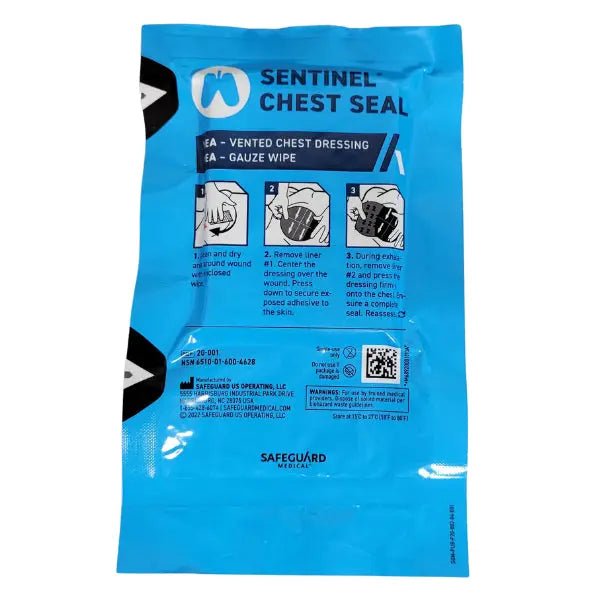
What makes the Sentinel Chest Seal different from other vented chest seals?
The Sentinel Chest Seal uses a dual-vent technology that channels air and blood through separate pathways simultaneously — reducing the risk that blood accumulation will block the air venting channel, a failure mode observed in some single-channel or single-valve designs. It also uses a 360° Sentinel 10x™ acrylate adhesive base (non-water-based) rather than a hydrogel, which maintains consistent adhesion in the presence of blood, sweat, and water without softening or swelling over extended evacuation periods. The transparent layered design allows wound monitoring after application without seal removal.
Is the Sentinel Chest Seal vented or non-vented?
The Sentinel Chest Seal is vented. It features dual-vent technology designed for the simultaneous release of blood and air from the chest cavity. This vented design is consistent with the CoTCCC-recommended approach for treating open and sucking chest wounds, as specified in the 2024 TCCC Guidelines — which direct responders to apply a vented chest seal to all open chest wounds when available. The vent design minimizes occlusion risk, reducing the need to manually burp or replace the seal.
Can the Sentinel Chest Seal be used alone or is it only part of the SENTINEL Kit?
The Sentinel Chest Seal is available as a standalone product (SKU 20-001) for integration into existing IFAKs and trauma kits. It is also the chest seal component of the SENTINEL Chest Trauma Kit by Combat Medical Systems, which additionally includes the Dart® 14-gauge 3.25" needle decompression catheter and the Dart® Target placement guide. Purchasing the standalone seal allows organizations to configure their own kits or replace individual components without purchasing a complete kit assembly.
How does the Sentinel's acrylate adhesive compare to hydrogel adhesives?
Most chest seals use hydrogel adhesives, which are water-based gel formulations that conform well to skin texture. The Sentinel uses an acrylate-based adhesive, which is not water-based and therefore does not absorb moisture or swell in wet conditions. Published clinical data on the Sentinel indicates it maintains static placement across environmental extremes. The acrylate adhesive is the same general chemistry class used in advanced wound dressings and some surgical drapes. For operators in extremely wet environments (rain, submersion risk), the non-water-based chemistry may provide an adhesion advantage over some hydrogel alternatives.
What are the packaged dimensions of the Sentinel Chest Seal for IFAK planning?
The Sentinel Chest Seal packages at 19.7 × 14 × 1.3 cm (approximately 7.75" × 5.5" × 0.5") and weighs 0.7 oz. The deployed seal measures 20.3 × 15.2 cm. The relatively flat, low-profile packaging is compatible with standard IFAK pouches. For complete chest trauma capability, the Sentinel pairs with the Dart® needle decompression catheter (14G × 3.25") in the SENTINEL Chest Trauma Kit — the kit dimensions are 6.88" L × 1.0" D and weigh 3 oz total.
How does the Sentinel Chest Seal's dual-vent technology reduce vent occlusion?
Single-channel vented seals use one pathway for both blood and air egress. In an active hemorrhage scenario, blood can pool in this channel, blocking air from escaping and effectively converting the seal from vented to non-vented without the provider's knowledge. The Sentinel's dual-vent system provides separate simultaneous pathways for blood and air, so blood drainage does not compete with or block air venting. Per Safeguard Medical product documentation, this design specifically addresses the vent-occlusion failure mode identified in published chest seal research.
Why does the Sentinel use acrylate adhesive rather than hydrogel?
Most chest seals use hydrogel adhesives, which are water-based formulations that provide good initial conformability to skin texture. The limitation of hydrogels in tactical environments is that they can absorb environmental moisture, swell, and lose adhesive strength when exposed to heavy perspiration, rain, or blood-diluted surfaces. The Sentinel's 360° Sentinel 10x™ acrylate adhesive is not water-based and therefore does not absorb moisture or swell. Per Safeguard Medical product documentation, it maintains static placement across environmental extremes — a meaningful advantage in wet-climate operations or when the wound site has significant blood contamination.
Does the Sentinel Chest Seal need to be purchased as part of the SENTINEL Kit or is it available solo?
The Sentinel Chest Seal (SKU 20-001) is available as a standalone individual seal for integration into existing IFAKs. It is also included as the chest seal component of the SENTINEL Chest Trauma Kit, which adds the Dart™ 14 Ga × 3.25" decompression needle and the Dart Target™ placement guide. Per Safeguard Medical product documentation, buying the seal alone allows units to configure the complete chest trauma module independently or augment existing kits that already include a decompression needle.
What does the 360° adhesive ring on the Sentinel mean for application technique?
The Sentinel's adhesive is applied in a full circumferential ring around the wound contact area, rather than covering the entire backing surface or using spot adhesive. This 360° ring ensures a continuous, uninterrupted seal perimeter around the wound, eliminating the potential for air tracking under an incomplete adhesive edge. The ring design is applied by pressing from the wound center outward to seat the adhesive progressively without trapping air. The transparent layered backing allows the provider to confirm the ring is fully seated before releasing pressure.