


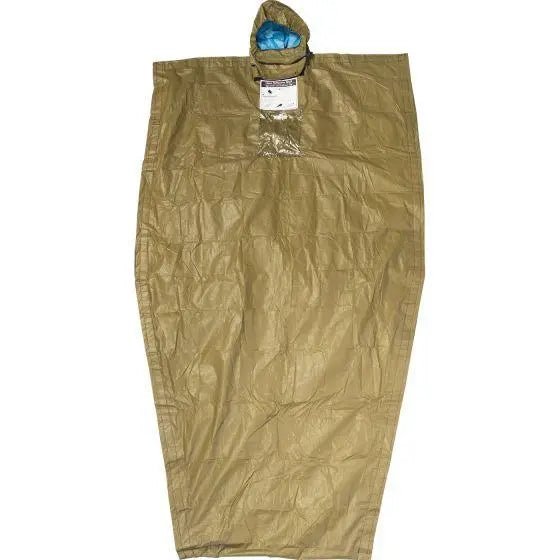
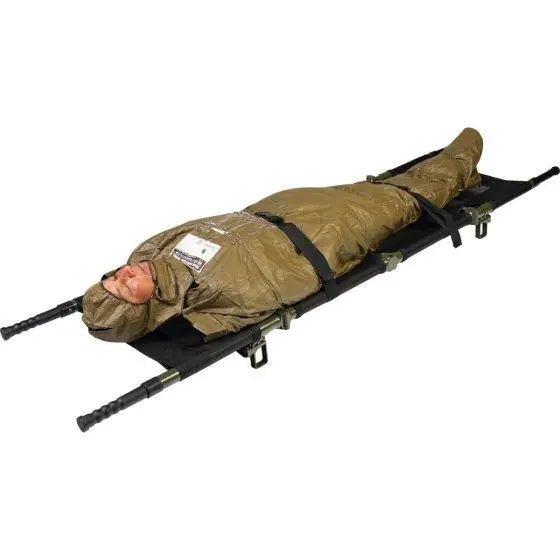

A Mylar space blanket reflects radiant heat — and tears, crackles, and offers zero structural support the moment you try to package and move a patient. The NAR Heat Reflective Shell (HRS) is the reinforced thermal covering that serves as the outer shell of the CoTCCC-recommended HPMK, offered here on its own for use with an existing warming system or as a serious upgrade over emergency blankets.
Can your thermal covering survive a helicopter load and a ground transport — or does it shred the first time you move the casualty?
The 4-ply composite construction combines flexibility for patient packaging, structural strength to support a fully loaded patient across multiple layers of continuous hook-and-loop, and a non-conductive reflective layer that insulates without the bulk of batting or foam. A built-in hood extends coverage to the head and neck — a major site of heat loss that emergency blankets ignore — and an integrated fluid-absorption pad manages wound, IV, and airway drainage. The covering is impervious to wind and rain, and its tapered shape conforms to body geometry to minimize the air gaps that drive convective heat loss.
Provider scope: The HRS is a passive thermal-management covering. Apply hypothermia prevention within your scope of practice and local protocol as part of casualty care. This listing describes the device; it is not a substitute for accredited trauma or tactical-casualty-care training.
Why This Shell
The outer shell component of the CoTCCC-recommended HPMK — the field-hypothermia benchmark in tactical and military casualty care, available on its own.
4-ply build with 1.5 in. continuous hook-and-loop holds 250+ lb — survives casualty handling, helicopter loading, and ground transport where a space blanket fails.
Built-in hood covers the head and cervical region; an integrated fluid-absorption pad manages drainage without breaking wind/rain resistance.
Continuous hook-and-loop opens partially for wound reassessment and line adjustment without removing the covering and dumping the patient’s retained heat.
HRS vs Standard Emergency Blanket
| HRS | Mylar Space Blanket | |
|---|---|---|
| Construction | 4-ply reinforced composite | Single-layer Mylar |
| Patient Packaging | Supports 250+ lb via Velcro | No structural support |
| Reassessment Access | Partial 360° via continuous Velcro | Full removal required |
| Durability | Withstands transport & handling | Fragile, easily punctured |
Who Fields It
Field hypothermia prevention as part of MARCH casualty care, standalone or with a warming liner.
A reusable, durable upgrade over disposable space blankets for trauma transport.
Wind- and rain-proof patient encapsulation for exposed backcountry rescues.
Build It Out
Pair the shell with active warming, or step up to the full kit or the insulated cold-weather variant.
The complete CoTCCC-recommended kit — shell plus Ready Heat warming.
The Climashield-insulated cold-weather version of this shell.
Warming blankets and thermal-management adjuncts.
Up Close


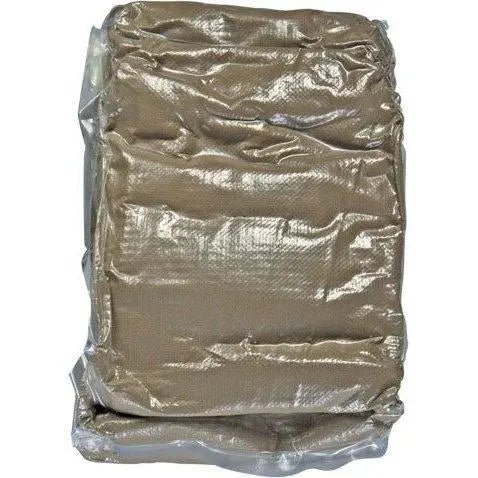
Reinforced 4-ply thermal covering with a built-in hood — durable patient encapsulation that survives the move.

Specifications
| Construction | 4-ply composite fabric, non-conductive reflective layer |
| Weight Rating | 250+ lb via 1.5 in. continuous Velcro |
| Access | 360° via continuous Velcro closures |
| Hood | Built-in, head and neck coverage |
| Additional Features | Integrated fluid-absorption pad; tapered shape |
| Environmental | Impervious to wind and rain |
| Application | Standalone covering or HPMK outer shell |
| Manufacturer | North American Rescue |
When to Deploy the NAR Heat Reflective Shell
- Prolonged Field Care (PFC) — Hypothermia Prevention: The HRS is the reinforced outer shell of the CoTCCC-recommended HPMK. In PFC environments where casualty evacuation is delayed beyond the golden hour, maintaining core temperature prevents the lethal triad of hypothermia, acidosis, and coagulopathy.
- CASEVAC / MEDEVAC Encapsulation: During casualty transport on rotary or ground platforms, patients lose heat rapidly to ambient air and rotor wash. The HRS reflective outer surface deflects radiant heat loss and resists wind penetration without the bulk of a sleeping bag or vacuum mattress.
- Trauma Bay / Far-Forward Aid Station Staging: Forward surgical teams and battalion aid stations stage the HRS as a reusable thermal management tool for trauma patients awaiting surgery. Unlike a space blanket, the HRS is a durable, reinforced component rated for repeated use.
- EMS Mass Casualty Incident (MCI) Response: EMS teams managing multiple patients in cold or wet conditions can deploy the HRS to stabilize priority casualties without committing the full HPMK to each patient — freeing the heating component for higher-acuity cases.
- Cold-Weather Training Exercises: In live field environments where exposure hypothermia is a training risk, the HRS provides rapid thermal protection that can be applied by a single provider while maintaining situational awareness.
How the Heat Reflective Shell Compares
HRS vs. Emergency Mylar Space Blanket: A standard mylar space blanket is single-use, prone to tearing under field conditions, and has no structural integrity. The NAR Heat Reflective Shell is reinforced, reusable, and designed to retain heat during patient handling and transport — not just static rest. It is the outer shell of the CoTCCC-recommended HPMK system, not a commodity item. See the hypothermia prevention collection at tactical-medicine.com.
HRS vs. NAR HPMK (Standard): The HPMK includes both the Heat Reflective Shell and the Ready-Heat® II self-activating chemical heat blanket. The HRS alone provides passive radiant heat retention; the full HPMK adds active heat generation. Choose the HRS when a reusable outer shell is needed for staging or when the active heating component is already in use on another casualty.
HRS vs. NAR HPMK-I (Insulated): The HPMK-I adds an insulated inner liner between the heat source and the patient for sustained warmth in extreme cold. The HRS is the outer shell component common to both HPMK versions. In arctic or sub-zero operations, the full HPMK-I system outperforms the HRS alone. Explore the HPMK-I at tactical-medicine.com.
HRS vs. SOF® Tactical Blanket (Blizzard): The Blizzard SOF Tactical Blanket is a 4-layer ambulatory wrap; the NAR HRS integrates directly with the HPMK Ready-Heat® component for active heat management rather than passive insulation alone. For CoTCCC-compliant hypothermia protocols, the HPMK system (shell + heat source) is the referenced solution.
HRS vs. Vacuum Mattress: Vacuum mattresses immobilize and insulate simultaneously, primarily for spinal precautions. The HRS is a lighter, faster-deploying thermal wrap with no immobilization function. In the field, speed of application and pack size often make the HRS the first thermal intervention deployed while heavier evacuation equipment is prepared.
Heat Reflective Shell — Frequently Asked Questions
Q: Is the NAR Heat Reflective Shell CoTCCC-recommended?
A: The Heat Reflective Shell (HRS) is the outer shell component of the CoTCCC-recommended Hypothermia Prevention and Management Kit (HPMK). The Committee on Tactical Combat Casualty Care endorses the HPMK system for hypothermia prevention in the H (Hypothermia Prevention) phase of MARCH. The HRS alone functions as the passive radiant-heat-retention layer of that system.
Q: What temperature range does the Heat Reflective Shell protect against?
A: North American Rescue does not publish a specific temperature floor for the HRS in isolation, as performance depends on the insulating layers beneath (clothing, litter padding) and the presence of the Ready-Heat® active heat source in the full HPMK system. In clinical use, the HPMK system (HRS + Ready-Heat® II) is rated to maintain normothermia in casualties exposed to cold ambient conditions consistent with extended field care. For extreme cold environments, the HPMK-I adds an insulated inner liner for additional thermal retention.
Q: Is the Heat Reflective Shell single-use or reusable?
A: The NAR Heat Reflective Shell is designed as a reusable component. It can be decontaminated and redeployed, making it suitable for staging in aid stations, vehicle litter kits, or unit medical sets where consumable budgets favor durable outer shells. The Ready-Heat® II heat blanket inside the full HPMK system is single-use/single-activation.
Q: Does the Heat Reflective Shell have an NSN?
A: The full HPMK system (including the HRS) has National Stock Numbers for military procurement. Contact North American Rescue directly or via MED-TAC for current NSN data and CAGE code information, as NSN assignments can be updated. The HRS is available for direct civilian, EMS, and law enforcement purchase through tactical-medicine.com without procurement restrictions.
Q: How do you apply the Heat Reflective Shell in the field?
A: Lay the HRS flat beneath the casualty during litter loading, or wrap over the patient after initial assessment. Tuck open edges at the feet and sides to trap warmth. In the full HPMK configuration, activate the Ready-Heat® II chemical heat blanket first, position it against the torso (not directly on skin), then enclose the assembly in the HRS, shiny side outward. A single provider can complete the wrap in under 60 seconds on a supine casualty.
Related searches: NAR heat reflective shell, HRS hypothermia shell, HPMK outer shell, reusable casualty blanket, tactical thermal blanket, reflective patient encapsulation, hypothermia prevention shell.
All products sourced direct from North American Rescue. CoTCCC recommendation status verified where applicable. Ships from MED-TAC International, Pembroke Pines, FL — clinician-founded, veteran-led, SDVOSB-certified.
Specifications coming soon. Contact us for detailed product information.
FREQUENTLY ASKED QUESTIONS


