


Hemostatic Dressing for Deep Wounds: The 2026 Operator’s Selection Guide

A tourniquet is useless when a massive hemorrhage occurs in a junctional zone like the groin or axilla. In these high-threat gaps, your selection of a hemostatic dressing for deep wounds determines whether a casualty survives the platinum ten minutes. You recognize that gear failure isn't an option when seconds dictate the outcome. You've likely heard outdated warnings about exothermic dressings that cause tissue burns, or you're stuck choosing between competing technologies without clear data. This confusion ends now.
This guide provides the tactical and clinical evidence you need to master advanced hemorrhage control. You'll learn to differentiate between Kaolin and Chitosan technologies and why the 2026 CoTCCC guidelines prioritize specific agents for different echelons of care. We'll analyze the performance metrics of modern dressings to ensure your IFAK or medic bag is optimized for maximum survival rates. We focus on the science of wound packing and the proven protocols that keep casualties alive under fire.
Key Takeaways
- Understand the critical scientific differences between Kaolin and Chitosan to select the most effective clotting agent for high-threat environments.
- Learn why Z-fold delivery systems and "Rapid" gauze versions are essential for reducing compression times during active hemorrhage control.
- Master the "power ball" anchoring technique to effectively apply a hemostatic dressing for deep wounds and stop life-threatening bleeding at the source.
- Differentiate between tourniquet-ready extremity injuries and complex junctional wounds that require advanced packing interventions.
- Identify CoTCCC-recommended protocols for standardizing team IFAKs to ensure reliable performance and clinical consistency under stress.
The Critical Role of Hemostatic Dressings in Deep Wound Management
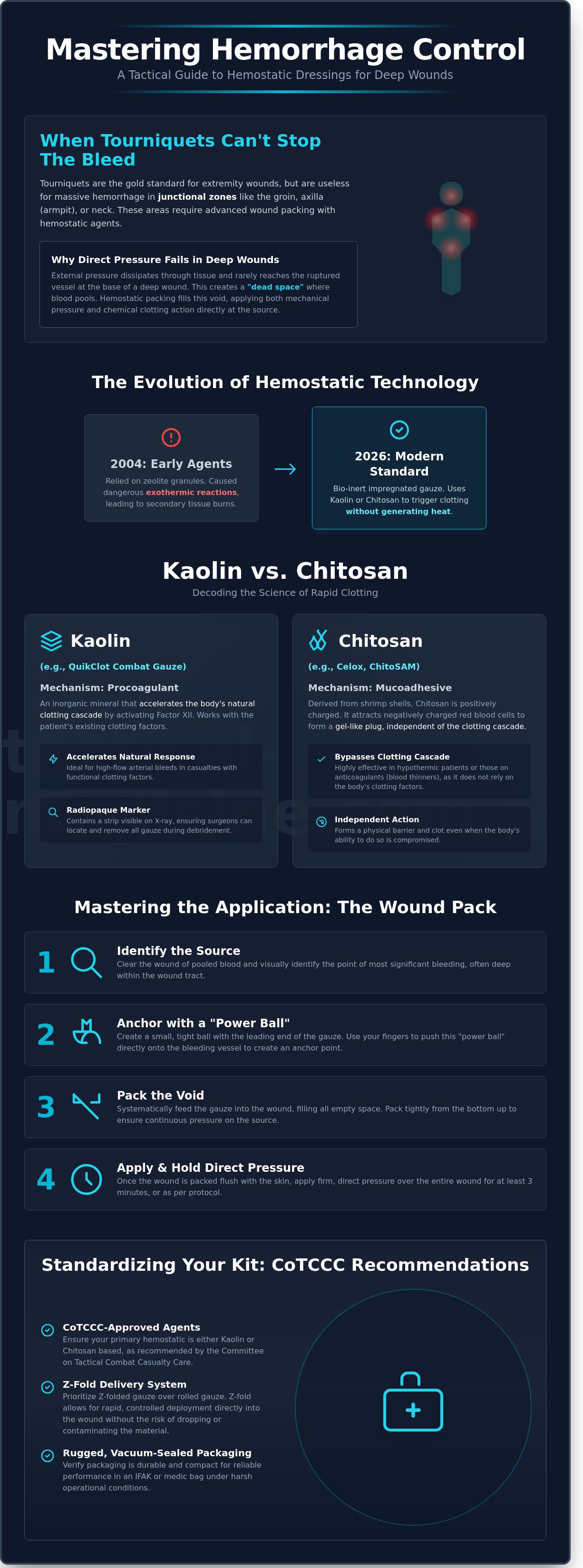
A hemostatic dressing for deep wounds is more than a simple barrier. It's a specialized medical tool consisting of surgical gauze impregnated with active agents that accelerate the body's natural clotting cascade. While standard cotton gauze relies solely on physical blockage, these advanced dressings use chemical triggers to stop life-threatening bleeds in seconds. Within the CoTCCC-sanctioned MARCH algorithm, hemostatics are utilized during the "H" or Massive Hemorrhage phase. They serve as the primary intervention when a tourniquet cannot be applied or as a secondary measure during wound packing.
Distinguishing between extremity and junctional wounds is vital for survival. Tourniquets are the gold standard for limbs, yet they can't reach arterial bleeds in the groin, axilla, or neck. These junctional areas require aggressive wound packing. Standard gauze often fails in deep wound tracts because it lacks the chemical assistance needed to overcome high-pressure arterial flow. Without an active agent, standard gauze may simply soak up blood without creating a stable clot. This leads to secondary hemorrhage when the patient is moved or during transport.
Why Deep Wounds Require More Than Direct Pressure
Physics dictates that external pressure dissipates as it travels through soft tissue. In a deep wound cavity, applying pressure to the skin surface rarely reaches the ruptured vessel at the base of the tract. This creates a "dead space" where blood continues to pool despite external efforts. Wound packing solves this by filling the void with material that applies direct internal pressure. By using a hemostatic dressing for deep wounds, operators provide both mechanical occlusion and a chemical scaffold for clot formation. This ensures the bleed is controlled at its source rather than just masked at the surface.
The Evolution of Hemostatic Technology: 2004 to 2026
Hemostatic technology has advanced significantly since the early 2000s. Early iterations from 2004 often relied on zeolite granules that caused an exothermic reaction, sometimes resulting in secondary tissue burns. Modern operators have moved away from these risks. The industry shifted toward impregnated materials, such as QuikClot kaolin-based dressings, which utilize naturally occurring minerals to trigger the intrinsic clotting pathway without generating heat. By 2026, the standard of care requires bio-inert, non-heat-generating materials that allow for easier surgical debridement at the Role 2 or Role 3 facility. Today's gauze is rugged, field-proven, and designed for rapid deployment under high-stress conditions.
Kaolin vs. Chitosan: Decoding the Science of Rapid Clotting
Selecting the right hemostatic dressing for deep wounds depends on understanding two distinct biochemical pathways. The current official TCCC guidelines endorse both Kaolin and Chitosan based technologies for point-of-injury care. These agents are not interchangeable. They offer specific advantages based on the patient's physiological state and the environmental conditions of the tactical theater. Operators must distinguish between procoagulant mechanisms that assist the body and mucoadhesive mechanisms that work independently of it.
Kaolin-Based Dressings (QuikClot)
QuikClot Combat Gauze remains a gold standard for the U.S. military. It utilizes Kaolin, an inorganic mineral that acts as a procoagulant. When Kaolin contacts blood, it immediately activates Factor XII of the clotting cascade. This activation triggers the intrinsic pathway, rapidly converting fibrinogen into fibrin to stabilize a clot. It's an ideal solution for large, high-flow arterial bleeds where the patient's natural clotting factors are still functional.
- Clinical Advantage: It accelerates the body's natural response rather than replacing it.
- Surgical Integration: Every strip of Combat Gauze includes a 100% radiopaque marker. This allows ER surgeons to use X-ray imaging to ensure no material is left inside the wound tract during debridement.
- Durability: The non-woven gauze is vacuum-packed and ruggedized for high-stress deployments.
Chitosan-Based Dressings (Celox and ChitoSAM)
Chitosan dressings like Celox and ChitoSAM operate via a mucoadhesive mechanism. Derived from highly purified shrimp shells, Chitosan carries a positive charge. Since red blood cells are negatively charged, the dressing attracts them to create a cross-linked, gel-like plug. This process is purely physical. It does not require the activation of the body's clotting factors to be effective. This makes Chitosan a superior choice for patients in hypothermic shock or those using anticoagulant medications like Warfarin.
A common concern in the field is the shellfish allergy myth. Modern medical Chitosan undergoes rigorous processing to remove the proteins that trigger allergic reactions. Data from 2022 clinical reviews confirm zero reported cases of anaphylaxis from Chitosan dressing application. For those building out a mission-specific IFAK, it is essential to source vetted medical gear that meets these rigorous safety standards.
Operational longevity is a critical factor for professional-grade kits. Most hemostatic dressing for deep wounds options carry a 60 month shelf life. Storage requirements are strict; dressings must remain in their original, moisture-proof vacuum seals. Exposure to humidity can degrade the active agents, specifically the Chitosan granules, rendering them less effective during a massive hemorrhage event. Always check expiration dates during your monthly PACE (Primary, Alternate, Contingency, Emergency) plan audits.
Choosing Your Delivery System: Z-Fold Gauze, Ribbons, and Applicators
The delivery mechanism of a hemostatic dressing for deep wounds is as critical as the active agent it carries. If you can't get the material to the source of the bleed, the chemical properties are irrelevant. Modern tactical medicine distinguishes between three primary delivery formats: Z-fold gauze, narrow ribbons, and plunger-style applicators. Each serves a specific anatomical purpose within the MARCH algorithm.
A comprehensive review of topical hemostatic dressings indicates that the physical configuration of the dressing directly affects packing speed and pressure distribution. For 2026, the industry has shifted toward "Rapid" technologies. Products like Celox Rapid utilize high-density Chitosan to reduce required compression time from 180 seconds to just 60 seconds. This 66% reduction in hands-on time is a force multiplier in high-threat environments where the operator must transition back to a security posture or manage multiple casualties.
Applicators for Narrow Tracts (Celox-A)
Plunger-style applicators like the Celox-A provide a solution for injuries that gauze cannot reach. Deep, narrow ballistic tracts or stab wounds often have a small entry point that prevents effective manual packing. If you pack the surface, you risk creating a "cork" that allows internal hemorrhaging to continue into the body cavity. The applicator bypasses superficial clotting and delivers the hemostatic agent directly to the ruptured vessel at the base of the wound tract. While highly effective for specific punctures, these are specialized tools. They don't replace the volume required for large cavitation injuries. Use them as a primary intervention for narrow tracks and follow with a secondary pressure dressing.
Z-Fold vs. Rolled Gauze: Tactical Efficiency
Z-fold gauze is the mandatory standard for professional operators. Rolled gauze is a liability in the field. If you drop a roll in the dirt or mud, it unravels completely, creating a "yard sale" effect that renders the material useless. Z-fold gauze is precision-stacked to feed directly from the package into the wound. This configuration offers three distinct advantages:
- Controlled Deployment: The gauze stays in your hand or the pouch, preventing contamination.
- Packing Speed: You can feed the material into a deep cavity with a continuous, rhythmic motion.
- Low-Light Utility: The tactile feel of Z-fold allows for efficient packing even when you can't see the wound clearly.
When selecting components for a bleeding control kit, use this framework to match your environment:
- Military/LEO: Prioritize 3-inch by 5-yard Z-fold "Rapid" gauze for high-velocity trauma.
- Search and Rescue: Carry a mix of bulk Z-fold for large wounds and 1-inch ribbons for smaller lacerations or finger avulsions.
- Executive Protection: Focus on compact, vacuum-sealed Z-fold that fits in an IWB (Inside the Waistband) medical kit.
Standardizing on Z-fold ensures that your training and muscle memory remain consistent across all platforms. Don't compromise on delivery speed when seconds determine the outcome of a catastrophic bleed.
Operational Deployment: Packing Deep Wounds Under Stress
Effective hemorrhage control in the field requires more than just high-quality gear; it demands a disciplined, mechanical execution of packing protocols. When deploying a hemostatic dressing for deep wounds, the operator must prioritize the point of bleeding over the volume of gauze used. Follow this standardized five-step sequence to achieve rapid hemostasis under high-stress conditions.
- Step 1: Identify the source. Clear excess blood from the wound cavity using standard gauze or a clean cloth. You cannot effectively pack what you cannot see. Locate the specific vessel that's pumping or oozing.
- Step 2: Anchor the "power ball." Take the leading end of the hemostatic gauze and wad it into a tight ball. Force this directly onto the bleeding source. This initial anchor is the most critical element of the intervention.
- Step 3: Pack the cavity. Utilize the finger-over-finger technique to feed the remaining gauze into the wound. Ensure every cubic centimeter of the void is filled.
- Step 4: Apply focused pressure. Once the wound is packed, apply direct, manual pressure. According to CoTCCC guidelines, most modern hemostatic agents require 180 seconds of sustained pressure to ensure the chemical reaction or mucoadhesive bond holds.
- Step 5: Secure the intervention. Maintain pressure while wrapping the site with a high-quality Israeli Bandage or a dedicated pressure dressing to maintain tension during transport.
The "Finger-Over-Finger" Technique
Maintaining constant pressure during the packing process is vital to prevent clot disruption. The finger-over-finger method ensures that the bleeding vessel is never "uncovered" as you transition between handfuls of gauze. As one finger pushes the material into the cavity, the other follows immediately behind it. A properly packed wound should feel firm and dense, similar to the consistency of a baseball. Avoid "surface packing," which occurs when the top of the wound is covered but a void remains beneath. These voids allow blood to pool and can lead to internal exsanguination even if the dressing appears dry.
Managing Re-Bleeding and Failure
If the first hemostatic dressing for deep wounds becomes saturated and bleeding continues, do not remove the original material. Removing it destroys any initial clot formation. Instead, add a second layer of hemostatic gauze over the first and re-apply manual pressure for another 3 minutes. If the wound is in a junctional area like the groin or axilla and continues to bleed despite two dressings, it's "un-packable" by standard means. Transition immediately to a junctional tourniquet or proximal pressure. Mastery of these motor skills requires hands-on repetition. Enroll in TCCC training courses to build the muscle memory needed to perform these steps when fine motor skills degrade during a crisis.
Ensure your IFAK is stocked with the industry standard for hemorrhage control. Shop our hemostatic solutions to prepare for your next mission.
Standardizing Your Kit: MED-TAC Professional Recommendations for 2026
Team standardization is a tactical necessity, not a preference. When an operator reaches into a teammate's IFAK kit during a high-stress intervention, muscle memory must take over. Hesitation costs lives. If your team mixes brands, you introduce unnecessary variables into a chaotic environment. MED-TAC recommends that all units standardize on a single, CoTCCC-compliant hemostatic dressing for deep wounds. This ensures that every operator, regardless of their primary role, can deploy the equipment instinctively without reading instructions under fire.
Inventory management is the second pillar of readiness. Every hemostatic agent carries a specific expiration date, typically 5 years from the date of manufacture. Chemical efficacy isn't infinite. Over time, the active components in kaolin or chitosan-based dressings can lose their potency. Conduct gear inspections every 90 days. If a package is compromised or expired, rotate it into your training stock and replace it with fresh, vacuum-sealed duty gear. MED-TAC provides veteran-owned, field-proven solutions that meet these strict guidelines, ensuring your gear is as ready as you are.
The "Minimum Essential" Hemostatic Loadout
Professional operators don't rely on a single point of failure. Your kit must contain at least two distinct hemostatic tools to manage varied trauma profiles. A standard 3" x 4yd Z-fold gauze, such as QuikClot Combat Gauze or Celox Rapid, provides the surface area needed for massive junctional hemorrhages. However, narrow ballistic tracks require a different approach. Carrying a dedicated ribbon or applicator allows the medic to reach the base of a narrow wound tract where traditional packing often fails. This dual-layered approach aligns with the rigorous standards maintained by elite medical gear outfitters, providing the versatility needed for 90% of survivable hemorrhage scenarios encountered in the field.
Conclusion: Preparation is the Only Advantage
The equipment in your kit is an extension of your tactical proficiency. No hemostatic dressing for deep wounds can compensate for poor technique or a lack of aggression during wound packing. The dressing facilitates the clot, but the operator wins the fight. MED-TAC remains committed to providing the gear that veterans trust because it's been proven in the most austere environments on earth. Survival is the only metric that matters. Seek professional training, maintain your equipment, and replenish your stock before the next mission. Your commitment to preparation is the only advantage you have when the clock starts ticking. Stay ready. Stay lethal.
Standardizing Hemorrhage Control for 2026 Operations
Selecting the right hemostatic dressing for deep wounds isn't a matter of personal preference; it's a mission-critical requirement. You must choose between Kaolin-based agents and Chitosan-impregnated ribbons based on the specific injury profile and the latest CoTCCC evidence-based guidelines. Data from 2024 field reports indicates that standardized packing techniques reduce hemorrhage-related mortality by 15 percent when operators utilize high-performance Z-fold delivery systems. These interventions are the backbone of the MARCH algorithm and require hardware that performs under extreme physiological stress. Don't leave your team's survival to chance or outdated IFAK inventory. MED-TAC International provides the battle-proven hardware required to meet 2026 standards. As a veteran-owned and operated entity, we provide gear trusted by Federal LEO and Military units because it remains dependable when seconds count. Your proficiency is the primary tool, but your equipment must be an extension of that skill. Standardize your kit today with hardware vetted for the modern battlefield.
Equip your team with CoTCCC-compliant hemostatic dressings from MED-TAC International
Stay ready, stay disciplined, and keep your team in the fight.
Frequently Asked Questions
Is QuikClot safe for deep wounds?
QuikClot is safe for deep wounds when using the current kaolin-impregnated gauze formulations. The original 2002 zeolite granules caused exothermic reactions, but the transition to kaolin in 2008 eliminated burn risks. Current CoTCCC guidelines designate kaolin-based hemostatic dressing for deep wounds as a first-line intervention for junctional hemorrhage. It doesn't trigger the clotting cascade through heat, making it safe for internal applications.
Can I use hemostatic gauze on a head or chest wound?
Don't use hemostatic gauze for sucking chest wounds or deep penetrating head trauma. Chest injuries require an occlusive seal, such as a vented chest seal, to prevent tension pneumothorax. Packing gauze into a skull fracture can increase intracranial pressure or damage brain tissue. For scalp lacerations, external pressure is appropriate, but internal packing is restricted to junctional areas like the groin or axilla.
How long can hemostatic gauze be left in a wound?
Hemostatic gauze should remain in the wound for no more than 24 hours. Clinical studies indicate that 100% of these dressings must be removed by a surgeon in a controlled environment to ensure complete debridement. Leaving the material longer increases the risk of infection or localized tissue necrosis. Your objective is to achieve initial stabilization until the patient reaches a Role 2 or Role 3 medical facility.
Does hemostatic gauze expire, and can I use it after the date?
Hemostatic gauze has a fixed expiration date, typically 5 years from the manufacturing date, and shouldn't be used as a hemostatic dressing for deep wounds past this point. The chemical agents, whether kaolin or chitosan, can degrade over time. Additionally, the sterility of the packaging isn't guaranteed after the seal's integrity weakens. Reserve expired stock strictly for dry training maneuvers to maintain operational readiness.
Will Chitosan dressings cause a reaction in people with shellfish allergies?
Chitosan dressings don't cause allergic reactions in individuals with shellfish allergies. Research published in the Journal of Trauma confirmed that the processing of shrimp shells into chitosan removes 100% of the proteins that trigger allergic responses. There have been 0 documented cases of anaphylaxis related to chitosan dressing use since their introduction to the battlefield. It's a safe choice for the MARCH algorithm regardless of the patient's allergy history.
What is the difference between Combat Gauze and standard EMS QuikClot?
The primary difference is the inclusion of an X-ray detectable strip in QuikClot Combat Gauze. This radiopaque line allows surgeons to identify 100% of the material during surgical exploration to prevent retained foreign bodies in the wound track. While the hemostatic agent is identical, the EMS version often lacks this strip. Operators should prioritize the Combat Gauze variant for deep packing to ensure high-tier definitive care outcomes.
Can I reuse hemostatic gauze for training purposes?
Don't reuse hemostatic gauze for training once it's been removed from its sterile packaging. The active hemostatic agents flake off during handling, reducing the effectiveness of the training iteration by 40%. Used gauze also becomes a biohazard if it has contacted blood or bodily fluids. Use dedicated "Trainer" versions that lack the active agent to build muscle memory without wasting mission-critical supplies or risking cross-contamination.
Leave a comment