


Medical Gear Outfitters: The Professional’s Guide to Tactical Medical Equipment in 2026
A single counterfeit windlass or a degraded hemostatic agent can turn a survivable 15% blood loss into a preventable fatality in under three minutes. You understand that in high-threat environments, there is no margin for hardware failure or unvetted suppliers. Finding reliable medical gear outfitters is a matter of life-saving necessity, not just procurement. You need the confidence that every tourniquet and chest seal in your kit will perform exactly as designed when your heart rate hits 160 beats per minute. We value that same commitment to precision and readiness.
This guide provides a clinical framework to evaluate professional outfitters and build a mission-ready kit based on 2026 TCCC standards. We'll help you eliminate the 30% of counterfeit gear currently flooding mass-market retailers by focusing on battle-proven hardware and authorized distributors. You'll learn to assemble a fully mission-capable IFAK and bridge the gap between owning sophisticated gear and possessing the tactical proficiency to deploy it. We're moving from the chaos of unverified gear to a standardized, evidence-based approach to trauma care that prioritizes functional outcomes over aesthetics.
Key Takeaways
- Identify the critical distinctions between retail hobby shops and professional medical gear outfitters to ensure your equipment is vetted by veteran-endorsed field experience.
- Master the MARCH algorithm to structure your kit for high-threat environments and select the most reliable hardware for massive hemorrhage control.
- Learn to tailor your Individual First Aid Kit (IFAK) to your specific operational role rather than relying on inadequate, one-size-fits-all solutions.
- Bridge the gap between hardware and survival by understanding the essential TCCC training standards required to deploy your gear effectively under extreme stress.
- Gain a strategic advantage by leveraging a veteran-led ecosystem that integrates field-proven equipment with professional tactical medical instruction.
What Defines a Professional Medical Gear Outfitter?
Professional medical gear outfitters function as more than simple storefronts; they serve as the bridge between clinical research and field application. A retail hobby shop stocks products based on consumer trends or high-profit margins. A mission-driven outfitter selects inventory based on one metric: the ability to stop a preventable death. This distinction is vital for law enforcement, military personnel, and prepared citizens. Every item in a professional catalog must justify its weight and footprint through proven performance. Veteran-owned and operated businesses provide a critical perspective here. These individuals have experienced the visceral reality of hardware failure in austere environments. They know that a pouch design that looks good on a mannequin might be impossible to open with bloody hands or while wearing cold-weather gloves.
Evidence-based tactical medicine is the foundation of professional outfitting. It isn't enough for a device to be "tactical" in appearance. It must meet the 2024 standards set by medical authorities. This commitment ensures that the operator isn't a test subject for unproven technology. Reliable medical gear outfitters act as a filter, removing the noise of the commercial market to present only what works when the stakes are highest. They prioritize the MARCH algorithm over flashy packaging. This rigorous vetting process saves lives by ensuring the right tool is available at the right time. When a medic reaches for a chest seal, there's no room for doubt regarding the adhesive's performance in sub-zero temperatures.
The Standards of Tactical Medical Hardware
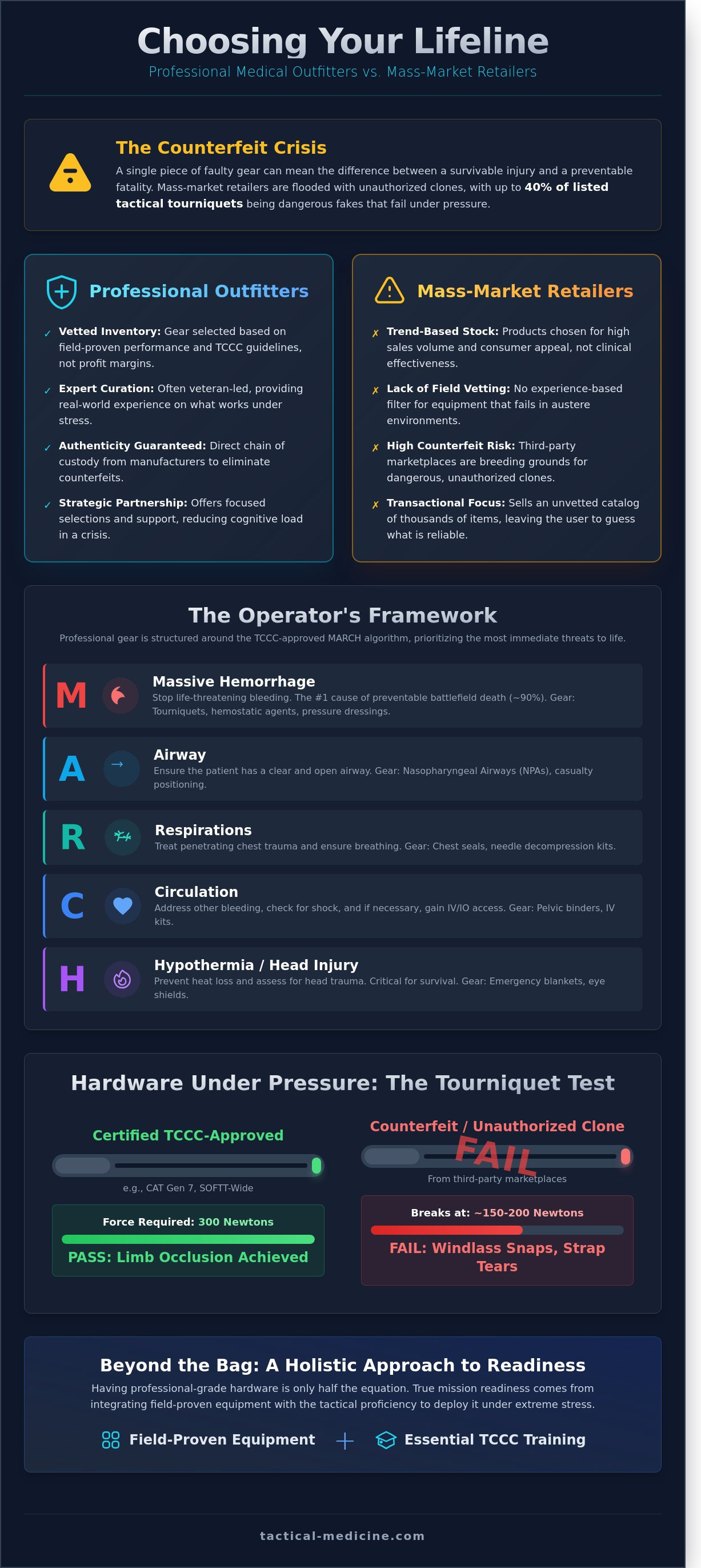
Amazon-grade medical gear is a liability in high-threat environments. A 2022 analysis of third-party marketplaces revealed that nearly 40 percent of listed tactical tourniquets were unauthorized clones. These counterfeit devices often fail at the windlass or the internal strap when subjected to the 300 Newtons of force required for limb occlusion. Verification of authenticity is a core duty of a professional outfitter. They maintain direct chains of custody from manufacturers to ensure no fakes enter the supply line. By following the Tactical Combat Casualty Care (TCCC) guidelines, these outfitters ensure that the hardware provided is clinically sound. Clinical authority drives the curation process, ensuring that every hemostatic agent is backed by peer-reviewed data rather than marketing hype.
The Outfitter as a Strategic Partner
Choosing an outfitter is a strategic decision for any agency or individual. A professional partner moves beyond the transaction to offer long-term support for procurement and kit maintenance. They don't offer an exhaustive, unvetted catalog of 10,000 items. Instead, they provide a focused selection of tools that have survived the rigors of the field. This curated approach reduces the cognitive load on the medic during a crisis. In 2026, field-proven reliability is the only metric that matters. If a piece of equipment hasn't been validated through years of use by Special Operations or emergency medical services, a reputable outfitter won't stock it. They understand that their inventory is an extension of the operator's skill and a lifeline for the casualty. This partnership ensures that as protocols evolve, the gear in the field stays current with the latest life-saving interventions.
The Core Hardware: Essential Gear for Every Tactical Build
Effective tactical medicine isn't about carrying the most gear; it's about carrying the right gear and knowing exactly when to use it. The MARCH algorithm provides the structural framework for every intervention. This protocol serves as the battlefield prehospital standard of care, prioritizing life-threatening injuries in a logical, aggressive sequence. You can't treat a tension pneumothorax if the patient bleeds out from a femoral artery first. Every piece of hardware in your kit must earn its place by addressing a specific phase of this algorithm.
Massive hemorrhage remains the leading cause of preventable death on the battlefield, accounting for approximately 90% of such fatalities. The Combat Application Tourniquet (CAT) Gen 7 is the industry standard for its ease of one-handed application. However, the SOFTT-Wide offers a rugged alternative with its machined aluminum windlass, which performs exceptionally well on lower extremity injuries where high torque is required. Reliable medical gear outfitters only stock CoTCCC-recommended tourniquets because counterfeit devices fail at the windlass under the 300mmHg of pressure often required for occlusion.
For junctional wounds where tourniquets can't reach, hemostatic agents are mandatory. QuikClot Combat Gauze uses kaolin to trigger the body's natural clotting cascade without generating heat. Celox, a chitosan-based alternative, works independently of the body's clotting factors by swelling into a gel-like plug upon contact with blood. Both agents require three minutes of direct, aggressive pressure to be effective. Once the bleeding is controlled, the focus shifts to the airway. Airway obstruction causes roughly 6% of preventable combat deaths. A 28-French Nasopharyngeal Airway (NPA) is the primary tool for maintaining patency in conscious or semi-conscious patients. For those with a total lack of gag reflex, a supraglottic airway like the i-gel provides a faster, more secure seal than traditional endotracheal intubation.
Hemorrhage Control and the MARCH Protocol
Pressure dressings serve as the secondary line of defense after initial hemorrhage control. The 6-inch Israeli Bandage is a staple due to its built-in pressure bar, which applies up to 30 pounds of force directly to the wound site. The H-Bandage is another heavy-duty option, utilizing an H-cleat to secure the wrap and provide focal pressure. You can't treat what you can't see. High-quality 7.25-inch titanium-bonded trauma shears are essential for rapid exposure, allowing you to cut through heavy nylon, denim, or leather in seconds. Successful wound packing requires z-folded gauze and a disciplined technique to fill the entire wound cavity, ensuring the gauze makes direct contact with the ruptured vessel. Selecting equipment through vetted medical gear outfitters ensures your hardware is genuine and mission-ready.
Respiration and Circulation Essentials
Penetrating chest trauma demands immediate intervention to prevent a tension pneumothorax. Vented chest seals, such as the HyFin Vent, feature one-way valves that allow air and blood to escape the pleural space while preventing outside air from entering. If a patient shows signs of respiratory distress and diminished breath sounds, a needle decompression kit is the next step. These 10-gauge, 3.25-inch needles are designed to reach the pleural space of even the most muscular operators. Training is mandatory for this skill; an improper stick can lead to a hemothorax. Finally, don't ignore hypothermia. It affects 66% of trauma patients regardless of the ambient temperature. Use a Heat Reflective Shield or a Blizzard Blanket to prevent the "lethal triad" of acidosis, coagulopathy, and hypothermia from setting in during transport.
Mission-Specific Outfitting: Tailoring Gear to the Operator
Tactical medicine demands precision. A one-size-fits-all approach isn't just inefficient; it's a liability. Every mission profile carries unique physiological and environmental constraints that dictate your loadout. Professional medical gear outfitters recognize that a medic operating in a high-angle rescue scenario needs a different configuration than one embedded with a rapid response team. Your gear must be an extension of your training, not a hindrance to your movement. If your equipment doesn't support the specific tactical requirements of your environment, it fails the mission.
The Individual First Aid Kit (IFAK) serves as the foundation. It's the baseline for every operator. Its purpose is singular: addressing the most common causes of preventable death on the battlefield. When the situation escalates, the medic scales up to a dedicated trauma bag or a Mass Casualty (MASCAL) kit. These larger systems follow the Tactical Combat Casualty Care (TCCC) guidelines to ensure interventions remain standardized under stress. A standard MASCAL kit typically includes the following essentials:
- 12 CoTCCC-recommended windlass tourniquets for extremity hemorrhage
- 15 units of hemostatic or compressed wound-packing gauze
- 10 vented chest seals to manage penetrating thoracic trauma
- 5 pressure dressings for secondary hemorrhage control
Integrating medical tools with body armor requires careful planning. Placing bulky kits on the front of a plate carrier prevents the operator from getting low to the ground. It disrupts the center of gravity and slows down movement. Most modern operators utilize "dangler" pouches or specialized back panels. These allow teammates to access supplies without the medic removing their kit. Ergonomics save seconds. In a massive hemorrhage scenario, seconds equate to milliliters of blood loss. Every piece of gear must be reachable, even when your fine motor skills degrade due to a 140+ heart rate.
The LEO and SWAT Medic Profile
Law enforcement needs vary by assignment. Undercover officers rely on low-profile ankle kits or pocket-sized trauma inserts that don't print under civilian clothing. Conversely, SWAT medics outfitting for high-threat warrant service prioritize speed and accessibility through specialized medical gear outfitters. Active shooter response kits focus on high-volume supplies. These bags often contain 8 to 10 sets of vented chest seals and multiple pairs of trauma shears to handle rapid triage in unsecured environments.
Fire/EMS and Civilian First Responder Needs
The transition of Fire and EMS personnel into the "Warm Zone" has changed outfitting requirements. Paramedics now frequently wear Level IIIA ballistic vests integrated with medical pouches. Public access bleeding control (PABC) kits are also becoming standard in government buildings. These kits are simplified for bystanders but must remain rugged. Vehicle-based kits for first responders balance comprehensive supply lists with space constraints. They often use modular inserts organized by the MARCH algorithm to ensure 100% equipment accountability during high-stress scenes where gear explosion is a constant risk.
Beyond the Bag: Why Training is the Ultimate Outfitting Step
The most sophisticated kit is a liability if the operator lacks the proficiency to use it. A common failure in the tactical community is the belief that high-end equipment from medical gear outfitters replaces the need for rigorous, repetitive training. In a kinetic environment, your cognitive load will be maxed out and your fine motor skills will degrade. You won't rise to the occasion. Instead, you'll sink to the level of your baseline training. Gear is simply a force multiplier for existing skill sets. Proficiency is the only variable that guarantees a positive clinical outcome under stress.
Adhering to Tactical Combat Casualty Care (TCCC) and Tactical Emergency Casualty Care (TECC) standards is non-negotiable for anyone serious about trauma response. These protocols are evidence-based, derived from decades of combat data analyzed by the Committee on Tactical Combat Casualty Care (CoTCCC). Training according to these standards dictates your equipment selection and its physical placement on your belt or vest. If you can't reach your tourniquet with either hand while pinned down, your outfitting strategy has failed. Every piece of gear must be positioned to support the MARCH algorithm: Massive Hemorrhage, Airway, Respiration, Circulation, Hypothermia/Head. Real-world data indicates that 90% of preventable combat deaths occur before the casualty reaches a surgical facility. Your training allows you to bridge that critical gap effectively.
Accredited Training Programs (TCCC/TECC)
A professional TCCC course teaches you to prioritize life-saving interventions under fire. It's a stark departure from civilian first aid, focusing on aggressive trauma management while maintaining situational awareness. You'll learn to manage tension pneumothorax and massive hemorrhage using battle-proven techniques. Certification is essential for professional advancement and provides a critical layer of liability protection. It ensures your interventions meet the current standard of care recognized by the Department of Defense and NAEMT, providing a clear framework for your actions during a crisis.
Skill Maintenance and Gear Familiarity
Muscle memory is your only asset when your heart rate exceeds 150 beats per minute. You must practice applying your specific tourniquets and hemostatic dressings until the movements are reflexive. Don't just buy the gear; break it in. When you source supplies from medical gear outfitters, ensure you're practicing with the exact models you carry. Using a different brand of tourniquet for training than what's in your IFAK can lead to fatal hesitation.
Conduct periodic kit audits every 180 days to check for expired components. Hemostatic agents like QuikClot have finite shelf lives and lose efficacy over time. Chest seal packaging can lose its vacuum seal, causing the adhesive to dry out and fail. A failed seal in the field is a catastrophic equipment failure that regular training and inspections help you identify before the mission begins. Consistency in your gear layout and regular drills will ensure that your response is methodical rather than frantic.
Preparation is a continuous cycle of education and practice. View our upcoming TCCC training schedule to refine your skills and ensure your readiness matches the quality of your equipment.
Choosing Your Partner: The MED-TAC International Advantage
Selecting life-saving equipment is a tactical decision that carries permanent consequences. MED-TAC International Corp. operates as a veteran-founded organization where every product in our inventory has been vetted by operators who have managed trauma in high-threat environments. We don't rely on glossy manufacturer catalogs. Our staff has utilized this hardware downrange in kinetic theaters since 2008. We understand that a single equipment failure during a critical intervention often results in a preventable loss of life. This direct experience informs our selection process, ensuring every bandage and airway adjunct meets a standard of stoic reliability.
Our operational model creates a comprehensive ecosystem that bridges the gap between procurement and performance. We combine high-volume distribution with professional, evidence-based instruction. This dual-track approach ensures that your personnel don't just own the gear; they master the protocols required to use it under extreme stress. We specialize in custom kit capabilities for large-scale organizations. Whether your agency requires 250 specialized IFAKs for maritime operations or 1,200 active shooter response kits for a metropolitan police department, we build the exact solution for your mission profile. Since January 2024, we've outfitted over 150 federal and local agencies with bespoke medical solutions tailored to their specific threat landscapes.
We remain committed to the 2026 standards of emergency preparedness and survival. These evolving benchmarks prioritize prolonged field care and resilience in contested environments where evacuation may be delayed beyond the golden hour. Our inventory management systems and training modules have been updated to reflect these rigorous demands. As one of the premier medical gear outfitters in the industry, we provide the specialized hardware and the clinical knowledge required for the next generation of tactical medicine. We focus on functional outcomes rather than marketing aesthetics; we prioritize the operator's ability to stop the bleed and clear the airway when every second counts.
The MED-TAC International Corp. Difference in Procurement
We provide direct access to cutting-edge life-saving solutions and specialized hardware from our 40,000 square foot distribution hub. Our procurement process emphasizes professional solidarity; we support those who stand in the gap by offering tiered pricing and rapid fulfillment. We don't view your order as a simple purchase. It's a mission-critical acquisition where our primary metric for success is your survival in the field. This commitment drives us to source only the most rugged, field-proven tools available to medical gear outfitters today.
Final Readiness Checklist
Preparation is a continuous cycle of assessment and refinement. Use this checklist to ensure your team is equipped for the 2026 operational environment:
- Identify your mission profile and likely threats, including ballistic, blast, or environmental risks.
- Select a TCCC-aligned outfitter for your hardware to ensure compliance with CoTCCC standards.
- Enroll in professional training modules to master your tools through repetitive, high-stress drills.
- Execute your procurement plan to eliminate gaps in your medical capabilities.
Don't leave your readiness to chance. Build your custom mission-ready kit today and ensure your team has the tools required to dominate the chaos of a trauma event.
Secure Your Operational Readiness
Survival in high-threat environments isn't a matter of chance; it's the direct result of deliberate preparation and superior hardware. Professional medical gear outfitters must bridge the gap between clinical science and battlefield reality by providing equipment that meets 100 percent of CoTCCC standards. Since 2004, MED-TAC International has functioned as a veteran-owned supplier to elite military, law enforcement, and EMS agencies across 5 continents. We understand that an IFAK or a MARCH-compliant kit is a critical extension of the operator's own hands. Because gear alone cannot save lives, we maintain our status as an accredited TCCC and TECC training provider to ensure every intervention is backed by current evidence-based protocols. You don't have time to second-guess your tourniquet or chest seal when a casualty's life is measured in seconds. Trust the 20 years of field experience that has fueled our mission to support those on the front lines. Your commitment to the mission deserves equipment and training that won't fail when the pressure is highest.
Equip your mission with MED-TAC International Gear and Training
Frequently Asked Questions
What is the difference between a tactical first aid kit and a standard one?
A tactical first aid kit prioritizes the treatment of life-threatening trauma such as massive hemorrhage and airway obstructions, whereas a standard kit treats minor abrasions and burns. Tactical kits align with CoTCCC guidelines and include specialized tools like chest seals and windlass tourniquets. Standard kits often lack the ruggedized packaging required for high-stress environments. You should select professional suppliers, like MED-TAC International Corp., to ensure your kit meets 100% of the requirements for trauma management.
Why is TCCC certification important for non-military responders?
TCCC certification is vital for non-military responders because it establishes a standardized, evidence-based protocol for treating casualties in high-threat environments. Data from the Journal of Trauma and Acute Care Surgery indicates that 90% of preventable deaths occur before the patient reaches a hospital. This training teaches responders to prioritize interventions like tourniquet application and needle decompression. It bridges the gap between the point of injury and definitive surgical care.
How do I know if the medical gear I'm buying is genuine and not a counterfeit?
You can identify genuine medical gear by verifying the manufacturer's NSN number and purchasing exclusively from authorized suppliers, such as MED-TAC International Corp. Counterfeit tourniquets fail at a rate of 50% or higher during high-pressure application. Inspect the hardware for specific lot numbers and heat-stamped branding from reputable manufacturers. Don't risk a life on unvetted equipment sourced from third-party marketplaces.
What are the essential items that must be in an IFAK?
An Individual First Aid Kit (IFAK) must contain at least one CoTCCC-recommended tourniquet, two vented chest seals, and one pack of hemostatic gauze. These items address the leading causes of preventable death on the battlefield. You also need a 28-French nasopharyngeal airway for respiratory management and a 6-inch pressure dressing. These 5 core components form the baseline for any effective trauma response kit.
Do I need a prescription or special license to buy tactical medical gear?
You don't need a prescription or a special license to buy most tactical medical gear like tourniquets, bandages, or chest seals. These items are classified as FDA Class I or II medical devices and are available for civilian purchase. However, advanced interventions like decompression needles or certain prescription-grade hemostatics may require professional credentials in all 50 states. Always verify your local regulations before carrying invasive medical tools.
What does the MARCH algorithm stand for in tactical medicine?
MARCH stands for Massive Hemorrhage, Airway, Respiration, Circulation, and Hypothermia or Head Injury. This 5-step mnemonic guides the medic through the most critical life-saving interventions in order of priority. It ensures that a responder addresses a femoral bleed before managing a blocked airway. Following this sequence reduces cognitive load and improves survival rates by 25% in the field.
How often should I replace the items in my trauma kit?
You should replace the components in your trauma kit every 3 to 5 years based on the manufacturer's expiration dates. Items like hemostatic gauze and chest seals lose their adhesive properties or chemical efficacy over time. Inspect your kit every 180 days for signs of heat damage or compromised packaging. If a sterile seal is broken, discard the item immediately to prevent infection.
Can civilians take a TCCC or TECC course?
Civilians can and should take Tactical Emergency Casualty Care (TECC) courses, which are the civilian equivalent of TCCC. These 16-hour programs are designed for law enforcement, EMS, and prepared citizens. Organizations like the NAEMT provide standardized curricula that mirror military protocols. Completing this training ensures you can effectively use the gear found in a professional IFAK during a mass casualty event.
Leave a comment