


Trauma Kit Comparison Guide: Professional Selection Standards for 2026
What if the windlass on your tourniquet snaps the moment you apply 400 mmHg of pressure to a catastrophic femoral bleed? You know that in a high-threat environment, a substandard trauma kit is a death sentence. It's frustrating to navigate gear-junkie forums where marketing aesthetics often overshadow clinical utility. You need equipment that functions under the intense cognitive load of a real-world crisis, not just in a sterile classroom. We understand that your gear must be as disciplined and reliable as your training.
This guide provides the professional standards needed to select equipment that aligns with 2026 CoTCCC guidelines and your specific mission profile. You'll master the medical logic required to evaluate components for ruggedness and clinical efficacy. We'll break down the non-negotiable items within the MARCH algorithm and provide a rigorous framework for vetting manufacturers against field-proven metrics. By the end of this analysis, you'll have the confidence to carry a kit that's a true extension of your life-saving capabilities rather than a liability in the field.
Key Takeaways
- Distinguish between basic "comfort care" and the critical interventions required to treat the primary killers in high-threat environments.
- Master the MARCH protocol to ensure your trauma kit contains the evidence-based components necessary for systematic hemorrhage control and airway management.
- Evaluate the trade-offs between portability and capability to determine whether an IFAK, vehicle kit, or full medic bag fits your specific mission profile.
- Identify how to scale your medical response based on your threat profile while avoiding the common pitfall of over-packing beyond your current training level.
- Understand why high-tier medical gear remains a liability without the muscle memory developed through disciplined, TCCC-standard training.
Defining the Trauma Kit: Why Standard First Aid is Not Enough
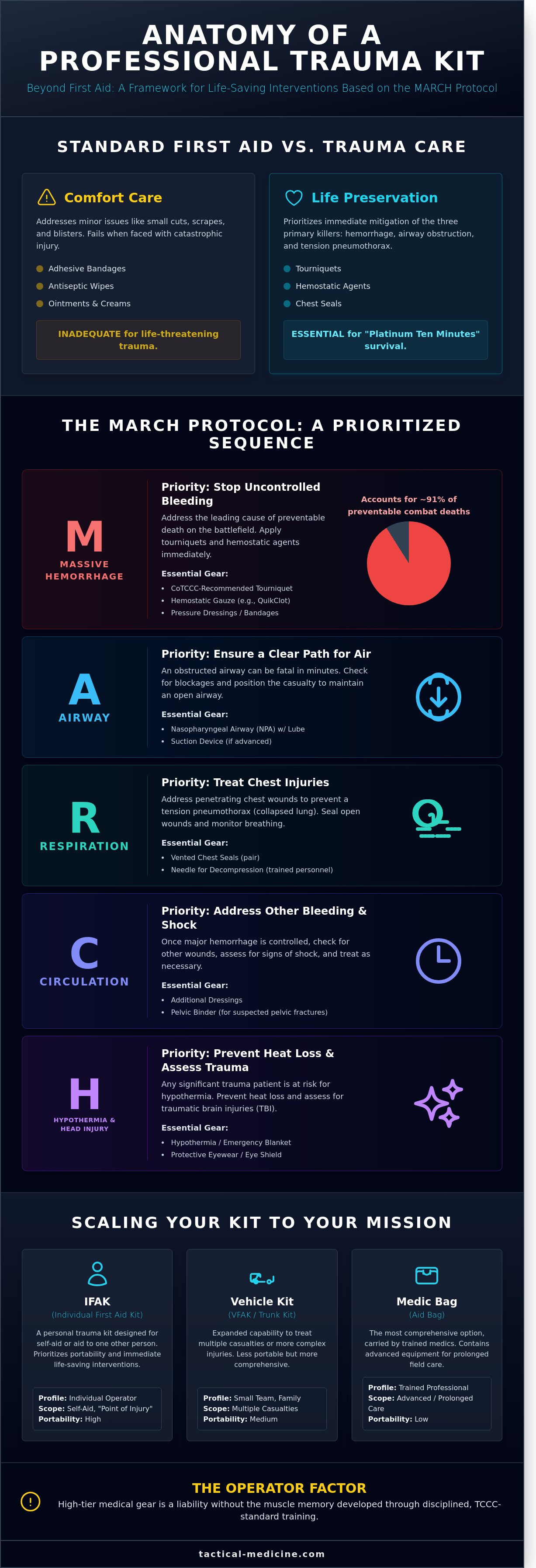
A trauma kit isn't a plastic box filled with adhesive bandages and antiseptic wipes. While standard first aid kits address minor "comfort care" needs like blisters or small cuts, they fail when faced with catastrophic injury. In high-threat environments or severe civilian accidents, the mission shifts from convenience to life preservation. Professional medical response in 2026 prioritizes the immediate mitigation of the three primary killers: massive hemorrhage, tension pneumothorax, and airway obstruction. According to CoTCCC data, uncontrolled bleeding remains the leading cause of preventable death on the battlefield, accounting for approximately 90% of such fatalities.
The MED-TAC perspective demands equipment that functions under extreme physiological stress. You don't need an ointment for a femoral artery breach; you need a windlass tourniquet. 2026 standards have moved away from brittle plastic containers that crack under pressure. Mission-ready kits now utilize ruggedized, weather-resistant nylon or hard-shell cases designed to withstand abrasion and environmental exposure. A trauma kit is a specialized toolset engineered for one purpose: keeping a casualty alive until higher-level care arrives. It represents the difference between a controlled medical intervention and a preventable tragedy.
The Critical Gap in Traditional First Aid
Standard kits lack the specialized components required for "care under fire" or complex industrial accidents. Survival often hinges on the "Platinum Ten Minutes," the narrow window where medical intervention determines the outcome before EMS arrives. If your gear doesn't include hemostatic agents or chest seals, you're unprepared for critical trauma. For those building a baseline of readiness, our Essential First Aid Items guide provides the necessary foundation for basic medical support before upgrading to trauma-grade gear.
Trauma Kit vs. IFAK: Understanding the Terminology
Terminology often confuses new operators. An Individual First Aid Kit (IFAK) is a personal trauma kit designed to treat the person carrying it. It follows MARCH protocols and prioritizes self-aid. Conversely, a Bleeding Control Kit is a specialized subset often found in public spaces, focusing strictly on hemorrhage. When we use the term "tactical," we're referring to gear that meets military-grade durability standards and protocol alignment. This ensures every component serves a specific, evidence-based function in a life-saving sequence, regardless of the environment's aesthetics.
The Anatomy of a Professional Trauma Kit: The MARCH Protocol
Effective point-of-injury care relies on the MARCH protocol. This evidence-based algorithm dictates the priority of treatment to address the most immediate life threats first. A professional trauma kit organizes medical hardware to mirror this sequence. It ensures that critical interventions happen in seconds rather than minutes. Every component in a high-tier MED-TAC kit serves a specific step in this tactical medical framework. This methodology moves beyond basic first aid, focusing instead on the physiological priorities of a casualty in a high-threat environment.
Speed of deployment is non-negotiable. Critical items like tourniquets must allow for one-handed operation. This is essential for self-aid when an upper extremity is compromised by injury. Redundancy is equally vital. High-volume arterial bleeding often requires multiple interventions to achieve complete occlusion. Relying on a single device is a tactical error. Professional kits are built with the understanding that equipment can fail or be lost under stress. Therefore, carrying secondary hemostatic agents and additional pressure dressings is a clinical necessity for any operator.
Massive Hemorrhage and Airway Management
Massive Hemorrhage is the leading cause of preventable death on the battlefield, accounting for approximately 91% of such fatalities according to TCCC data. Your kit must include CoTCCC-recommended tourniquets like the CAT Gen 7 or SOFTT-W. For junctional wounds where tourniquets can't be applied, hemostatic agents like QuikClot Combat Gauze are necessary. A hemostatic dressing is a chemically treated gauze designed to accelerate the body’s natural clotting process. These tools are central to the Stop the Bleed campaign, which emphasizes that uncontrolled bleeding can kill in under 180 seconds.
Airway management follows bleeding control. An unconscious casualty's tongue can easily obstruct their breathing. Utilizing Nasopharyngeal Airways (NPA) provides a reliable path for air. These soft, flexible tubes are better tolerated than oropharyngeal alternatives and don't trigger a gag reflex in semi-conscious patients. They're a fundamental component for maintaining a patent airway during transport.
Respiration, Circulation, and Hypothermia
Penetrating chest trauma requires immediate Respiration interventions. Vented chest seals are the clinical standard for treating open pneumothorax. The vents allow air to escape the pleural space while preventing outside air from entering; this mitigates the risk of a tension pneumothorax. For Circulation, operators must use pressure dressings to maintain perfusion and conduct a thorough sweep for hidden bleeds in high-threat areas. Missing a secondary wound during the initial assessment can be fatal.
The final step, Hypothermia, is often overlooked. Trauma-induced coagulopathy occurs when a patient's temperature drops, preventing blood from clotting correctly. Every trauma kit must include a high-performance space blanket to preserve body heat. Failure to manage temperature often leads to the Lethal Triad of acidosis, coagulopathy, and hypothermia. To ensure your gear meets these rigorous standards, you should audit your current medical loadout against 2026 CoTCCC guidelines to ensure total mission readiness.
Comparing Trauma Kit Configurations: IFAK vs. Vehicle vs. Medic Bag
Selecting a trauma kit requires balancing immediate accessibility with medical capability. The industry standard follows a tiered response model. Tier 1 is the Individual First Aid Kit (IFAK). Tier 2 is the vehicle or team kit. Tier 3 is the full medic bag. Each tier serves a specific mission profile and requires different hardware specifications. Effective trauma response relies on the ability of bystanders to become trained, equipped, and empowered to act before professional EMS arrives. Refer to our Bleeding Control Kit Buying Guide for specific component certifications and technical specs.
Container choice dictates durability and deployment speed. A 500D Cordura exterior provides the necessary abrasion resistance for field use without the weight penalty of heavier 1000D fabrics. For maritime or vehicle mounted roles, hardshell cases with IP67 ratings are superior. These cases prevent the crushing of sterile packaging and protect against environmental degradation. Soft kits prioritize the operator's mobility; hardshell kits prioritize the integrity of the medical supply chain.
The IFAK: Your Personal Life-Line
The IFAK is designed for self-aid or buddy-aid. Belt-mounted platforms offer rapid access and a lower profile for vehicle operations. Vest-mounted MOLLE kits provide more real estate but can be difficult to reach if the operator is pinned or injured in a confined space. A tear-away feature is non-negotiable. This allows the user to rip the kit from its mounting point to work in their workspace or hand it to another responder. A minimalist 2026 standard IFAK must include a CoTCCC-recommended tourniquet, compressed gauze, a vented chest seal, and nitrile gloves. These items address the immediate causes of preventable death on the battlefield.
Vehicle and Large-Scale Response Kits
A car emergency kit requires more volume to manage multi-casualty events. Tactical medicine in a vehicle context often involves extraction and stabilization of multiple patients. Use organized, color-coded inserts rather than loose supplies. High-stress retrieval is prone to error; clear organization mitigates cognitive load. These kits should include specialized tools that IFAKs omit due to size constraints. This includes 7.5-inch titanium-bonded trauma shears and dedicated seatbelt cutters. A vehicle trauma kit serves as a mobile casualty collection point, bridging the gap between the point of injury and the arrival of an ambulance.
- IFAK: Weight under 1.5 lbs, focuses on massive hemorrhage and airway.
- Vehicle Kit: Weight 5-10 lbs, includes splinting and burn care.
- Medic Bag: Weight 15+ lbs, supports prolonged field care and advanced interventions.
Mission-Specific Selection: Matching Gear to Environment
Effective medical intervention depends on the synergy between training and equipment. Your trauma kit must reflect your daily threat profile. A law enforcement officer on a 12-hour shift has different spatial constraints than a civilian carrying a concealed firearm. Over-packing is a common failure point. Carrying advanced tools like surgical airways or decompression needles without certified training is a liability. It also adds unnecessary bulk that slows movement. Stick to the MARCH protocol. If you haven't mastered the skill in a high-stress environment, the equipment is just dead weight.
Environmental conditions dictate the physical housing of your medical supplies. Consider these factors:
- Maritime Environments: Use IP67-rated waterproof containers. Saltwater destroys the integrity of hemostatic agents and corrodes trauma shears within 48 hours of exposure.
- Arid Climates: Fine particulate dust can compromise the hook-and-loop fasteners on tourniquets. Use sealed, dust-proof pouches to ensure 100% functionality.
- Urban Commuting: Prioritize slim form factors. A kit that is too bulky stays in the car. It won't help you on the third floor of an office building.
Custom medical kits for specialized teams must follow standardized loadouts. When every team member carries the same trauma kit in the same location, muscle memory replaces conscious thought during a mass casualty event. This consistency reduces intervention time by an average of 15 percent in high-stress drills.
Law Enforcement and First Responder Requirements
Space on a duty belt is at a premium. Modern 2026 standards favor low-profile pouches that utilize less than 4 inches of horizontal space. Many agencies now mandate "hanger" pouches that attach to the base of ballistic plate carriers. This placement allows for ambidextrous access during a self-aid scenario. Ensure your kit has high-visibility medical identifiers. In a multi-agency response, a standardized "MED" patch ensures a partner can locate your life-saving gear in seconds.
Civilian EDC and Home Preparedness
The best kit is the one on your person. Ankle kits allow for a full TCCC-compliant loadout under standard trousers. Pocket paks are viable for lighter hemorrhage control needs. At home, stage kits based on room-specific risks. The kitchen needs burn dressings. The workshop requires supplies for amputations and major arterial bleeds. Since 2017, the Stop the Bleed program has trained over 3.8 million civilians. This surge in training has made standardized kits a requirement for modern office safety protocols.
Ensure your team is equipped for the mission. View our professional-grade trauma kit options here.
The Operator Factor: Why Gear Without Training is a Liability
A trauma kit is inert hardware. It possesses no inherent ability to stop a life-threatening hemorrhage or manage a compromised airway without a deliberate hand to guide it. At MED-TAC, we operate under a singular philosophy: the kit is a tool, but the operator is the solution. High-end medical components only deliver clinical outcomes when the person holding them can execute protocols under extreme duress. If the user fails, the equipment is irrelevant.
Training through TCCC or TECC programs develops the muscle memory essential for survival. When a catastrophic injury occurs, the sympathetic nervous system triggers a massive adrenaline dump. This physiological spike can degrade fine motor skills in as little as 10 to 15 seconds. Without rigorous practice, the simple act of threading a tourniquet buckle becomes an insurmountable task. Training converts conscious effort into subconscious reflex, allowing you to stay focused on the tactical environment while performing life-saving interventions.
Possessing unboxed, unpracticed gear creates a false sense of security that can be fatal. A trauma kit sitting in a vacuum-sealed bag at the bottom of a rucksack is a liability if you haven't mastered its deployment. You must be able to reach, prep, and apply every component in total darkness and with limited mobility. Gear isn't a talisman; it's a clinical resource that requires a baseline of professional competence to be effective.
The TCCC Standard of Care
The Committee on Tactical Combat Casualty Care (CoTCCC) sets the benchmarks that dictate the contents of every professional trauma kit. Adhering to these evidence-based guidelines ensures you aren't carrying redundant or ineffective gimmicks. We emphasize the necessity of "training as you fight" by using dedicated dummy tourniquets for repetitions. This preserves the integrity of your primary gear while building the speed required for the field. TCCC training reduces preventable combat deaths by focusing on the three phases of care: Care Under Fire, Tactical Field Care, and Tactical Evacuation Care.
Maintenance and Readiness Checks
Professional operators perform a "pre-flight" check on their medical gear every 90 days. This inspection includes verifying the seal integrity of chest seals and hemostatic dressings. Check every expiration date; adhesives and chemical agents lose efficacy over time. Pay close attention to tourniquets staged on the exterior of vests or belts. Research from 2013 confirms that UV degradation significantly weakens nylon fibers and plastic windlasses, which can lead to catastrophic mechanical failure during tightening. Replace any equipment that shows signs of fraying or sun-bleaching immediately.
Survival is a matter of preparation and discipline. Don't wait for a crisis to realize your limitations. Equip yourself with battle-proven trauma kits and TCCC training at MED-TAC.
Master Your Medical Readiness for 2026
A professional trauma kit isn't a simple collection of bandages; it's a life-saving system engineered around the MARCH protocol. Selecting your gear requires strict adherence to CoTCCC guidelines, which focus on the 3 primary causes of preventable death in tactical environments. Whether you're outfitting a single operator with an IFAK or a team with a vehicle-mounted bag, the hardware must be field-proven and rugged. We've established that the most advanced medical supplies fail in the hands of an untrained operator. True capability exists where medical science meets tactical discipline. Tactical Medicine provides 100% CoTCCC-compliant hardware and accredited TCCC/TECC training to bridge this critical gap. As a veteran-founded and operated organization, we ensure every component meets the rigorous 2026 standards for survival. It's time to move beyond standard first aid and adopt a professional medical posture. Don't leave your readiness to chance. Equip yourself with battle-proven tools and the specific skills required to use them under stress. You're now prepared to make an informed selection that saves lives.
View Our Professional-Grade Trauma Kits and IFAKs
Frequently Asked Questions
Do trauma kits expire, and how often should I replace components?
Yes, sterile components within a kit typically expire 5 years after the date of manufacture. Items like chest seals, hemostatic gauze, and medical adhesives lose their effectiveness as the chemical agents or adhesives degrade over time. You should perform a physical inspection of your kit every 6 months. Replace any item that shows a compromised seal or has passed its printed expiration date to ensure 100% reliability during an intervention.
Is it legal for a civilian to carry and use a professional trauma kit?
It's legal for civilians to own and carry a trauma kit in all 50 U.S. states. Good Samaritan laws generally protect lay responders who provide emergency care in good faith. However, your actions should align with your specific level of training. Completing a TCCC or Stop the Bleed course provides the foundational skills needed to use these tools effectively while minimizing personal legal liability in an emergency.
What is the difference between a CAT tourniquet and a SOF-T, and which is better?
The CAT uses a velcro strap and a plastic windlass, while the SOF-T features a high-strength metal windlass and a rugged buckle system. Both devices are currently recommended by the CoTCCC for limb occlusion. The CAT is widely preferred for one-handed self-application due to its lightweight design. The SOF-T is often selected for its durability in extreme temperatures and its ability to fit around larger limbs or over thick winter clothing.
Can I build my own trauma kit, or is it better to buy a pre-assembled one?
Building your own kit allows for complete customization, but pre-assembled kits from reputable manufacturers ensure all components meet professional standards. A custom build requires you to source each item from authorized distributors to avoid the 20% failure rate associated with counterfeit goods. Pre-assembled options like those from North American Rescue are mission-ready and follow the MARCH algorithm right out of the box, saving time and ensuring compatibility.
What should I look for to avoid buying counterfeit medical supplies?
Purchase only from authorized distributors to ensure your gear survives the 300 Newtons of force required for arterial occlusion. Genuine CAT tourniquets feature a single-routing buckle and heat-stamped lot numbers on the windlass base. Counterfeits often lack these identifiers and use inferior plastics that snap under pressure. Check for a verified CAGE code or a holographic manufacturer seal to confirm the equipment is battle-proven and authentic.
Do I need a chest seal if I already have an Israeli bandage?
Yes, you must carry a chest seal because an Israeli bandage cannot treat a tension pneumothorax. A chest seal creates an airtight, occlusive barrier for penetrating wounds between the navel and the neck. This prevents air from entering the pleural space and collapsing the lung. While the Israeli bandage is a superior tool for hemorrhage control, it doesn't provide the specific seal required for thoracic injuries according to TCCC protocols.
How do I identify a "TCCC-approved" tourniquet?
Verify the device against the official Committee on Tactical Combat Casualty Care recommended list, which currently includes 7 specific limb tourniquets. Approved models like the CAT Gen 7 or the SAM XT have passed rigorous testing by the Department of Defense. If a device isn't explicitly listed in the 2024 guidelines, it isn't TCCC-approved regardless of marketing claims. Always prioritize gear that carries this specific clinical endorsement for life-saving interventions.
Is a trauma kit the same as a "Stop the Bleed" kit?
A trauma kit is a more comprehensive system that includes tools for airway management and chest injuries, whereas a Stop the Bleed kit focuses primarily on hemorrhage. Most Stop the Bleed kits contain only a tourniquet, gauze, and gloves. A professional trauma kit or IFAK follows the full MARCH protocol; it addresses massive hemorrhage, airway obstructions, respirations, circulation, and hypothermia prevention to manage the most common causes of preventable death.
Leave a comment