


Bleeding Control Kit Buying Guide: Professional Standards for 2026
A "tactical" label on your medical pouch is worthless if the windlass snaps during a massive femoral bleed. You understand that in a high-stress environment, your gear is a literal extension of your training, not a fashion statement. Yet, the market is currently flooded with counterfeit tourniquets that fail under the 150mmHg of pressure required for arterial occlusion, posing a lethal risk to the operator. Finding a legitimate **bleeding control kit** requires looking past rugged aesthetics and focusing on clinical data.
This veteran-vetted guide provides the professional standards for 2026, ensuring you master the selection of life-saving hardware that meets strict CoTCCC requirements. You'll gain the confidence that your equipment will function under extreme physiological stress. We'll break down the essential components of the MARCH algorithm, identify the specific dressings required for junctional wounds, and explain the "why" behind every field-proven intervention in your kit.
Key Takeaways
- Distinguish between retail first aid kits and professional trauma systems designed for high-volume hemorrhage control.
- Identify the critical windlass tourniquets and hemostatic agents that meet CoTCCC standards for field-proven reliability.
- Eliminate the risk of equipment failure by learning to spot counterfeit gear that compromises life-saving interventions.
- Configure your bleeding control kit for specific mission requirements, ranging from minimalist EDC profiles to comprehensive vehicle response systems.
- Transition from hardware ownership to mission readiness by integrating vetted equipment with established TCCC and TECC protocols.
What is a Bleeding Control Kit and Why Standard First Aid Fails
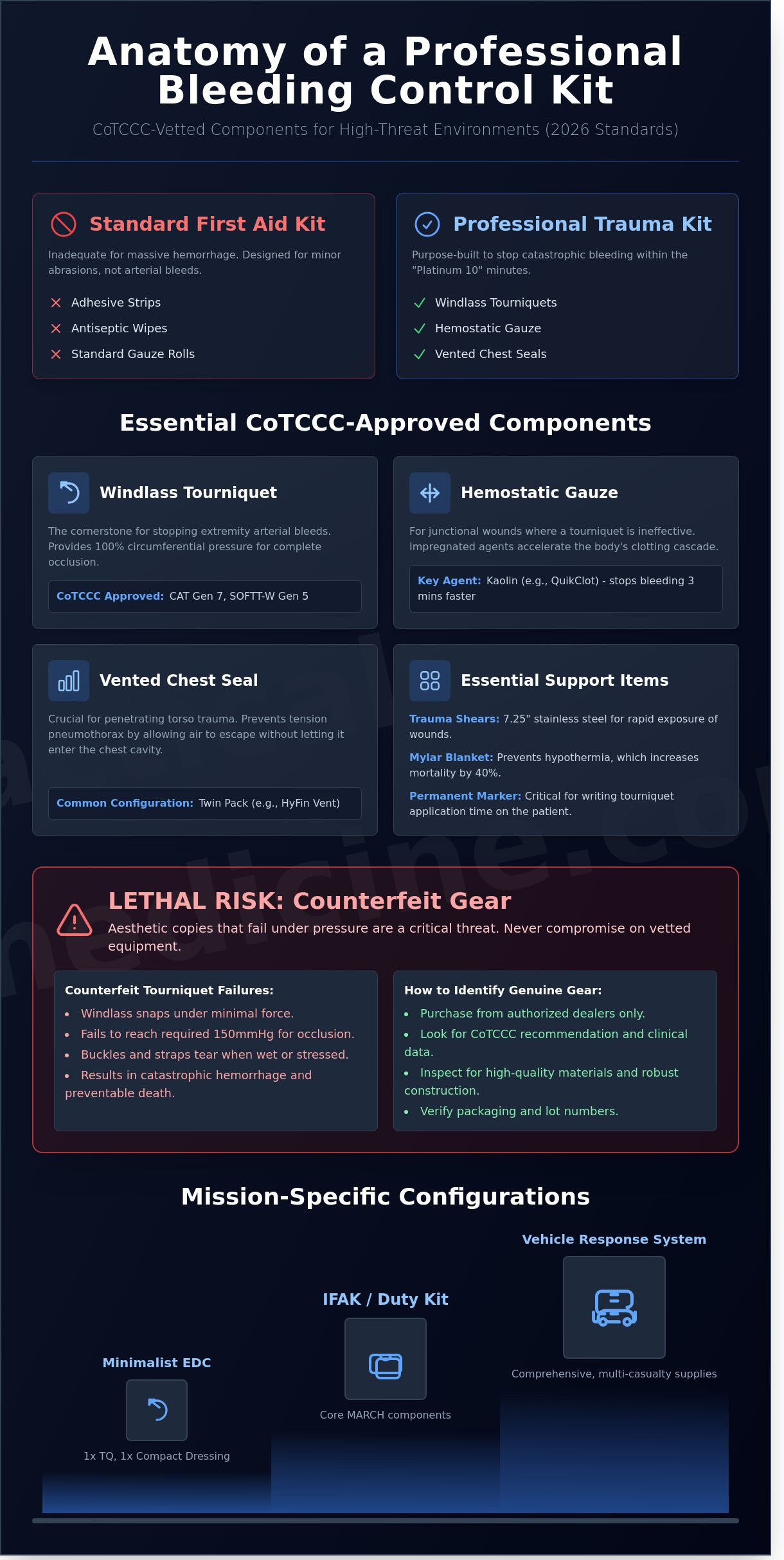
A bleeding control kit isn't a collection of adhesive strips and antiseptic wipes. It's a purpose-built trauma system designed to address massive hemorrhage in high-threat environments. Most retail first aid kits fail because they lack the hardware required to counteract arterial pressure. While a standard kit manages minor abrasions, a professional bleeding control kit focuses on catastrophic injuries where seconds dictate the outcome. Professionals operate within the "Platinum Ten" minutes. This is the critical window where immediate medical intervention determines survival or fatality. The mission is singular: stop preventable death from extremity and junctional bleeding before the patient reaches definitive care.
The Reality of Traumatic Hemorrhage
Exsanguination remains the leading cause of preventable death on the battlefield. When a major artery is severed, the physiological clock starts instantly. An adult can lose their entire blood volume in less than five minutes; however, unconsciousness can occur in as little as 120 seconds. Speed is the primary metric for success. Specialized tools like CoTCCC-recommended windlass tourniquets are non-negotiable for arterial bleeds. Manual pressure is often insufficient and difficult to maintain during patient transport or tactical movement. You need mechanical advantage to occlude blood flow effectively.
Beyond the Basic First Aid Kit
Standard gauze and bandages are insufficient for traumatic wounds. They lack the density and chemical properties needed to induce clotting in high-flow scenarios. Modern hemorrhage control relies on targeted pressure and hemostatic agents. These chemical agents, such as kaolin or chitosan, accelerate the body's natural coagulation process even when the patient is in shock. This shift in protocol follows the "Stop the Bleed" national preparedness standard. Established by the American College of Surgeons, this standard moved trauma care out of the hospital and into the hands of the first person on the scene. A professional bleeding control kit ensures you have the rugged, field-proven components necessary to meet these standards under extreme stress.
- Tourniquets: Essential for limb-based arterial occlusion.
- Hemostatic Gauze: Necessary for packing junctional wounds where tourniquets can't be applied.
- Pressure Dressings: Used to maintain constant compression on a wound site.
- Chest Seals: Critical for treating penetrating thoracic trauma.
Don't mistake a domestic first aid box for a trauma solution. The equipment in a professional kit is designed to be used under high cognitive load, ensuring that every movement contributes to life-saving outcomes.
Anatomy of a Professional Bleeding Control Kit: Essential Components
A professional bleeding control kit isn't a random assortment of bandages. It's a curated system of medical hardware designed to address the MARCH algorithm under extreme stress. Every component must meet the 2024 CoTCCC (Committee on Tactical Combat Casualty Care) standards to ensure it performs when seconds dictate survival. Relying on unvetted gear in a massive hemorrhage scenario is a failure of preparation.
Primary Intervention Tools
The windlass tourniquet is the foundation of any serious kit. The CAT Gen 7 and the SOFTT-W Gen 5 provide the mechanical advantage required to occlude arterial blood flow in large muscle groups. Unlike elastic or ratchet style devices, these windlass systems offer 100% circumferential pressure that won't slip when saturated with blood. For junctional wounds where a tourniquet can't be applied, hemostatic agents like QuikClot Combat Gauze are vital. These dressings are impregnated with kaolin, which activates Factor XII of the clotting cascade to stop bleeding 3 minutes faster than standard gauze. You'll also need 7.25 inch stainless steel trauma shears to strip away heavy clothing and body armor. Rapid exposure is the first step in identifying the source of the bleed.
Secondary and Support Items
Once massive hemorrhage is controlled, you must address respiratory and circulatory threats. Vented chest seals, such as the HyFin Vent Twin Pack, are essential for treating penetrating torso trauma. These prevent tension pneumothorax by allowing trapped air to escape the chest cavity while blocking outside air from entering. To support the circulatory system, every bleeding control kit should include a Mylar emergency blanket. Trauma patients lose heat rapidly; maintaining normothermia is critical to preventing the lethal triad of acidosis, coagulopathy, and hypothermia, which increases mortality by 40% in severe cases. Finally, use a permanent marker to record the exact time of tourniquet application. This data is vital for surgeons during the transition of care. For those building a custom setup, choosing field-proven medical components ensures your gear won't fail during a critical intervention.
- Wound Packing: Z-fold gauze is preferred over rolled compressed gauze because it doesn't roll away in the dirt during high-speed packing.
- PPE: Heavy-duty nitrile gloves with a 5-mil thickness or greater protect the provider from bloodborne pathogens.
- Pressure Dressings: The Israeli Bandage or H-Bandage provides 30 to 35 pounds of pressure directly on the wound site using a built-in pressure bar.
Professional vs. Consumer Grade: Identifying Life-Saving Gear
High-stakes environments demand hardware that exceeds minimum safety thresholds. A professional bleeding control kit isn't a collection of consumer-grade bandages; it's a life-sustaining system engineered for 100% reliability. Equipment failure during a massive hemorrhage is often fatal. Professionals prioritize material science over cost savings because gear must function under extreme physiological and environmental stress.
Material integrity defines the gap between professional and hobbyist gear. Professional kits utilize 1000D Cordura nylon for their pouches. This fabric resists abrasion from concrete and maintains structural integrity even when saturated with blood or water. Medical-grade polymers used in professional windlasses are designed to sustain 350 Newtons of force without deformation. In contrast, budget alternatives often use 600D polyester and recycled plastics that fail at 180 Newtons. You must also manage inventory with precision. Hemostatic agents like QuikClot Combat Gauze carry a 5-year shelf life. Beyond this date, the kaolin impregnation can degrade, reducing clotting efficiency by up to 40%. Check your sterile seals monthly. A compromised seal on a chest seal makes the adhesive useless in high-humidity environments.
Spotting the Counterfeits
Fake tourniquets kill. Genuine North American Rescue (NAR) CAT Gen 7s feature a sonic-welded windlass, a gray "TIME" stamp, and a distinct lot number on the baseplate. Counterfeits from unverified third-party vendors often use brittle plastic that snaps during the second turn. This leads to catastrophic blood loss. Professional distributors like MED-TAC ensure supply chain integrity by sourcing directly from manufacturers. This eliminates the 25% risk of receiving "training only" fakes prevalent in open-market secondary channels. Never use training gear for real-world bleeding control kit interventions.
Standards and Certifications
The Committee on Tactical Combat Casualty Care (CoTCCC) is the ultimate authority for vetting life-saving equipment. Their recommendations are based on clinical data and battlefield outcomes. For federal and state agencies, Berry Amendment compliance under 10 U.S.C. § 2533a is mandatory. This ensures the gear is 100% American-made, providing a higher level of quality control. CoTCCC-recommended hemostatic dressings demonstrate a 90% success rate in achieving hemostasis. Generic, non-impregnated gauze often shows success rates as low as 60% in high-pressure arterial bleeds.
Choosing Your Kit: Mission-Specific Configurations
Operational success depends on matching equipment to the specific threat profile. A single configuration doesn't exist for every scenario. You must scale your bleeding control kit based on your proximity to a trauma center and your expected patient load. Mission dictates equipment. A kit left in a vehicle is useless during a massive hemorrhage event in a crowded terminal. You must scale your medical footprint based on your specific role and expected response time.
- Every Day Carry (EDC): Minimalist kits for ankle rigs or pocket carry.
- Vehicle and Home Kits: Comprehensive trauma bags for high-volume response.
- Public Access Bleeding Control (PABC): Wall-mounted stations for schools and corporate offices.
- Tactical IFAKs: Individual First Aid Kits for law enforcement duty belts and plate carriers.
The EDC and Individual Operator
Space and weight are your primary constraints. You can't carry a full surgical suite on your ankle. Prioritize a CoTCCC-recommended windlass tourniquet and a single pack of hemostatic gauze. Vacuum-sealed "flat" kits are the standard for low-profile carry. These configurations reduce kit volume by 40% compared to traditional nylon pouches. The trade-off is durability; once the seal breaks, the components are exposed to moisture and friction. Select a carrier that facilitates one-handed deployment. In a self-aid scenario, you'll likely be operating with significant cognitive load and limited dexterity. The gear must be reachable by either hand.
High-Capacity and Institutional Kits
Institutional response requires a different architecture. Public Access Bleeding Control (PABC) kits must follow the 2015 Hartford Consensus standards for ease of use. These kits must be intuitive for untrained bystanders. Data from 2023 indicates that color-coded internal pouches improve identification speed by 30% under high-stress conditions. For mass casualty incidents (MCI), configure your bag with "throw kits." These are secondary, self-contained modules that you can toss to other responders or victims; this allows a single medic to distribute life-saving tools across a wide area immediately.
Tactical IFAKs for law enforcement must integrate with existing load-bearing equipment. These kits prioritize the MARCH algorithm, focusing on massive hemorrhage and airway management. Use ruggedized 500D Cordura pouches that withstand the abrasion of daily patrol. Ensure the tourniquet is staged for immediate access, not buried under gauze or gloves. Stop the bleed effectively by choosing field-proven medical gear designed for rapid intervention.
The MED-TAC Advantage: Vetted Gear and Mission Readiness
Selection isn't about aesthetics or marketing trends. It's about survivability in the most unforgiving environments. Our veteran-owned perspective ensures every bleeding control kit we assemble meets the strict rigors of high-threat operations. We eliminate the guesswork by sourcing gear that has performed under fire. Every component in our inventory undergoes a rigorous vetting process rooted in real-world field experience. We don't just sell equipment; we provide the exact tools we've relied on to save lives in tactical environments. This grounded approach prioritizes functional outcomes over everything else.
Field-Proven Reliability
MED-TAC has a documented history of supplying government agencies and elite tactical units with mission-critical medical gear. Our training courses serve as the ultimate testing ground for every product we carry. We identify gear failures during high-stress simulations so they never occur during a real-world intervention. Our 'Operator-First' philosophy guides every kit build. This means we prioritize rapid access, intuitive deployment, and rugged durability. If a tool requires complex fine motor skills or fails under extreme temperature shifts, it doesn't make the cut. We focus on CoTCCC-recommended hardware that works when your heart rate exceeds 160 beats per minute.
We understand that a standard kit doesn't fit every mission profile. Our team specializes in building custom medical solutions tailored to the specific needs of your unit or agency. Whether you operate in maritime environments, rural wilderness, or dense urban centers, we align your hardware with your operational reality. This commitment to mission readiness ensures your team is never under-equipped for the specific trauma risks they face. We build kits that withstand the transition from the training floor to the battlefield.
Next Steps: Training and Procurement
High-tier hardware is a liability without the proficiency to use it. Gear is useless without the muscle memory developed through intensive TCCC and TECC training. You must be able to perform life-saving interventions instinctively. We provide the comprehensive training required to turn a bleeding control kit into a functional extension of the operator. Our instructors bring decades of combat medic experience to every session, ensuring your team is prepared to win the fight against trauma. Don't wait for a critical incident to realize your preparation is insufficient. To secure your readiness, equip your team with MED-TAC Bleeding Control Kits and contact us to schedule a professional training evolution for your agency today.
Standardize Your Medical Readiness for 2026
The margin between a controlled injury and a fatality is measured in seconds. A professional bleeding control kit is a life-saving system built around CoTCCC-compliant components, not a standard first aid box. As 2026 standards approach, the requirement for field-proven gear like the Combat Application Tourniquet (C-A-T) remains absolute. Don't settle for consumer-grade imitations that fail under the 150 to 200 pounds of pressure required for arterial occlusion. MED-TAC is a Veteran-Owned and Operated company and an authorized distributor for North American Rescue. This ensures every component is vetted for high-threat environments. Your equipment must be a reliable extension of your tactical medical training. By selecting a mission-specific configuration, you ensure that the MARCH algorithm is executed without delay. Take the lead on your own preparedness. You've got the knowledge to identify professional gear; now ensure you have the tools to back it up.
Shop Mission-Ready Bleeding Control Kits
You're ready to protect what matters most.
Frequently Asked Questions
What is the difference between a Stop the Bleed kit and an IFAK?
A Stop the Bleed kit focuses exclusively on massive hemorrhage, while an Individual First Aid Kit (IFAK) covers the full MARCH algorithm. The MARCH protocol includes Massive hemorrhage, Airway, Respirations, Circulation, and Hypothermia. IFAKs are designed for individual operators to treat themselves or teammates, whereas Stop the Bleed kits are often staged in public areas for immediate bystander intervention.
Can I use a belt or a piece of cloth as a makeshift tourniquet?
No, you shouldn't rely on makeshift tourniquets because they fail in 75% of applications according to 2012 data from the Journal of Trauma and Acute Care Surgery. Belts and clothes lack the mechanical advantage required to occlude arterial blood flow in a limb. These improvised items often act as a venous tourniquet, which actually increases blood loss by preventing return flow without stopping the arterial supply.
Do bleeding control kits and their components expire?
Yes, critical components like hemostatic gauze typically have a 5 year shelf life from the date of manufacture. While a tourniquet doesn't have a hard expiration date, its materials degrade when exposed to UV light or extreme temperatures. You should inspect your gear every 6 months and replace any tourniquets stored in vehicles every 24 months to ensure they don't snap under tension during a crisis.
Is it legal for a civilian to carry and use a bleeding control kit?
Yes, it's legal for civilians to carry and use a bleeding control kit in all 50 U.S. states under Good Samaritan laws. These laws protect individuals who provide reasonable assistance to those who are injured or in peril. The Federal Stop the Bleed Research Act of 2023 further supports the deployment of these kits in public spaces to reduce preventable deaths from trauma.
Why are QuikClot and other hemostatic agents better than regular gauze?
Hemostatic agents are superior because they utilize active minerals like kaolin to trigger the body’s natural clotting cascade in under 3 minutes. Regular gauze relies entirely on mechanical pressure, which often fails in deep junctional wounds. Using a hemostatic agent increases the probability of survival by creating a stable clot faster than manual compression alone can achieve in high-flow arterial bleeds.
How many tourniquets should I have in a standard bleeding control kit?
You should carry at least 2 CoTCCC recommended tourniquets in every bleeding control kit. Data from the American College of Surgeons shows that 20% of patients with severe extremity trauma require a second tourniquet to fully stop the bleeding. Having a second device ensures you can treat a multi-limb injury or reinforce an initial application that hasn't achieved full occlusion.
What does CoTCCC recommended mean for medical equipment?
CoTCCC recommended means the Committee on Tactical Combat Casualty Care has validated the device through rigorous clinical testing and battlefield data. This body, part of the Joint Trauma System, updates its guidelines annually to ensure only the most effective gear is used by professionals. As of the 2024 updates, only specific windlass and mechanical tourniquets like the CAT Gen 7 meet these stringent life-saving requirements.
Should I choose a hard case or a soft pouch for my trauma kit?
Choose a hard case for static locations where the kit must withstand 100% of moisture, dust, or impact, such as a construction site or marine vessel. Select a soft pouch for individual carry or vehicle use where weight and rapid access are the priorities. Soft pouches often feature tear-away panels that allow you to bring the entire kit to the casualty in under 5 seconds during an emergency.
Leave a comment