


The Ultimate Car Emergency Kit Guide: Professional Preparedness for 2026
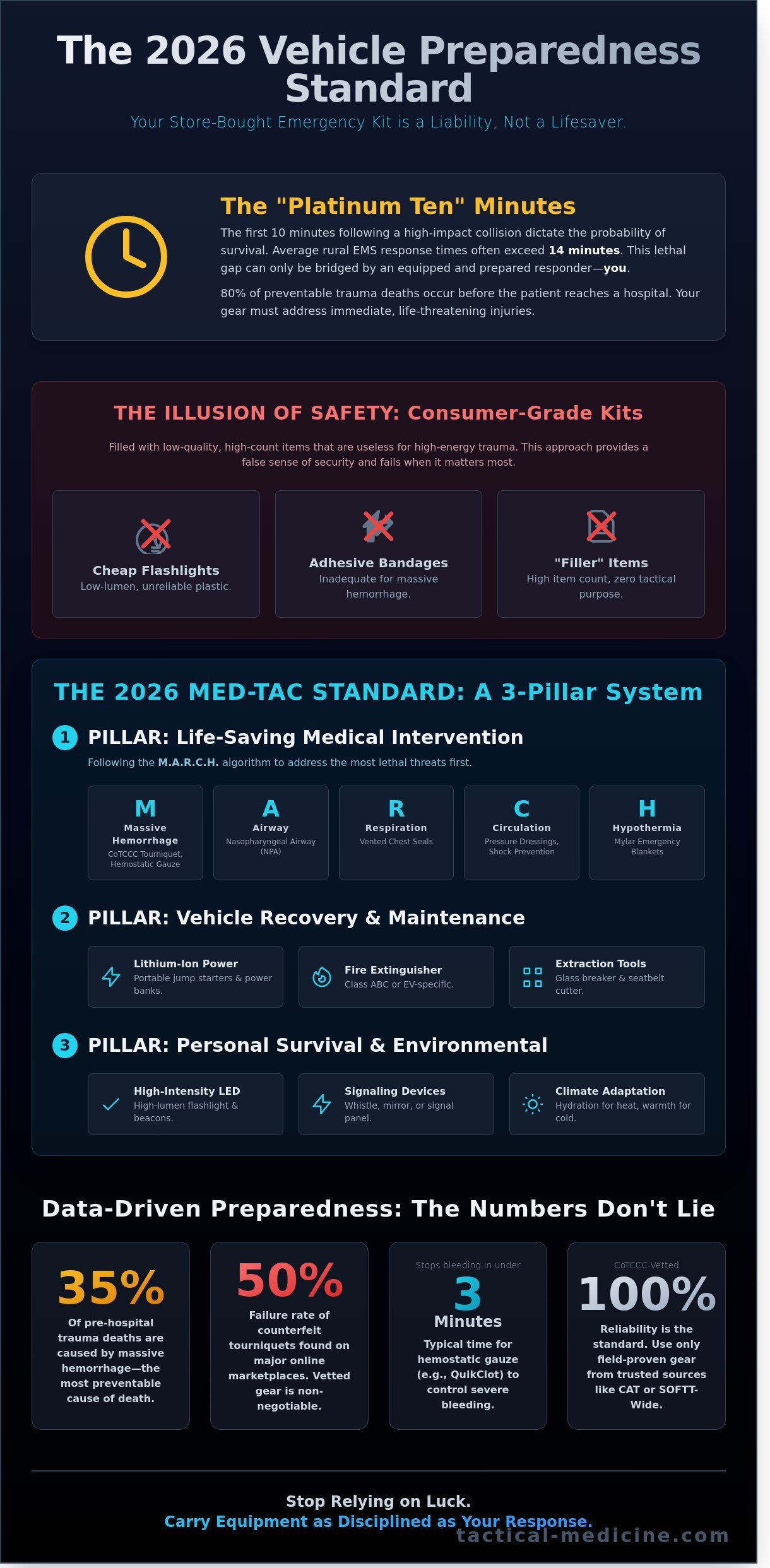
The store-bought "all-in-one" car emergency kit you keep in your trunk is a liability, not a lifesaver. Most consumer-grade kits prioritize cheap plastic flashlights and adhesive bandages over the rugged tools required to manage massive hemorrhage or airway obstructions. You likely recognize that professional readiness requires more than a roadside assistance card and a reflective vest. When a high-speed collision occurs on a remote highway, the Platinum Ten minutes define the boundary between survival and a preventable fatality.
This guide moves beyond basic recovery to provide a battle-proven framework for modern vehicle preparedness. You'll learn how to assemble a car emergency kit that integrates CoTCCC-standard trauma interventions with essential mechanical recovery hardware. We'll audit vetted gear from the 2026 market, distinguish between simple roadside repair and critical life-saving care, and establish the protocols needed to act with clinical authority under extreme stress. It's time to stop relying on luck and start carrying equipment that's as disciplined as your response.
Key Takeaways
- Master the "Platinum Ten" concept to maximize survival during the critical minutes following a high-impact collision.
- Implement the MARCH algorithm to transform your car emergency kit into a dual-purpose system capable of managing catastrophic hemorrhage.
- Upgrade legacy recovery tools to 2026 standards, including high-intensity LED beacons and lithium-ion power solutions for rapid intervention.
- Adapt your preparedness profile for climate-specific threats, addressing hypothermia mitigation in winter and hydration protocols for extreme heat.
- Transition to the MED-TAC standard by utilizing field-proven gear vetted by veteran trauma specialists for professional-grade reliability.
The 2026 Standard for Car Emergency Kits: Why Basic Isn’t Enough
The modern car emergency kit is no longer a collection of roadside flares and a spare tire. It's a sophisticated, dual-purpose system designed for both vehicle recovery and high-energy medical trauma. As of 2026, the baseline for preparedness has shifted. Reliance on professional first responders is a gamble that many lose. Average EMS response times in rural areas often exceed 14 minutes according to 2024 NHTSA data. This creates a lethal gap that only an equipped operator can bridge.
You have ten minutes. This is the "Platinum Ten," a clinical reality where the first ten minutes post-impact dictate the patient's probability of survival. If you can't control massive hemorrhage or manage an airway within this window, the outcome is often fatal. Statistics show that 80% of preventable trauma deaths occur before the patient reaches a surgical suite. You must transition from a passive passenger to a proactive responder. Your gear must reflect that responsibility.
Most retail kits provide a false sense of security. They're packed with "filler" items that waste space. You'll find 50 adhesive bandages but zero CoTCCC-recommended tourniquets. A comprehensive survival kit should prioritize functional outcomes over high item counts. Cheap plastic ponchos and generic flashlights won't save a life during a high-speed collision. You need battle-proven hardware that functions under extreme stress.
The Evolution of Roadside Preparedness
Vehicle technology dictates your gear requirements. Electric Vehicles (EVs) present high-voltage risks and specific thermal runaway profiles that differ from Internal Combustion Engines (ICE). A 2026 standard kit accounts for these variables. Roadside assistance is a luxury that may not arrive during mass casualty events or severe weather. Self-reliance is the only viable strategy. High-energy trauma from modern highway speeds requires medical gear that meets tactical standards, not just basic first aid.
The Three Pillars of a Complete Kit
A professional-grade car emergency kit is built on three distinct pillars. Each pillar addresses a specific phase of an emergency, moving from life-saving interventions to long-term environmental survival.
- Pillar 1: Life-Saving Medical Intervention. This follows the MARCH protocol. You need tools for Massive hemorrhage, Airway, Respiration, Circulation, and Hypothermia. This includes windlass tourniquets, hemostatic gauze, and chest seals.
- Pillar 2: Vehicle Recovery and Maintenance. Focus on hardware that facilitates movement or extraction. This includes rated tow straps, a dedicated fire extinguisher (Class ABC or specialized for lithium-ion), and heavy-duty glass breakers.
- Pillar 3: Personal Survival and Environmental Protection. This covers the period after the immediate threat is neutralized. It includes high-lumen lighting, emergency blankets to prevent shock-induced hypothermia, and reliable signaling devices.
Don't settle for "good enough." In a crisis, the quality of your equipment is the only thing that compensates for the chaos of the environment. Every item in your vehicle must have a proven clinical or tactical purpose. Discipline in your gear selection translates to competence in the field.
This disciplined approach to safety and equipment management is not unique to roadside readiness; it's a core principle in high-stakes industries like aviation. For a deeper understanding of how technical services and management support uphold these standards in a different critical environment, you can visit Air Tech Consulting.
The Critical Medical Tier: Trauma Gear Every Driver Needs
Effective medical intervention in a vehicle accident requires more than a box of adhesive bandages. You must prioritize life-saving actions using the MARCH algorithm: Massive Hemorrhage, Airway, Respiration, Circulation, and Hypothermia. This evidence-based framework ensures you address the most lethal threats first. While a government-recommended car kit provides basic survival items, a dedicated trauma tier is necessary for high-velocity impacts. Your car emergency kit must be built to handle the 35% of pre-hospital trauma deaths caused by exsanguination.
Hemorrhage Control Essentials
Massive hemorrhage is the leading cause of preventable death in trauma. A CoTCCC-vetted tourniquet is the most critical item in your vehicle. Choose the Combat Application Tourniquet (CAT) or the SOFTT-Wide. Avoid marketplace knockoffs; independent testing shows these counterfeits fail at a rate of 50% under tension. You need hardware that won't snap when you're applying the 150 pounds of pressure required to occlude arterial flow.
For junctional wounds where a tourniquet cannot be applied, hemostatic agents are mandatory. QuikClot Combat Gauze uses kaolin to accelerate the body's natural clotting process, often stopping bleeding in under 3 minutes. An individual first aid kit is the foundation of car safety. These tools are useless without the discipline to keep them within reach of the driver's seat. If you're trapped by a collapsed dashboard, your gear must be accessible with one hand.
Managing Penetrating and Blunt Trauma
Vehicle collisions frequently result in blunt force thoracic trauma or penetrating injuries from shattered glass. Vented chest seals are the standard intervention for open chest wounds. They allow air to escape the pleural cavity while preventing it from entering, which stops the development of a tension pneumothorax. This condition can shift the heart and lungs, causing cardiac arrest within minutes if left untreated. A comprehensive car emergency kit must include these specialized tools to manage the physiological chaos of a crash.
Versatility is key when storage space is limited. The Emergency Bandage, commonly known as the Israeli Bandage, functions as a primary dressing, pressure applicator, and secondary wrap. It provides up to 30 pounds of pressure directly on the wound site. You also need a pair of 7.5-inch trauma shears. They're designed to cut through seatbelts and heavy denim, allowing you to expose injuries for immediate treatment. High-stress environments leave no room for fumbling with pocket knives or dull scissors. Investing in professional-grade medical supplies ensures you're prepared for the worst-case scenario on the road.
Once bleeding and breathing are stabilized, you must address circulation and hypothermia. Shock is a silent killer that often follows major trauma. Even in warm climates, a patient in shock loses the ability to regulate body temperature. Keep a compact Mylar rescue blanket or a high-performance HPMK (Hypothermia Prevention and Management Kit) in your gear. Maintaining a core temperature above 95 degrees Fahrenheit is vital for the blood's ability to clot properly. Every second counts when the "Platinum Ten Minutes" are ticking away.
Roadside Survival and Vehicle Recovery Essentials
Scene safety is the primary directive in any tactical or medical emergency. Before you can deploy a tourniquet or manage an airway, you must secure the perimeter of your vehicle. A compromised scene creates new casualties. You must integrate recovery and signaling tools into your car emergency kit to manage the environment while performing life-saving interventions. Relying on legacy technology in 2026 is a failure of preparation. Modern threats require updated hardware that functions under extreme stress.
Visibility and Signaling Tools
Visual command of the roadway is non-negotiable for the prepared operator. Chemical flares are obsolete. They present a fire hazard near fuel leaks and typically burn out in less than 30 minutes. Transition to high-intensity LED beacons that meet SAE J845 Class 1 standards. These electronic flares provide 360-degree visibility for up to 100 continuous hours. They remain cool to the touch and operate safely in the presence of combustible fluids. Use at least three beacons to create a taper that directs traffic away from your work zone.
Hands-free illumination is a critical requirement for mechanical repair or medical treatment. Handheld flashlights occupy a hand that should be holding a wrench or a pressure dressing. Secure a headlamp with a minimum output of 1,000 lumens and a waterproof rating of IP67. This ensures you can identify threats or injuries in driving rain or snow. Statistics from the National Safety Council emphasize that winter driving preparedness requires high-contrast gear to prevent secondary strikes on dark shoulders. Wear an ANSI/ISEA 107-2020 Class 2 reflective safety vest immediately upon exiting the vehicle. It's the most effective tool for ensuring you aren't the next victim on the highway.
Power and Mechanical Support
The transition to lithium-ion technology has revolutionized vehicle recovery. Heavy, lead-acid jump boxes are no longer acceptable for a mobile car emergency kit. A compact 2000A peak current lithium starter can jump-start a 7.0L gas engine or a dead 12V system in an Electric Vehicle (EV) approximately 20 times on a single charge. These units also serve as power banks for communication devices, ensuring your lifeline to emergency services remains active. Choose a model with spark-proof technology and reverse polarity protection to prevent equipment damage during high-stress deployments.
Mechanical failures require rugged, field-proven tools. Carry a heavy-duty multi-tool that includes needle-nose pliers, wire cutters, and a serrated blade. This tool isn't for major overhauls; it's for rapid interventions like clearing debris or stripping wires. For tire failures, include a T-handle plug kit and a portable 12V compressor. Sealant cans often fail in temperatures below 32 degrees Fahrenheit, but a physical plug creates a permanent mechanical bond.
Fire suppression is a mandatory component of vehicle readiness. Every vehicle needs a 2.5-pound dry chemical extinguisher with a UL rating of 1-A:10-B:C. This covers trash, liquid fuel, and electrical fires. Mount the extinguisher using a quick-release bracket within reach of the driver's seat. Seconds matter when a localized engine fire threatens the passenger cabin. Don't store it in the trunk under a pile of gear. If you can't reach it in three seconds, it's useless when the smoke starts. This proactive approach to vehicle recovery ensures that the operator remains an asset rather than a liability during a roadside crisis.
Customizing Your Kit for Climate and Commute
A standard car emergency kit provides a baseline, but the environment dictates your specific mission requirements. You must adapt your gear to the terrain and climate where you operate. Failure to account for environmental stressors can turn a survivable mechanical failure into a multi-casualty event. Your medical interventions will fail if you don't address the external factors threatening the patient's physiology.
In sub-zero environments, trauma patients lose heat rapidly. Hypothermia inhibits blood clotting and leads to coagulopathy, a key component of the trauma triad of death. Your winter kit requires 20 pounds of sand or traction grit and a collapsible aluminum shovel to prevent being stranded. For heat-dominant regions, critical fluid loss is the primary threat. Store 4 liters of water per person in pouches rated for 125-degree Fahrenheit trunk temperatures. Include oral rehydration salts that meet World Health Organization standards to manage electrolyte depletion during prolonged exposure.
Commute patterns also dictate your loadout. Urban response times for Emergency Medical Services (EMS) average 7 to 9 minutes in major U.S. cities. In these zones, your focus remains on immediate life-saving interventions like hemorrhage control. Rural travelers face a different reality. Response times often exceed 40 minutes, and cell service is unavailable in 22% of rural landmasses. If you operate in remote areas, a satellite communicator is a mandatory addition to your vehicle's manifest.
Environmental Protection Strategies
Thermal management is a clinical priority. Mylar blankets reflect 90% of body heat and are ideal for immediate shock management in the golden hour. They don't provide insulation, however. You need wool blankets for long-term survival because wool retains 80% of its insulating properties even when wet. For nutrition, pack 2,400-calorie emergency rations. These bars remain stable in extreme temperature fluctuations from -40 to 150 degrees Fahrenheit, unlike standard grocery store snacks that spoil or melt.
Scenario-Based Customization
Modify your kit based on your passengers and vehicle type. Off-road operators should prioritize rugged recovery tools and full-size shovels over compact versions. For daily urban driving, focus on rapid egress. Ensure your kit contains a dedicated glass breaker and seatbelt cutter within reach of the driver's seat. If you transport children, your medical gear must scale down. Standard CAT tourniquets aren't effective on limbs with a circumference smaller than 7 inches. You must include SWAT-T wraps or pediatric-specific cuffs to ensure you can provide effective occlusion on infants or small children.
Preparation isn't a static process. It's a continuous assessment of the threats you're likely to encounter on the road. Professional operators audit their kits every six months to swap seasonal gear and check expiration dates on hemostatic agents. You should maintain this same level of discipline to ensure your equipment is ready when the mission demands it. Invest in comprehensive trauma kit components to build a foundation that withstands any environment.
The MED-TAC Standard: Professional Preparedness for the Everyday Driver
Tactical Medicine operates on a foundation of veteran-led experience. We don't guess what works; we provide gear that has survived rigorous field deployments. A professional car emergency kit shouldn't be a collection of adhesive bandages and low-grade antiseptic. It must be a life-saving system designed for high-energy trauma. Our approach adapts battle-proven interventions for the civilian environment. We prioritize the MARCH algorithm: Massive hemorrhage, Airway, Respiration, Circulation, and Hypothermia. This standardized medical protocol ensures that every component in your vehicle serves a specific, evidence-based purpose during a crisis.
The transition from a passive driver to an active responder requires gear that performs under extreme stress. We select hardware based on reliability, not price points. When a high-speed collision occurs, the physics of the injury are identical to those found in kinetic combat zones. You need rugged tools that won't fail when lives are on the line. Our veteran background means we've seen these tools in action. We know which windlasses snap and which chest seals peel. We only offer what we would carry ourselves.
The Importance of Training
Owning a bleeding control kit is only half the battle. Equipment is an extension of your skill; it's not a substitute for it. Without muscle memory, the most advanced tourniquet becomes a confusing piece of plastic during a massive hemorrhage event. You have roughly 120 seconds to stop a major arterial bleed before the patient loses consciousness. This is why finding TCCC training courses is mandatory for any serious driver. Training replaces the freeze response with deliberate action. It lowers your heart rate and allows you to execute life-saving interventions with clinical precision. The psychological benefit of competence cannot be overstated. When you know the protocol, panic disappears.
Quality Assurance and Reliability
The market is currently flooded with counterfeit medical gear. A 2021 study by independent researchers found that knock-off tourniquets sold on major marketplaces failed at rates exceeding 50% when subjected to standard limb occlusion pressure. These failures often occur at the windlass or the internal strap, rendering the device useless. Tactical Medicine eliminates this risk by only stocking hardware recommended by the Committee on Tactical Combat Casualty Care (CoTCCC). We source directly from verified manufacturers to ensure your car emergency kit contains authentic, life-saving tools. Reliability is our only metric for success.
Maintenance is the final pillar of readiness. Medical components degrade over time due to the extreme temperature fluctuations inside a vehicle. A 60-second audit performed every six months ensures your gear remains mission-ready. Follow this checklist to maintain your standard of care:
- Check Expiration Dates: Verify that chest seals and hemostatic gauze are within their 5-year shelf life. Expired adhesives often fail to stick to bloody skin.
- Inspect Seals: Ensure all vacuum-sealed packaging remains airtight. If a seal is compromised, the contents are no longer sterile.
- Battery Check: Test headlamps and flashlights. Replace alkaline batteries every 12 months to prevent corrosion and leakage.
- Tourniquet Integrity: Inspect the hook-and-loop material for debris or UV damage that could compromise its grip.
Preparedness is a discipline, not a one-time purchase. By combining CoTCCC-recommended gear with professional training and consistent maintenance, you move beyond the status of a bystander. You become a capable responder ready to manage the critical minutes before EMS arrives.
Mastering the Standard of Roadside Readiness
The standard for vehicle safety has shifted. You can't rely on plastic bandages and flimsy reflective vests when facing high-velocity collisions or severe trauma. A professional car emergency kit must prioritize life-saving interventions over minor comforts. Every driver acts as the first responder in those critical minutes before professional EMS arrival. You need tools that meet the rigorous CoTCCC standards to manage massive hemorrhaging and airway obstructions effectively. Since 2004, MED-TAC has been veteran-founded and operated, providing battle-proven gear to those who operate in high-threat environments. Our equipment is the trusted choice for Law Enforcement and Tactical Medics nationwide because it performs under extreme stress. Don't settle for consumer-grade tools when lives are on the line. Ensure your vehicle is an asset by carrying gear engineered for survival. You've the power to change the outcome of a crisis through deliberate preparation and superior hardware. Stay focused, stay prepared, and ensure you're ready for the road ahead.
Equip your vehicle with a professional-grade trauma kit from MED-TAC
Frequently Asked Questions
What is the most important item in a car emergency kit?
A CoTCCC-recommended windlass tourniquet, such as the North American Rescue CAT Gen 7, is the most critical item. Hemorrhage is the leading cause of preventable death in trauma, accounting for 35 percent of pre-hospital fatalities. This tool stops arterial bleeding in seconds. It's the essential foundation of any car emergency kit intended for life-saving intervention.
Are store-bought car emergency kits worth it?
Most store-bought kits fail to meet professional standards for trauma. They often contain low-quality adhesive bandages and plastic tools instead of field-proven medical gear. A 2023 review of retail kits found that 90 percent lacked essential hemorrhage control components like hemostatic gauze. Build a custom kit to ensure your equipment survives the stress of a high-speed collision.
How often should I check or replace items in my car kit?
Inspect your kit every 6 months to ensure all components remain sterile and functional. Extreme vehicle temperatures can degrade adhesives and plastic packaging over time. Replace hemostatic agents and chest seals according to their specific expiration dates, which usually range from 3 to 5 years. Check your tourniquet windlass for stress fractures twice a year to maintain readiness.
Do I need a tourniquet in my car if I am not a medic?
You need a tourniquet because bystanders act as first responders in 70 percent of traumatic incidents. You don't need a medical degree to apply a tourniquet effectively. Organizations like Stop The Bleed have trained over 2.6 million civilians in these life-saving techniques since 2015. Carrying a tourniquet in your car emergency kit allows you to bridge the gap until EMS arrives.
What is the MARCH algorithm and how does it apply to car accidents?
MARCH is a clinical mnemonic for Massive hemorrhage, Airway, Respiration, Circulation, and Hypothermia. It prioritizes the most lethal injuries first during a vehicle extraction. In a high-impact collision, you must stop massive bleeding before addressing minor wounds. This evidence-based protocol, derived from TCCC guidelines, provides a clear roadmap for treatment when you're operating under significant cognitive load.
Is it legal to carry a professional trauma kit in my vehicle?
It's legal to carry professional medical supplies in all 50 U.S. states. Good Samaritan laws protect individuals who provide reasonable assistance in an emergency. These laws, such as the 1959 California statute, shield you from civil liability when acting in good faith. Always train to the level of your equipment to ensure competent intervention during a mass casualty event.
What is the best way to store a car emergency kit to prevent damage?
Store your kit in a rugged, UV-resistant bag inside the vehicle's passenger cabin. Don't use the trunk, where temperatures can exceed 150 degrees Fahrenheit in summer months. Use a container with internal organization, like a tear-away IFAK pouch. This ensures you can access critical tools in under 10 seconds when every moment determines the survival of the patient.
Should I include a fire extinguisher in my car kit?
Every vehicle should carry a 2-pound UL-rated 1-A:10-B:C dry chemical fire extinguisher. Vehicle fires account for 1 out of every 8 fire department responses in the United States. Mount the extinguisher securely using a metal bracket. This prevents the canister from becoming a projectile during a 40 mph collision while keeping it within immediate reach of the operator.
Leave a comment