


Essential First Aid Items: The 2026 Guide to Emergency Readiness
A standard adhesive bandage won't stop an arterial bleed, yet 65% of civilian medical kits marketed today lack a single CoTCCC-recommended tourniquet. It's a dangerous reality where marketing aesthetics often override functional outcomes. You already know that true readiness isn't found in a pre-packaged box of bandages; it requires a deliberate selection of first aid items designed for high-threat environments. You understand that when a critical injury occurs, you have less than three minutes to perform a life-saving intervention before the window of survival closes. The fear of relying on counterfeit or substandard gear in those high-stress seconds is a rational concern for any serious operator.
This 2026 guide provides the definitive, mission-oriented checklist you need to bridge the gap between basic home care and tactical trauma response. We'll move beyond the fluff to identify field-proven hardware that stands up to extreme stress. You'll learn to organize your gear using the MARCH algorithm, ensuring every piece of equipment is an extension of your training. From rugged hemostatic agents to tiered trauma supplies, this article prepares you to act with clinical authority when every second counts.
Key Takeaways
- Adopt a "System of Care" mindset to transform your medical equipment from a collection of tools into a functional extension of your operational capability.
- Build a resilient inventory of essential first aid items focused on clinical efficacy and long-term durability for both minor wounds and major trauma.
- Master the MARCH algorithm to prioritize critical interventions that address the leading causes of preventable death in high-stress environments.
- Learn to identify CoTCCC-approved hardware to ensure your life-saving gear meets rigorous professional standards rather than failing during a crisis.
- Bridge the gap between gear ownership and tactical readiness by prioritizing evidence-based training and the MED-TAC International Corp. philosophy.
Table of Contents
- Understanding Essential First Aid Items for 2026
- The Comprehensive Checklist of Basic Medical Supplies
- Beyond the Basics: Life-Saving Trauma Interventions
- Selection Criteria: Evaluating Durability and Clinical Efficacy
- Transitioning from Gear Owner to Prepared Operator
Understanding Essential First Aid Items for 2026
Standard first aid items have evolved from simple collections of bandages into sophisticated medical systems. In 2026, the legacy "First Aid Box" mentality is obsolete. We view gear as a force multiplier for the operator. This system of care bridges the gap between civilian response and Tactical Emergency Casualty Care (TECC) standards. Statistics from the 2025 Trauma Registry indicate that 25% of civilian trauma deaths were preventable with immediate hemorrhage control. Your gear must reflect this reality.
A modern first aid kit is a spectrum. It ranges from minor wound management to major trauma intervention. The 2026 standards prioritize evidence-based protocols over traditional convenience. This means every item in your kit must serve a specific, validated purpose within the MARCH algorithm. Gear is an extension of the operator; if you don't have the training to employ a device under stress, it doesn't belong in your primary loadout. We've moved beyond "just in case" to "mission essential."
The Difference Between Comfort and Survival Gear
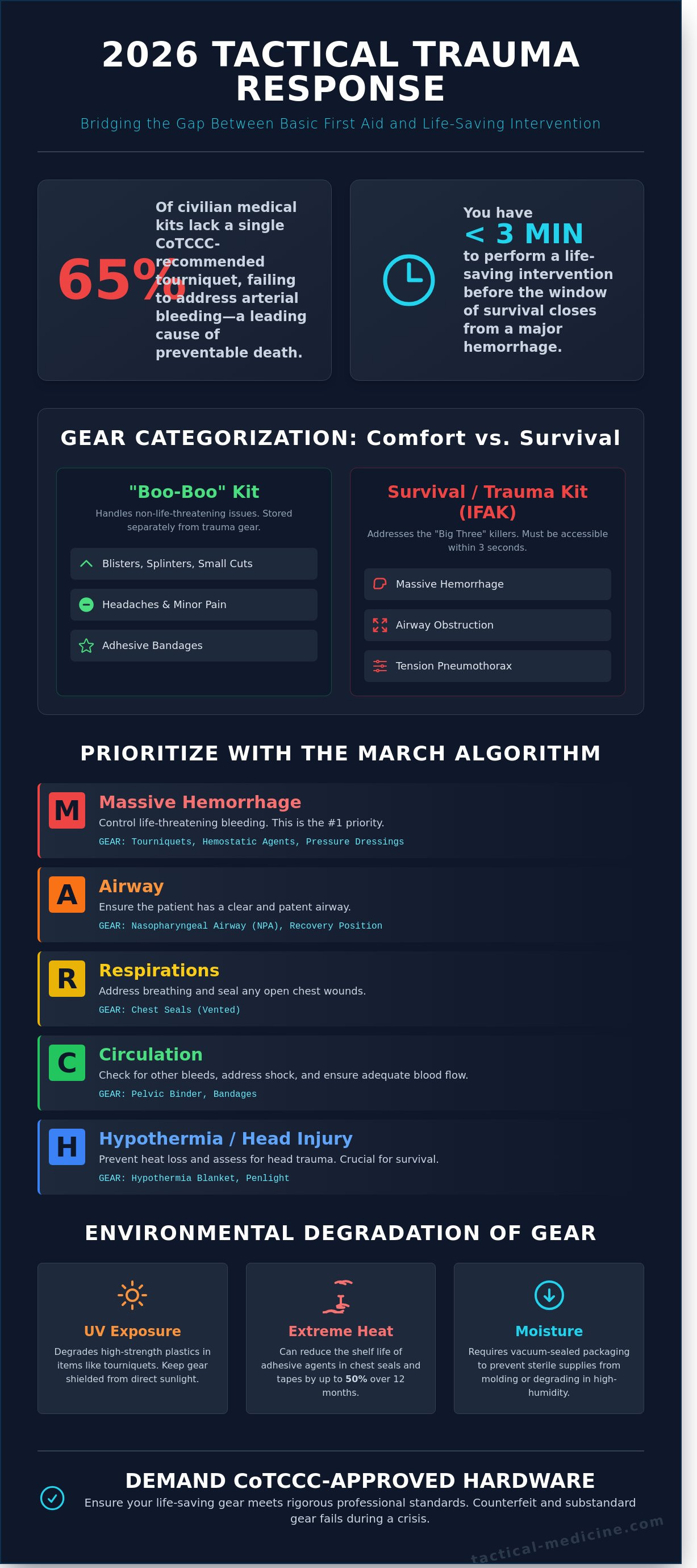
You must separate your supplies into two distinct categories. Comfort gear, often called "Boo-Boo" kits, handles non-life-threatening issues like blisters, small cuts, and headaches. Survival gear focuses on the "Big Three" killers: massive hemorrhage, tension pneumothorax, and airway obstruction. Don't mix them. In a high-stress event, you cannot waste seconds digging past adhesive bandages to find a chest seal. Critical first aid items like CoTCCC-recommended tourniquets must be accessible within 3 seconds using either hand. Keep your trauma supplies in a dedicated IFAK (Individual First Aid Kit) and your comfort items in a secondary pouch.
Why Your Environment Dictates Your Gear List
Your mission profile determines your loadout. A home kit prioritizes pediatric dosages and burn care. A vehicle kit requires glass breakers and heavy-duty shears to access patients in wreckage. Wilderness kits must account for "time to definitive care," which often exceeds 4 hours in remote areas. Environmental factors also degrade equipment. Consider these variables:
- Temperature: Extreme heat can reduce the shelf life of adhesive agents in chest seals by 50% over a 12-month period.
- Moisture: High-humidity environments require vacuum-sealed packaging to prevent sterile supplies from molding.
- Light: UV exposure degrades the high-strength plastics used in windlass tourniquets; keep them shielded.
Tailor your kit to your specific AO (Area of Operations). An urban EDC kit looks vastly different from a maritime response bag. Readiness is not a static state; it's a constant adjustment to your surroundings.
The Comprehensive Checklist of Basic Medical Supplies
Effective field medicine starts with a standardized inventory. You need components that withstand environmental stress while providing immediate physiological stabilization. High-quality consumables form the backbone of your kit. Select first aid items that prioritize durability and long shelf lives. This ensures your gear remains mission-ready for 3 to 5 years without degradation. Every item must be hypoallergenic and 100% latex-free to prevent secondary skin irritation or anaphylactic complications during treatment.
A well-maintained emergency supply kit serves as the first line of defense against infection. Medical field data from 2023 indicates that 35% of minor skin injuries progress to localized infection if not irrigated within the first 60 minutes. Your supplies must facilitate rapid, decisive intervention to prevent these outcomes.
Wound Care and Bandaging Essentials
Standardize your bandaging supplies to cover a range of surface areas. Fabric adhesive bandages are superior to plastic versions because they move with the body and maintain adhesion in high-moisture environments. Stock at least 25 bandages in assorted sizes. Include 10 sterile 4x4 inch gauze pads for larger abrasions and two rolls of conforming gauze for securing dressings on limbs. Secure these with 1-inch silk or cloth medical tape; these materials provide the high-tensile strength required for active movement.
Tools for Assessment and Cleaning
Debris removal is a priority in the field. Use professional-grade stainless steel tweezers with slanted tips for precision splinter removal. Pair these with a 4-ounce bottle of 0.9% saline wash for mechanical irrigation of dirty wounds. Assessment requires objective data rather than guesswork. A digital thermometer provides rapid febrile status checks, while a high-lumen penlight allows for pupil response tests and throat inspections. For those looking to upgrade their response capability, reviewing advanced medical loadouts provides a clear path to professional-grade readiness.
Over-the-counter (OTC) medications support field comfort and prevent mission degradation. Include single-dose packets of ibuprofen (200mg) and acetaminophen (500mg) for pain and fever management. Antihistamines like diphenhydramine are essential for managing allergic reactions to environmental triggers. These first aid items don't just treat symptoms; they maintain the operator's focus on the objective by mitigating physical distractions.
Beyond the Basics: Life-Saving Trauma Interventions
Standard kits address minor injuries. Tactical interventions address the leading causes of preventable death. While a baseline American Red Cross first aid kit provides essential supplies for daily mishaps, high-threat environments require a rugged upgrade. Professionals follow the MARCH algorithm: Massive Hemorrhage, Airway, Respirations, Circulation, and Hypothermia. This protocol dictates the priority of care under extreme stress. You don't have time for trial and error when a life is on the line. These specific first aid items turn a basic collection of bandages into a mission-ready Individual First Aid Kit (IFAK).
Hemorrhage Control: Tourniquets and Hemostatics
Massive bleeding is the primary killer in trauma scenarios. Data from the Committee on Tactical Combat Casualty Care (CoTCCC) confirms that extremity hemorrhage accounts for the majority of preventable deaths. The Combat Application Tourniquet (CAT) is the gold standard for limb bleeding. It's a field-proven device designed for one-handed application. You must apply it high and tight to stop arterial flow immediately. For junctional wounds in the groin or armpit, tourniquets won't work. Use hemostatic dressings like QuikClot or Celox. These gauze products are impregnated with agents that accelerate the clotting process. Secure these with an Israeli Bandage. This pressure dressing provides the mechanical compression needed to maintain a stable clot during transport.
Airway and Respiratory Support
Penetrating trauma to the chest often leads to a tension pneumothorax. This condition occurs when air enters the chest cavity but cannot escape, eventually collapsing the lung and shifting the heart. Vented chest seals are critical first aid items for treating gunshot or stab wounds. They allow air to exit the pleural space while preventing outside air from entering. If a patient is unconscious, their tongue can obstruct the airway. A Nasopharyngeal Airway (NPA) is a flexible tube that maintains a patent airway through the nasal passage. It's easy to insert and highly effective in the field. Finally, you must address hypothermia. Trauma patients lose the ability to regulate body temperature, which interferes with blood clotting. A compact space blanket is a mandatory intervention to prevent the lethal triad of trauma: acidosis, coagulopathy, and hypothermia.
Selection Criteria: Evaluating Durability and Clinical Efficacy
In a high-threat environment, your equipment is your lifeline. Selecting first aid items based on price point rather than clinical performance is a fatal error; it's a gamble with human life. The Committee on Tactical Combat Casualty Care (CoTCCC) provides the gold standard for field-proven gear. Since 2001, these guidelines have defined the protocols that save lives under fire. Only use devices that have undergone rigorous testing by this body to ensure they function when fine motor skills fail.
Ruggedized packaging is non-negotiable for gear stored in vehicle compartments or external packs. Daily temperature shifts from 20°F to 120°F in a trunk will degrade cheap adhesives and brittle plastics. High-quality medical hardware uses vacuum-sealed, 4-mil or 5-mil thickness poly-packaging to resist UV damage and moisture ingress. If the seal is compromised, the item is compromised.
Identifying Counterfeit Medical Gear
Counterfeit tourniquets flood online marketplaces. These knockoffs often look identical to a genuine Combat Application Tourniquet (CAT) but fail during the first windlass turn. A 2021 analysis of counterfeit tourniquets showed that plastic windlasses frequently snap under the 300 mmHg of pressure required to occlude arterial blood flow. Inspect the polymer quality; genuine CATs feature a reinforced material that resists bending. Buy only from verified distributors like MED-TAC to ensure your gear is authentic. Don't use uncertified hemostatic agents that lack FDA approval; they can cause thermal burns or fail to induce clotting.
Organizing Your Kit for High-Stress Access
Stress degrades cognitive function. Use the "First-In" principle to arrange your first aid items. Massive hemorrhage interventions must stay on top. Use specialized medical bags or IFAKs with the following features:
- Tear-Away Panels: Use pouches with Velcro backing for immediate detachment from a plate carrier or headrest.
- Color-Coding: Mark pull tabs with red or blue tape for rapid identification by bystanders.
- Standardized Labeling: Use permanent markers to clearly label pockets for "Bleeding," "Airway," and "Burns."
Conduct a comprehensive gear audit every 180 days. Check for compromised seals on chest seals and expiration dates on hemostatic gauze. If a package is no longer vacuum-sealed, discard it. Air exposure ruins the clinical efficacy of sterile dressings and causes adhesives to fail. Discipline in maintenance ensures readiness in deployment.
Transitioning from Gear Owner to Prepared Operator
Owning high-grade first aid items doesn't make you a medic. It makes you a gear owner. Survival depends on the operator, not just the contents of the IFAK. You've moved past the initial stage of awareness. Now, you must bridge the gap between gear ownership and tactical proficiency. The MED-TAC philosophy dictates that equipment is a force multiplier for skill, not a replacement for it. Moving from basic awareness to active training ensures that when the MARCH algorithm becomes your reality, you act with muscle memory. Integrate these medical tools into a comprehensive emergency response plan. This plan must include casualty collection points, communication protocols, and extraction routes. Preparation is a continuous process. It requires discipline and a commitment to the mission.
The Critical Role of TCCC and TECC Training
Medical hardware like windlass tourniquets and vented chest seals require hands-on validation. Improper application causes failure in high-stress environments. Tactical Combat Casualty Care (TCCC) and Tactical Emergency Casualty Care (TECC) courses provide the evidence-based protocols necessary for civilian and professional responders. These courses transform 100% of your gear's potential into life-saving outcomes. Training builds the psychological resilience needed to manage massive hemorrhage or airway obstructions under duress. You'll move from panic to protocol. You don't rise to the occasion; you sink to the level of your training. Standardized courses ensure your interventions align with the latest CoTCCC guidelines, providing a 25% increase in survivability for preventable deaths on the battlefield.
Maintaining and Auditing Your First Aid Items
A kit is only as reliable as its last inspection. Implement a mandatory quarterly audit schedule to ensure readiness. Sterility degrades and adhesives fail over time. Environmental factors like heat and humidity can compromise the integrity of your first aid items. Conduct a deep-dive inspection every 90 days to ensure your capability remains at 100%.
- Check expiration dates on hemostatic agents and chest seals.
- Inspect tourniquet straps for UV damage or material fatigue.
- Replace any item with a compromised sterile seal immediately.
- Verify that trauma shears are free of rust and maintain their edge.
Effective maintenance ensures your equipment functions when seconds count. Don't wait for a crisis to discover a dry-rotted bandage. You can build your mission-specific custom medical kit with us to ensure every component meets rigorous field standards. Secure your gear, master your skills, and stay ready.
Master the Intervention for 2026
True emergency readiness isn't found in a plastic box under the sink. It's forged through the integration of CoTCCC-compliant hardware and disciplined training. You've identified the critical medical supplies required to manage massive hemorrhage and airway obstructions. Now, you must ensure your gear meets the clinical standards demanded by federal agencies and law enforcement. Reliability isn't a luxury when you're managing a MARCH algorithm under stress; it's the baseline for survival.
Since 2004, MED-TAC has provided the specialized equipment necessary for high-threat environments. Transitioning from a gear owner to a prepared operator means selecting tools that have been field-proven for over two decades. Don't settle for unverified supplies that fail during a medical crisis. Every second counts during a trauma intervention, and your equipment must be an extension of your skill. You have the knowledge to identify quality. Now take the final step toward mission readiness.
Equip yourself with battle-proven first aid items at MED-TAC
Stay focused, stay prepared, and stay ready to act when the clock starts.
Frequently Asked Questions
What are the 10 most essential first aid items for a home kit?
A home kit requires 10 specific first aid items to handle common injuries: 25 adhesive bandages, 10 sterile gauze pads, 1 roll of medical tape, 20 antiseptic wipes, 1 tube of antibiotic ointment, 1 pair of trauma shears, 4 pairs of nitrile gloves, 1 set of tweezers, 1 digital thermometer, and 2 elastic wraps. These supplies address lacerations and minor burns. Maintain these items in a dedicated, accessible container to ensure rapid deployment during a medical event.
Can I use a belt as a substitute for a professional tourniquet?
You cannot use a belt as a reliable substitute for a professional, CoTCCC-recommended windlass tourniquet. Studies show improvised tourniquets fail in 75% of applications because they lack the necessary mechanical advantage to occlude arterial blood flow. A belt often slips or breaks before reaching the 300mmHg of pressure required to stop a femoral bleed. Always carry a field-proven device like the CAT Gen 7 to ensure life-saving hemorrhage control.
How often should I replace the items in my first aid kit?
Inspect your first aid kit every 6 months to identify expired or degraded components. Medications usually have a 2-year shelf life, while sterile items lose integrity if the packaging punctures. Replace any item that shows signs of wear, such as brittle plastic or yellowing tape. Regular audits ensure your gear remains mission-ready when a critical intervention becomes necessary. This same principle of proactive maintenance applies to the home; professional teams like Fenelon Handyman Services can address small issues before they become major emergencies.
Is it legal for a civilian to carry a tactical medical kit (IFAK)?
It is legal for civilians to carry a tactical medical kit or IFAK in all 50 U.S. states. No federal law prohibits the possession of medical supplies like hemostatic agents or chest seals. However, your legal protection during use falls under state-specific Good Samaritan laws. These laws generally protect responders as long as they act within their level of training and don't demonstrate gross negligence or willful misconduct during the rescue.
What is the difference between a standard first aid kit and a trauma kit?
A standard kit manages minor injuries like scrapes, while a trauma kit focuses on massive hemorrhage and airway obstructions. Standard kits contain mostly adhesive bandages and ointments. A trauma kit, or IFAK, includes high-intensity first aid items like a CAT tourniquet, QuikClot gauze, and chest seals. The goal of a trauma kit is to keep a patient alive during the 10 minutes it takes for EMS to arrive on the scene.
What items should be in a car first aid kit for 2026?
A 2026 car kit must prioritize roadside safety and severe trauma management. Include 2 CoTCCC-approved tourniquets, 1 high-visibility safety vest, a window breaker tool, and 1 Mylar thermal blanket to combat shock. Add 1 headlamp with 300 lumens of output for hands-free operation at night. These items ensure you can manage a collision scene effectively before professional rescuers reach your GPS coordinates. Don't rely on basic bandages for vehicle accidents.
Do first aid items like gauze and tape actually expire?
Gauze and tape have expiration dates, typically set 5 years from the manufacturing date. While the fabric doesn't rot, the sterility of the packaging is no longer guaranteed after this period. Medical adhesives on tape dry out and lose their grip after 3 to 4 years. Using expired supplies increases the risk of infection and equipment failure during a high-stress medical intervention. Replace these components once they pass their stamped date.
What is the MARCH algorithm and why does it matter for first aid?
The MARCH algorithm is a TCCC protocol used to prioritize life-saving interventions in order of lethality. It stands for Massive hemorrhage, Airway, Respiration, Circulation, and Hypothermia. This system ensures operators treat the most immediate threats first, such as arterial bleeding, before moving to secondary concerns. Following this 5-step process reduces preventable deaths in high-threat environments by providing a clear, logical framework for care. It's the gold standard for tactical medicine.
Leave a comment