


The CAT Tourniquet: The Definitive 2026 Guide to the World’s Most Trusted Life-Saving Device
Master the mechanics, application, and staging of the Gen 7 CAT tourniquet with this battle-proven guide from veteran medical operators. A CAT tourniquet is a precision medical instrument, not a simple strap; its efficacy depends entirely on professional staging and authentic sourcing. This guide moves beyond the "what" and "how" to provide the "why" and "watch out," establishing the definitive standard for authentic tactical medicine.
What is a CAT Tourniquet? The Evolution of Modern Hemorrhage Control
In the world of tactical medicine, few devices are as iconic or as critical as the Combat Application Tourniquet (CAT). This is not just a strap; it is a true one-handed windlass system engineered for rapid, effective hemorrhage control in the most extreme environments.
- History and Validation: First introduced to the U.S. Army in 2005, the CAT has undergone continuous refinement. The current Gen 7 is the culmination of years of battlefield data and clinical evidence. Its efficacy is validated by the Committee on Tactical Combat Casualty Care (CoTCCC), the governing body for pre-hospital trauma care in military settings.
- The Gold Standard: The CAT remains the #1 choice for military and civilian first responders for one simple reason: it is the most effective tool for preventing death from extremity exsanguination (severe blood loss). When correctly applied, it stops catastrophic bleeding and buys the most valuable resource in trauma care—time.
The Science of Exsanguination and the Golden Hour
A complete transection of the femoral artery can lead to death in less than three minutes. This brutal reality demanded a shift from traditional first aid to aggressive, life-saving interventions. The CAT tourniquet is the cornerstone of this modern tactical medicine. By applying targeted, circumferential mechanical pressure, it achieves 100% occlusion of blood flow in both upper and lower extremities, effectively shutting off the source of the bleed long before a casualty can bleed out.
CAT Gen 7 vs. Previous Generations: What Changed?
The Gen 7 CAT is the most advanced iteration, designed for faster and more reliable application under stress.
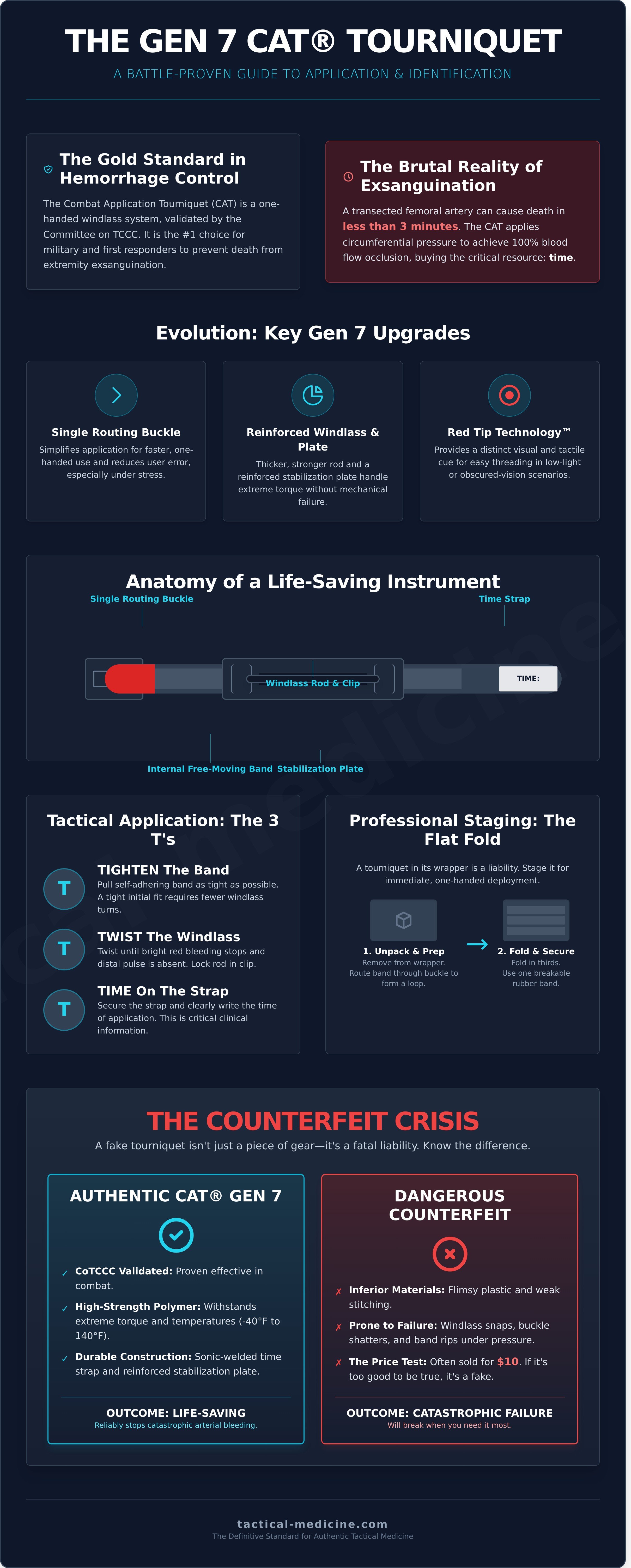
- Single Routing Buckle: Previous generations required routing the band through two slots, a task that could be difficult with one hand or when covered in blood. The Gen 7 features a single routing buckle, simplifying the process, reducing application time, and minimizing the potential for user error.
- Reinforced Windlass Rod & Stabilization Plate: The windlass rod is thicker and stronger, providing increased durability and a better grip. The stabilization plate is also reinforced to handle the immense torque required to stop arterial bleeding without risk of mechanical failure.
- Red Tip Technology™: The bright red elliptical tip provides a distinct visual and tactile cue, making it easier to locate and thread the band in low-light conditions or when vision is obscured.
Technical Breakdown: Anatomy of a Gen 7 Combat Application Tourniquet
Understanding the engineering of a genuine CAT tourniquet reveals why it is a life-saving instrument, not just a piece of gear.
- Single Routing Buckle: The patented design reduces slack with a single pull, requiring fewer windlass turns to achieve occlusion.
- Windlass Rod & Clip: This is the core of the system. The rod provides the mechanical advantage needed to generate arterial-occluding pressure. The clip securely locks the rod in place, preventing it from unwinding during patient movement.
- Internal Free-Moving Band: This band moves independently inside the outer sleeve, applying true, evenly distributed circumferential pressure to the limb. This design prevents the skin bunching and pinching common with simpler strap-based tourniquets.
- Stabilization Plate: A beveled and branded contact bar provides a clean, stable platform for the windlass clip, improving comfort and securing the entire system.
The Windlass System: Why It Beats Improvised Solutions
A belt, a stick, or a strip of cloth cannot reliably stop an arterial bleed. The physics of torque are unforgiving. Improvised methods fail to generate and maintain the specific, high-level pressure required for full occlusion. The CAT's windlass system is purpose-built for this task. The aggressive ribbing on the Gen 7 rod ensures a positive grip even when slick with blood, while the bilateral windlass clips offer a redundant and secure locking point.
Materials and Durability Standards
Every component of a CAT tourniquet is engineered for resilience. The high-strength polymer components are designed to function in temperature extremes ranging from -40°F to 140°F. The time strap is sonic-welded to the tourniquet for durability, as proper documentation of application time is a critical clinical requirement. The reinforced 2026 stabilization plate is a critical engineering upgrade that prevents mechanical failure under the extreme torque required to occlude arterial blood flow.
How to Use a CAT Tourniquet: Step-by-Step Tactical Application
There are two primary protocols for tourniquet placement: "high and tight" and "2-3 inches above the wound." For tactical environments where the exact source of a bleed may be unclear, the "high and tight" rule is the standard—place the tourniquet as high as possible on the injured limb. In a civilian or clear-cut scenario, placing it 2-3 inches above the visible wound on exposed skin is acceptable. Never place a tourniquet directly over a joint.
The core of the application process is the "Three Ts": Tighten the band, Twist the windlass, and write the Time on the strap.
Step-by-Step One-Handed Application
This procedure is for self-aid to an arm.
- Route the Limb: Insert the injured arm through the loop of the CAT.
- Pull and Secure: Pull the self-adhering band as tight as possible and securely fasten it back on itself. A properly tightened band is critical; the windlass should only need a few turns.
- Twist the Windlass: Twist the windlass rod until bright red, pulsatile bleeding stops completely. The pain will be significant—this is an indicator of effective pressure. Continue twisting until the distal pulse (e.g., in the wrist) is no longer present.
- Lock and Document: Lock the rod into the clip. Secure the remaining strap over the clip and through the time strap. Write the time of application clearly on the strap.
Professional Staging: Preparing Your CAT for Immediate Use
A tourniquet still in its plastic wrapper is a liability. Proper staging is a non-negotiable step for anyone serious about preparedness.
- The "Flat Fold" Technique: Remove the CAT from its wrapper. Run the band through the buckle to create a loop large enough for an arm or leg. Fold the tourniquet back on itself in thirds, securing it with a single rubber band that will break away easily. This minimizes its profile for storage in an IFAK or on your belt.
- Time Strap Prep: Ensure the time strap is pulled back over the windlass clips, leaving the "tail" of the strap open. This allows for one-handed access to the strap after application without having to pick at a sealed Velcro® end.
The Counterfeit Crisis: How to Identify a Genuine CAT Tourniquet
The market is flooded with counterfeit "tourniquets," particularly on major e-commerce platforms. These fakes look convincing but are made from inferior materials. They will break under pressure, failing at the exact moment they are needed most. A real CAT tourniquet is a Class I medical device; a fake is a dangerous piece of plastic.
- The Danger: Counterfeit windlass rods snap, buckles shatter, and stitching rips under the torque required to stop an arterial bleed. Relying on one is a fatal mistake.
- The Price Test: A genuine, CoTCCC-recommended CAT tourniquet is not cheap. If you see one advertised for $10-$15, it is almost certainly a dangerous counterfeit. A price that seems too good to be true is a life-threatening liability, not a bargain.
Authentic vs. Counterfeit: A Visual Checklist
Train your eye to spot the fakes.
- Branding: A genuine Gen 7 has "CAT" embossed on the stabilization plate and a molded NAR (North American Rescue) logo on the buckle.
- Windlass Strength: The windlass rod on a real CAT is made of a reinforced polymer that will not bend under maximum manual torque. Fakes often use brittle plastic that will bow or snap.
- The Red Tip: Examine the red elliptical tip. On a genuine CAT, the weld is clean and robust. On fakes, it is often poorly attached or made from a cheaper, flimsier material.
- Stitching: Look at the stitching that holds the stabilization plate and windlass clip. Authentic CATs have heavy-duty, precise stitching. Counterfeits often have thin, uneven, and weak seams.
Where to Safely Buy Tactical Medical Gear
The only way to guarantee you have a life-saving tool is to purchase it from a reputable, authorized distributor.
- Authorized Sources: Buy directly from the manufacturer or a certified distributor like MED-TAC. This ensures the device is authentic and has been stored correctly.
- Lot Numbers: A genuine CAT will have a lot number for tracking. This is essential for quality control and proves the device is part of the official supply chain.
- Take Action: Do not risk your life or the life of another on a counterfeit. Link to MED-TAC storefront for authentic CAT Tourniquets
Integrating the CAT into Your 2026 Emergency Preparedness Plan
Owning a CAT tourniquet is only the first step. True preparedness requires a system of gear, placement, and training.
- Placement: Your CAT must be immediately accessible. Carry it in a dedicated pouch on your belt, in your Individual First Aid Kit (IFAK), or mounted to a vehicle visor. It does you no good buried in a backpack.
- The MARCH Algorithm: In tactical medicine, all interventions follow a strict order of priority. The "M" in MARCH stands for Massive Hemorrhage. Controlling catastrophic bleeding with a tourniquet is the very first thing you must do—before addressing airway, respiration, or anything else.
- Training is Paramount: Owning the gear is only 10% of the survival equation. You must train with it until the application is muscle memory.
Building Your IFAK Around the CAT
The CAT is the primary tool for extremity hemorrhage, but it is part of a larger system. Your IFAK should also include:
- Hemostatic gauze for junctional wounds where a tourniquet cannot be applied.
- Chest seals for penetrating chest trauma.
- Trauma shears to expose wounds.
- Explore our pre-configured IFAK kits that integrate these tools for blind-reach accessibility.
The Importance of Hands-On Training
Watching a video is not enough. You must practice applying the CAT tourniquet to yourself and others, aiming for the professional standard of under 15 seconds from deployment to occlusion. The stress of a real event causes a significant decline in fine motor skills; only repetitive, hands-on training can overcome this.
Seek out a certified Tactical Combat Casualty Care (TCCC) or Tactical Emergency Casualty Care (TECC) course to move beyond gear ownership and build true life-saving competence.
CTA: Register for a MED-TAC Professional Training Course
Frequently Asked Questions
Can a CAT tourniquet be used on a child? Yes, the CAT is effective on pediatric casualties, provided the limb is large enough for the device to be fully tightened. For very small limbs, placement "high and tight" is critical to ensure it can be secured properly before engaging the windlass.
How long can a tourniquet stay on before permanent damage occurs? This is a persistent myth. A properly applied tourniquet can remain in place for several hours with a high likelihood of limb salvage. The choice is simple: risk of limb damage versus certain death from exsanguination. The tourniquet should only be removed by trained medical professionals in a clinical setting.
Is it possible to over-tighten a CAT tourniquet? No. The goal is 100% arterial occlusion. You must tighten the windlass until all bright red bleeding has stopped and there is no distal pulse. It will be extremely painful for the casualty, but this is necessary to save their life.
Should I buy a black, orange, or blue CAT tourniquet? Color indicates the intended use. Black is the standard for tactical applications to reduce visibility. High-visibility orange is for civilian EMS and rescue crews. Blue is a dedicated "Trainer" version with the same form and function but is not built to life-saving material standards. Never carry a blue CAT for real-world use.
Can I reuse a CAT tourniquet after it has been applied in a real emergency? No. A tourniquet used to control a real bleed has been subjected to extreme forces and bodily fluids. It must be considered a single-use item and disposed of properly after the patient is transferred to a higher level of care.
What is the difference between a CAT and a SOF Tourniquet? Both are excellent, CoTCCC-recommended tourniquets. The CAT uses a polymer windlass rod and a Velcro® band. The SOF-T typically uses a metal windlass and a different buckle system. Both are effective; proficiency with your chosen device is what matters most.
Do tourniquets work for neck or torso wounds? No. Tourniquets are for extremity hemorrhage only (arms and legs). Wounds to the neck, chest, abdomen, or groin (junctional areas) require different interventions like wound packing with hemostatic gauze.
How do I know if the tourniquet is tight enough? The tourniquet is tight enough when two conditions are met: 1) The bright red, pulsatile arterial bleeding has stopped completely. 2) You can no longer feel a distal pulse below the tourniquet (e.g., at the wrist or ankle).
Leave a comment