

Dark Angel Medical: A Comprehensive Review of Tactical Trauma Kits and Gear
If you had sixty seconds to stop a massive hemorrhage, would you trust a fifteen dollar tourniquet from an unverified online vendor? You already know that your IFAK is the most critical component of your line one gear, but finding the balance between medical capability and carry comfort is a constant struggle. Over 70% of operators report frustration with oversized kits that interfere with their movement or gear that lacks the rugged durability required for field use. In a market saturated with inferior knockoffs, Dark Angel Medical focuses on battle-proven solutions that prioritize functional outcomes over marketing aesthetics.
You need a kit that adheres to CoTCCC guidelines without adding unnecessary bulk to your mission profile. This comprehensive review explains why the tactical trauma kits and gear from Dark Angel Medical, a division of MED-TAC International Corp., remain a staple in the tactical community for those who value discipline and preparation. You'll discover how to select a kit that fits your specific environment, whether you're working in high-threat protection or a civilian patrol capacity. We'll analyze the internal components, mounting options, and the essential link between high-quality hardware and professional training. This guide provides a clear roadmap for integrating life-saving interventions into your daily carry with total confidence.
Key Takeaways
- Understand the veteran-founded philosophy behind dark angel medical and how their mission-driven focus ensures every component serves a critical purpose.
- Learn to utilize the MARCH algorithm to evaluate and select the specific IFAK configuration required for your operational environment.
- Examine the science of hemorrhage control through industry-standard interventions like the CAT Gen 7 and hemostatic gauze.
- Overcome the myth of bulky medical gear by integrating low-visibility ankle kits and pocket-sized solutions into your daily carry.
- Bridge the gap between gear ownership and life-saving proficiency by understanding the essential requirement for professional TCCC training.
The Dark Angel Medical Philosophy: Preparedness as a Way of Life
Dark Angel Medical was established in 2010 by a veteran flight medic who recognized a lethal gap in civilian emergency response. The brand's mission focuses on providing the training and equipment necessary to bridge the interval between a traumatic event and the arrival of professional medical services. This mission gained significant momentum following the 2015 launch of the national "Stop the Bleed" initiative. This program highlighted that traumatic injury is the leading cause of death for Americans under age 46. The brand's kit designs reflect this urgency, prioritizing life-saving interventions over minor wound care. While standard first aid kits are stocked with adhesive bandages and antiseptic wipes for comfort, a trauma kit is built for survival.
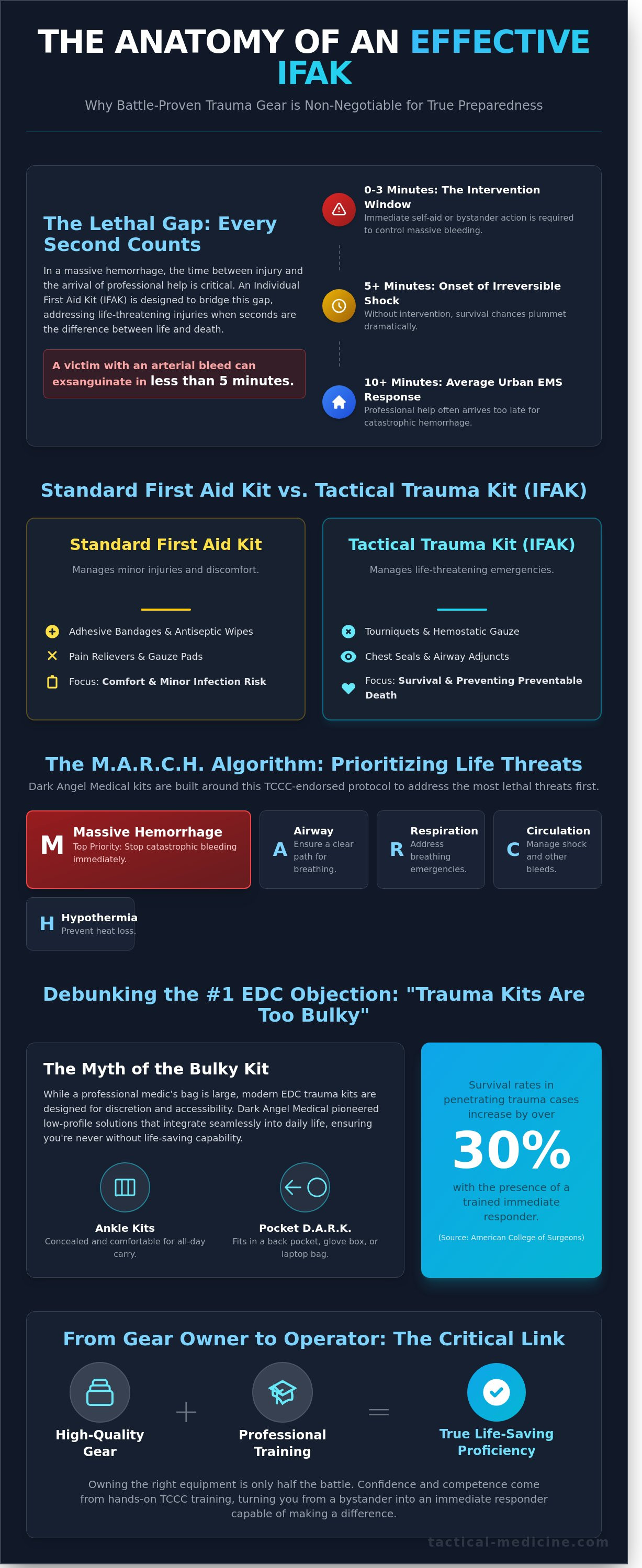
The distinction between these two types of kits is absolute. A standard kit manages pain and minor infection risks. A trauma kit, often referred to as an Individual First Aid Kit (IFAK), manages catastrophic hemorrhage and airway obstructions. For civilian first responders, carrying tactical medical gear is a practical necessity. In many urban environments, emergency response times can exceed 10 minutes. Without immediate intervention, a victim with an arterial bleed can exsanguinate in less than 5 minutes. Dark Angel Medical focuses on high-efficiency components that address the leading causes of preventable death on the battlefield and in the streets.
Battle-Proven Reliability
Reliability in a medical context is not a marketing claim. It's a clinical requirement. Every component selected for these kits undergoes rigorous field testing to ensure it performs under extreme physiological stress. The "Simplicity is Survival" design mantra exists because fine motor skills deteriorate when a responder's heart rate climbs above 140 beats per minute. Complex buckles or intricate packaging can become fatal obstacles. By adhering to the Tactical Combat Casualty Care (TCCC) guidelines, the brand ensures its hardware is backed by decades of combat data and clinical research.
Clinical authority dictates the selection of every bandage and tourniquet. The brand relies on evidence-based hardware, such as the Combat Application Tourniquet (C-A-T) and hemostatic agents like QuikClot. These items are standardized by the Committee on Tactical Combat Casualty Care, an organization formed in 2001 to modernize pre-hospital trauma protocols. This disciplined approach eliminates "tacticool" fluff, providing the operator with tools that have a proven statistical track record of saving lives in high-threat environments.
Everyday Carry (EDC) vs. Professional Use
The transition from military-grade gear to civilian accessibility requires a radical shift in form factor. While a professional medic might carry a large, multi-pound trauma bag, a civilian responder needs a solution that fits into a daily routine. Dark Angel Medical pioneered low-profile solutions like the Pocket D.A.R.K., which is small enough to fit in a standard back pocket or a laptop bag. This design philosophy ensures that life-saving tools are actually present when an incident occurs. Gear left in a vehicle or a locker is useless during the first 60 seconds of a trauma event.
This accessibility facilitates a vital psychological shift. When you carry medical gear, you move from the role of a passive bystander to that of an immediate responder. This mindset change is critical. Data from the American College of Surgeons indicates that the presence of a trained immediate responder increases survival rates in penetrating trauma cases by over 30 percent. Moving away from a "someone else will handle it" mentality requires both the right tools and the confidence that those tools won't fail. Professional-grade gear in a civilian-friendly package provides that confidence, turning preparation into a permanent state of readiness.
Decoding the D.A.R.K. Line: Which IFAK Fits Your Mission?
Selecting a medical kit isn't about aesthetics; it's about capability. The D.A.R.K. (Direct Action Response Kit) from dark angel medical is engineered around the MARCH algorithm. This mnemonic prioritizes the most lethal threats first. Massive Hemorrhage takes precedence because a casualty can bleed out in under 180 seconds. Airway, Respiration, Circulation, and Hypothermia follow in a logical, life-saving sequence. Every component in these kits is chosen for its adherence to CoTCCC standards. The inclusion of the Gen 7 CAT (Combat Application Tourniquet) and QuikClot Combat Gauze isn't accidental. These tools are the gold standard for stopping arterial bleeds. By following established prehospital bleeding control guidelines, the D.A.R.K. line eliminates guesswork when seconds count.
The D.A.R.K. line offers three primary configurations: the Gen 4, the Slim, and the Pocket. The Slim D.A.R.K. fills the gap between the full-sized Gen 4 and the minimalist Pocket version. It offers a vertical orientation that consumes less real estate on a duty belt or plate carrier. It maintains the full component list of the Gen 4 but streamlines the footprint for better mobility. This variety ensures that whether you're on a high-threat stack or in a corporate office, you have the tools to intervene effectively.
The D.A.R.K. Gen 4: The Gold Standard IFAK
The Gen 4 D.A.R.K. utilizes a proprietary vacuum-sealed insert system. This keeps components organized and protected from environmental degradation. When you pull the handle, the entire medical suite stays together. It prevents the "yard sale" effect where loose items scatter during a high-stress intervention. The pouch design allows for rapid, one-handed deployment. This is critical when you're managing your own injury or maintaining security. Understanding what is an IFAK starts with recognizing that organization is as vital as the tools themselves. The Gen 4 is the heavy hitter for patrol officers and military personnel who require a full MARCH-capable suite.
The Pocket D.A.R.K.: Trauma Care for the EDC Operator
The Pocket D.A.R.K. provides a solution for environments where a full-sized kit is impractical. It weighs approximately 5.5 ounces and fits into a standard back pocket. dark angel medical achieved this by selecting low-profile components like the SWAT-T or a compact hemostatic agent. It's designed for the 95% of your life spent in "non-tactical" settings. While it lacks the depth of the Gen 4, it addresses the most likely trauma interventions: massive hemorrhage and chest wounds. It's the ideal choice for concealed carry, office environments, and vehicle kits. You can upgrade your everyday carry to ensure you're never unarmed in a medical crisis. It balances kit weight against the statistical likelihood of specific trauma interventions, ensuring you actually carry it every day.
- Gen 4: Best for duty belts, plate carriers, and active shooter response bags.
- Slim: Best for space-constrained belts where vertical mounting is required.
- Pocket: Best for low-visibility operations, civilian EDC, and office environments.
Critical Components: The Science of Hemorrhage Control
Massive hemorrhage kills in minutes. You don't have time to second-guess your gear when a femoral artery is breached. This reality dictates why TCCC protocols emphasize specific, vetted tools over generic alternatives. Dark Angel Medical prioritizes the distribution of CoTCCC-recommended hardware because these items have a documented history of success in the most austere conditions imaginable. Effective intervention requires more than just intent; it demands hardware that has survived the rigors of combat testing.
Tourniquet Selection and Deployment
The Committee on Tactical Combat Casualty Care (CoTCCC) only recommends tourniquets that pass rigorous laboratory and field testing. Serious operators avoid 'knock-off' tourniquets found on generic marketplaces. These counterfeit devices often fail at the windlass; they snap under the 150 to 200 mmHg of pressure required to occlude arterial flow. The CAT Gen 7 utilizes a high-strength polymer windlass and a proprietary internal band to provide 360 degrees of circumferential pressure with minimal mechanical failure in the 2026 operational environment. It remains the industry leader because its single-handed application is intuitive even under extreme physiological stress.
Wound Packing and Pressure Dressings
Not every wound is on an extremity. For junctional areas like the groin or axilla, tourniquets are ineffective. This is where hemostatic agents like QuikClot Combat Gauze become critical. These agents use kaolin to accelerate the body's natural clotting cascade without causing the exothermic reactions seen in older technologies. These advances in trauma care demonstrate that aggressive wound packing saves lives when applied correctly in the field.
Once the wound is packed, maintaining pressure is the next priority. The Israeli Bandage, or Emergency Bandage, applies 30 to 40 pounds of direct pressure via its integrated pressure bar. This complements the hemostatic gauze by maintaining the seal against the ruptured vessel. For torso injuries, the protocol shifts. You must use a vented chest seal to prevent tension pneumothorax. This condition occurs when air trapped in the pleural space collapses the lung and shifts the mediastinum. Standard dressings don't work here; you need an occlusive barrier. High-quality Bleeding Control Kits include these specific components to address the full spectrum of the MARCH algorithm.
Rapid patient assessment is impossible if you can't see the injury. High-quality trauma shears, like those provided by Dark Angel Medical, are essential for cutting through heavy denim, leather, or tactical nylon. Cheap shears often dull or bend when hitting a thick seam. Professional-grade shears ensure you expose the injury site in seconds. This speed is the difference between a controlled scene and a fatality. Reliability in your equipment is the foundation of your medical response.
Addressing the #1 EDC Objection: 'Trauma Kits are Too Bulky'
The argument that medical gear is too cumbersome for daily carry is a relic of 1990s tactical thinking. This myth persists because many responders still associate trauma kits with overstuffed, five-pound cordura bags designed for rucksacks. Modern textile engineering has effectively neutralized this objection. Today, advanced materials like laser-cut laminates and high-tensile elastics allow for a 40% reduction in kit thickness compared to traditional nylon pouches. Systems from dark angel medical utilize these slim-line profiles to ensure gear disappears under a standard untucked shirt or fits discreetly within a pocket.
Effective Everyday Carry (EDC) requires a ruthless prioritization of components based on the MARCH algorithm. If space constraints force you to carry only one item, it must be a CoTCCC-recommended windlass tourniquet. Data from the Journal of Trauma and Acute Care Surgery indicates that extremity hemorrhage remains a leading cause of preventable death. A femoral artery bleed can lead to hypovolemic shock in under 90 seconds. No other tool provides the same life-saving ROI per square inch. Integrating this gear into a modern setup involves choosing "flat-packed" configurations that mirror the contours of the body rather than creating a blocky silhouette that prints through clothing.
The Ankle Medical Kit (AMK) Strategy
Ankle carry is the premier solution for plainclothes officers and prepared civilians who require a full IFAK without the waistline bulk. It utilizes the natural dead space around the lower leg, preventing gear overlap with holsters or belt-mounted tools. A high-quality ankle wrap must feature breathable, moisture-wicking padding to remain comfortable during a 12-hour shift. Reliability depends on accessibility. You must be able to reach your medical components with either hand. This is vital if one arm is incapacitated or if you are pinned in a vehicle. Test your wrap to ensure it doesn't slip during a dead sprint; stability is non-negotiable in high-threat environments.
Minimalist Kits for Maximum Impact
The "Mindset over Gear" principle dictates that a small kit on your person is superior to a massive trauma bag locked in a truck. Vacuum-sealing components like compressed gauze and chest seals can reduce their total volume by approximately 50%. This allows for a complete intervention kit to fit inside a standard jacket pocket. When staging medical gear in a vehicle, follow the 5-second rule. If you can't reach the kit while buckled in the driver's seat, it's poorly placed. Use headrest mounts or visor panels to keep dark angel medical components within your immediate reach. Preparation is a series of deliberate, practiced actions. Don't let the fear of bulk compromise your readiness.
Ready to upgrade your loadout with field-proven gear? Explore professional-grade trauma kits designed for low-vis carry.
From Gear Owner to Operator: The Training Requirement
Owning premium medical equipment from dark angel medical is a tactical advantage, but gear alone does not save lives. You must bridge the gap between possession and proficiency. High-end trauma kits are designed for specific, high-stress protocols that require more than a cursory understanding of first aid. Without professional instruction, a sophisticated IFAK remains a collection of specialized tools you cannot effectively deploy when the adrenaline surge hits. A kit is a resource; training is the capability.
During a high-threat event, such as a gunshot wound (GSW) scenario, your body undergoes significant physiological changes. Research indicates that when heart rates exceed 145 beats per minute, fine motor skills deteriorate and cognitive tunneling begins. You lose peripheral vision and the ability to process complex instructions. Tactical Combat Casualty Care (TCCC) training conditions the brain to bypass this "freeze" response. It builds the procedural memory required to apply a tourniquet or pack a wound in total darkness or under direct fire. You don't rise to the occasion; you sink to the level of your training.
The TCCC and TECC Standards
Modern tactical medicine relies on evidence-based guidelines established by the Committee on Tactical Combat Casualty Care (CoTCCC). These standards are updated periodically based on data from thousands of field interventions. MED-TAC International Corp prioritizes these accredited standards because they offer the highest probability of survival in the pre-hospital phase. If your training doesn't align with these protocols, you're practicing outdated medicine. Seek out TCCC Training Courses that provide hands-on validation of your skills under realistic stress loads.
Building a Comprehensive Survival Capability
Effective medical response isn't a standalone skill; it's an integrated part of your defensive posture. Your kit must be accessible, maintained, and familiar. Follow these steps to ensure your capability remains sharp:
- Bilateral Access: Ensure your medical kit is positioned where you can reach it with either hand. If your primary arm is incapacitated, you must still be able to deploy a tourniquet in under 10 seconds.
- Routine Inspections: Check your gear every 6 months. Verify the vacuum seals on chest seals and hemostatic agents. Heat and friction can degrade packaging over time.
- Skills Rehearsal: Practice your MARCH algorithm monthly. Physical repetition prevents the decay of life-saving skills.
The transition from a gear owner to an operator requires discipline. Professional tools like those from dark angel medical deserve a professional mindset. Don't wait for a crisis to realize you don't know how to use your equipment. Equip yourself with the best, then train like your life depends on it. In the field, it does.
Own the Response Through Superior Preparation
Survival in high-threat environments depends on three pillars: equipment, training, and mindset. Selecting dark angel medical hardware ensures your IFAK meets the rigorous standards established by the Committee on Tactical Combat Casualty Care (CoTCCC). The D.A.R.K. Gen 4 system effectively eliminates the bulk of traditional kits; this makes 100% EDC compliance a reality for every modern operator. Gear remains just one part of the survival equation. You've got to bridge the gap between possession and proficiency through accredited training protocols. As a veteran-owned and operated entity, MED-TAC International Corp. provides the expert guidance necessary to navigate these critical decisions. We're an authorized distributor for CoTCCC-standard hardware and a premier accredited provider for TCCC and TECC training. Equip yourself with battle-proven tactical medical gear at MED-TAC International Corp. Your commitment to preparation today determines your effectiveness when the clock starts. Stay focused, stay trained, and stay ready to save a life.
Frequently Asked Questions
Is Dark Angel Medical gear TCCC approved?
The Committee on Tactical Combat Casualty Care (CoTCCC) doesn't approve specific kits; however, Dark Angel Medical exclusively utilizes CoTCCC-recommended components. Your kit contains field-proven tools like the Gen 7 CAT or SOFTT-W tourniquet. These items meet the 2024 standards for hemorrhage control in high-threat environments. We prioritize evidence-based hardware to ensure every intervention is reliable when seconds determine the outcome during a life-saving event.
What is the difference between the D.A.R.K. and a standard IFAK?
The D.A.R.K. differs from a standard IFAK through its modular, vacuum-sealed insert and streamlined footprint. Standard kits often lack internal organization, which leads to gear scatter during high-stress deployments. Our design follows the MARCH algorithm, allowing you to access life-saving tools in a specific, logical sequence. This systematic approach reduces the cognitive load on the operator during a critical 2-minute window where every movement must be intentional.
Do I need a prescription to buy a trauma kit with hemostatic gauze?
You don't need a prescription to purchase trauma kits containing hemostatic gauze like QuikClot or Celox. These products are FDA-cleared for over-the-counter sale to both professionals and prepared citizens. While these agents are advanced medical tools, they're designed for immediate application by any trained responder. All included hemostatics in our kits meet current CoTCCC recommendations for efficacy and safety in stopping massive arterial bleeding.
How often should I replace the components in my medical kit?
Replace sterile components in your kit every 5 years or according to the specific manufacturer expiration date. You should perform a visual inspection of all seals every 180 days to check for vacuum compromise. Heat, moisture, and friction can degrade adhesives in chest seals and packaging. Maintaining a strict replacement schedule ensures your gear functions perfectly during a 1% event where equipment failure isn't an option.
Can civilians take a TCCC course to learn how to use these kits?
Civilians can take Tactical Emergency Casualty Care (TECC) courses, which are the civilian counterpart to TCCC protocols. Dark Angel Medical offers specialized training that bridges the gap between military medicine and civilian first response. These 2-day courses teach you to manage massive hemorrhage and airway issues using the same equipment found in professional kits. You'll gain the confidence to act decisively during active shooter or major trauma scenarios.
What is the best Dark Angel kit for a vehicle?
The DARK Trauma Kit is the superior choice for vehicle carry because it balances a comprehensive component list with a compact form factor. It measures approximately 8 inches by 4.5 inches, fitting easily into a glove box or seat-back pocket. This kit provides the necessary tools to treat 2 major trauma victims simultaneously. It's a rugged solution for the 35,000 fatal motor vehicle accidents occurring annually in the United States.
Does the Pocket D.A.R.K. include a full-sized tourniquet?
The Pocket D.A.R.K. includes a full-sized, CoTCCC-recommended windlass tourniquet despite its miniaturized design. It utilizes a vacuum-sealed insert to maintain a thickness of only 1 inch, making it ideal for everyday carry in a back pocket. You don't have to sacrifice capability for concealment. This kit ensures you have a 100% effective solution for extremity arterial bleeding without the bulk of a traditional medical pouch or bag.
Why is vacuum-sealing important for medical components?
Vacuum-sealing is critical because it reduces the volume of medical components by 40% to 60%. This process protects sterile items from water, sand, and UV exposure that can ruin packaging over time. A compromised seal on a chest seal or gauze can lead to contamination or product failure. By maintaining a vacuum, we ensure your equipment remains in factory-new condition until the moment of deployment in the field.

Leave a comment